


Battery C-Rate Explained: Charge and Discharge Speed
You’ll sometimes see charge and discharge limits written as a C-rate, such as “0.5C charge” or “1C discharge.” It’s a simple way to describe current relative to a battery’s size. Understanding C-rate helps you check whether a battery can handle your trolling motor, inverter or charger. This guide explains how it works, with examples from our product listings.
What C-rate means
C-rate is current divided by capacity:
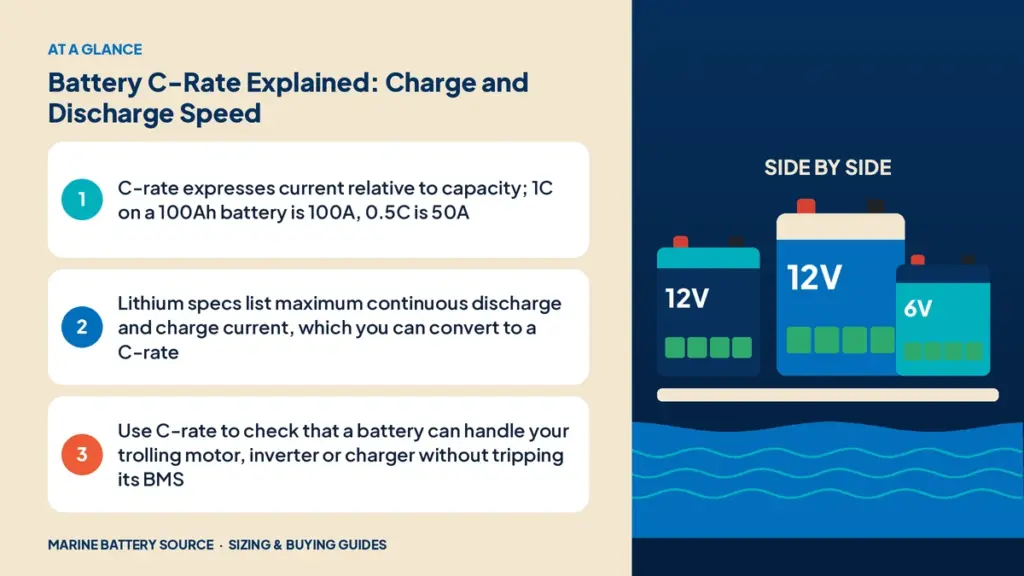
- 1C = a current equal to the battery’s amp-hour rating. For a 100Ah battery, 1C is 100A.
- 0.5C = half that, or 50A on a 100Ah battery.
- 0.2C = 20A on a 100Ah battery.
- 2C = 200A on a 100Ah battery.
At 1C, a battery would in theory go from full to empty in one hour. At 0.5C, two hours. At 0.05C, 20 hours, which is the rate most lead-acid capacity ratings use.
C-rate in lithium specs
Lithium listings usually give limits in amps. You can convert them to C-rates:
| Battery | Capacity | Max continuous discharge | Discharge C-rate | Max continuous charge | Charge C-rate |
|---|---|---|---|---|---|
| EPOCH 12V 50Ah Essential | 50Ah | 50A | 1C | Not listed | — |
| EPOCH 12V 100Ah Eco | 100Ah | 100A | 1C | 100A | 1C |
| EPOCH 12V 105Ah Essential | 105Ah | 105A | 1C | 100A | ~0.95C |
| EPOCH 12V 300Ah Essential | 300Ah | 200A | ~0.67C | 200A | ~0.67C |
| EPOCH 24V 230Ah V2 Elite | 230Ah | 110A | ~0.48C | 230A | 1C |
| EPOCH 12V 300Ah Pro dual purpose | 300Ah | 300A | 1C | 300A | 1C |
| Dakota DL+ 12V 60Ah | 60Ah | 100A | ~1.7C | Not listed | — |
| Lithium Rhino 36V 120Ah | 120Ah | 150A | 1.25C | 50A | ~0.42C |
Peak ratings, such as EPOCH’s 12V 100Ah Eco at 300A for 5 seconds, allow short bursts above the continuous rating.
Why it matters: discharge
If your load exceeds the battery’s continuous discharge rating, the battery management system (BMS) may shut the battery off to protect it. That can happen with:
- Large inverters: a 2,000W inverter can draw about 180A from a 12V bank at full load.
- Windlasses and thrusters: short, very high currents.
- High-thrust trolling motors at full power.
- Engine starting on a battery not rated for cranking.
Check your highest load against the battery’s continuous rating, and surges against the peak rating. If a single battery isn’t enough, add batteries in parallel to share the current, or choose a model with a higher rating.
Why it matters: charging
Charging current is also limited. A charger larger than the battery’s maximum charge current can trip the BMS or shorten battery life. Most marine chargers are small relative to lithium limits: a 15A charger on a 100Ah battery is only 0.15C. But large alternators and big shore chargers on small batteries can exceed limits. Check the listing’s maximum charge current.
Lead-acid batteries also have practical charging limits. A common guideline is a charger sized around 10–20% of amp-hour capacity, depending on the battery maker’s recommendation.
C-rate and capacity
For lead-acid, available capacity falls as the C-rate rises: a battery rated at 0.05C (20 hours) delivers noticeably less at 0.5C. This is the Peukert effect. Lithium batteries deliver close to rated capacity from low rates up to about 1C, which is one reason they perform so well with trolling motors.
C-rate and heat
Higher currents produce more heat in cells, cables and connections. Running near the maximum continuous rating for long periods on a hot day can trigger temperature protection on some lithium batteries. Give batteries airflow, use correctly sized cables and keep connections tight.
Matching a battery to your loads
- Find your largest continuous load in amps. For inverters, divide watts by about 10 for a 12V system, to allow for losses.
- Compare it with the battery’s maximum continuous discharge.
- Check surge loads against peak ratings.
- Confirm your charger and alternator output are within the maximum charge current.
Example
A center console has a 1,500W inverter for a small appliance. At 12V, that’s about 140A at full load. An EPOCH 12V 105Ah (105A continuous) isn’t enough alone. Options: two 105Ah batteries in parallel (210A combined, if the maker allows parallel use), or a 12V 300Ah Essential (200A continuous).
C-rate in series and parallel banks
- Series: current is the same through every battery, so the bank’s current limit is the same as one battery’s. Three 100A-rated batteries in series for 36V can still deliver 100A, but at three times the voltage, so three times the power.
- Parallel: current splits between batteries, so limits add. Two batteries rated 100A each can together deliver about 200A, as long as the cables are equal in length and the maker allows parallel use.
Trolling motors and C-rate
Most trolling motors draw well under 1C from a correctly sized battery. A 36V motor drawing 50A at full thrust from a 36V 100Ah battery is 0.5C. Problems tend to arise only with small batteries on large motors, such as a 50Ah battery on a high-thrust motor run at full speed for long periods. If you often run at full power, choose a battery with a continuous rating comfortably above the motor’s maximum draw.
Reading the fine print
Some listings give peak ratings with a time limit, like “300A for 5 seconds” or “200A for 60 seconds.” Treat these as surge allowances, not working limits. Size your system on the continuous rating.
More reading
For the basics, see amp-hours to watt-hours and depth of discharge. Learn to read all of these numbers in how to read a battery spec sheet, and compare costs in battery price per kWh. The marine battery buying guide puts it all together, and the BCI group size guide covers fit.
Products mentioned
- EPOCH 12V 105Ah Essential
- EPOCH 12V 300Ah Essential
- EPOCH 12V 300Ah Pro dual purpose
- EPOCH 12V 50A lithium charger
Frequently asked questions
What does 1C mean?
A current equal to the battery’s amp-hour rating, such as 100A for a 100Ah battery.
What is a safe charge rate for lithium?
Stay within the listing’s maximum continuous charge current. Many marine chargers are well below it.
Why did my lithium battery shut off under load?
The load may have exceeded the battery’s continuous or peak discharge rating, triggering the BMS.
Does C-rate matter for lead-acid?
Yes. Higher discharge rates reduce available capacity, and chargers should be sized to the maker’s guidance.
How do I handle a load bigger than one battery’s rating?
Use batteries in parallel to share the current, if the maker allows, or choose a higher-rated battery.