


Equalizing Flooded Batteries: When and How
Over time, the cells in a flooded lead-acid battery drift apart. Some charge more fully than others, acid settles toward the bottom of each cell (called stratification), and soft sulfate builds up on the plates. Equalization is a controlled overcharge that brings the cells back into balance. Done correctly, it can restore lost capacity and extend battery life. Done wrong, or on the wrong type of battery, it can cause damage. This guide explains how to equalize flooded marine batteries safely.
What equalization does
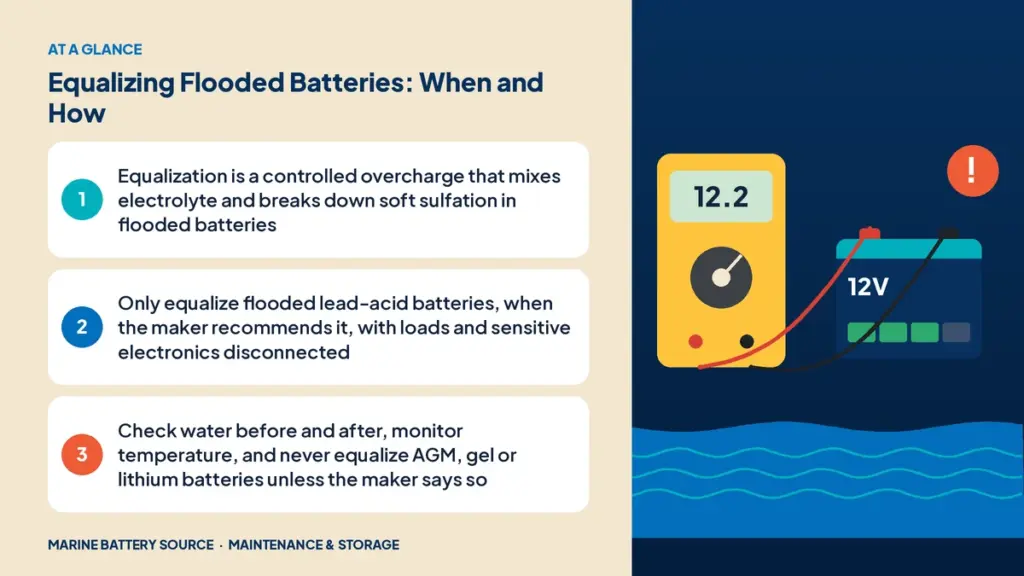
During equalization, the charger raises the voltage above the normal absorption level, typically to around 15.5V to 16.2V for a 12V flooded battery, for a few hours. This:
- Stirs the electrolyte through vigorous gassing, eliminating stratification
- Breaks down soft sulfate crystals before they harden
- Brings weaker cells up to full charge, balancing the battery
Which batteries can be equalized
- Flooded (wet cell) lead-acid: yes, if the manufacturer recommends it
- AGM: generally no, unless the manufacturer specifically allows a low-voltage equalization
- Gel: no
- Lithium (LiFePO4): never. The BMS handles cell balancing; high voltage can damage lithium cells or trip the BMS
Always check your battery’s documentation before equalizing.
When to equalize
- Periodically, often every one to three months for frequently cycled batteries, or as the maker recommends
- When hydrometer readings vary by more than about 0.030 to 0.050 between cells. See battery hydrometer test.
- When capacity seems reduced even after a full charge
- After a battery has been left partially discharged for a while
Don’t equalize as a routine daily or weekly practice; it uses water and stresses the plates.
What you need
- A charger with an equalization mode, or a manually adjustable charger
- Distilled water
- Hydrometer
- Thermometer or infrared temperature gun
- Safety glasses and gloves
- A well-ventilated area
Safety
Equalization produces significant hydrogen gas. Make sure the compartment is well ventilated, keep sparks and flames away, and don’t equalize in a closed space. Electronics on the boat may be sensitive to the high voltage, so disconnect loads.
Step-by-step equalization
- Fully charge the battery with a normal charge first.
- Check electrolyte levels. Add distilled water if plates are exposed, but don’t top up fully yet; equalization causes bubbling and expansion. See how to water flooded batteries.
- Disconnect loads and sensitive electronics. Turn off the battery switch so the battery is isolated from the boat’s DC system.
- Loosen vent caps (don’t remove them entirely) to let gas escape.
- Start equalization on the charger. Follow the maker’s voltage and time settings.
- Monitor temperature. If the battery gets above about 125°F (52°C), stop and let it cool.
- Check specific gravity every hour with a hydrometer. When readings stop rising and are consistent across cells, equalization is complete. This often takes two to four hours.
- Stop equalization and let the battery rest.
- Top up water to the correct level.
- Clean the battery top of any spray or residue. See how to clean boat battery terminals.
- Reconnect and return to normal charging.
Equalizing multiple batteries
For banks of flooded batteries, equalize each battery individually if possible, or equalize the bank on a charger rated for it. Series trolling banks charged by a multi-bank charger can usually be equalized bank by bank.
Signs equalization helped
- Specific gravity readings are higher and more consistent
- Battery holds charge longer
- Voltage under load is better
If readings don’t improve, the battery may have hard sulfation or a failing cell.
Warnings
- Never equalize AGM, gel or lithium without explicit manufacturer approval.
- Don’t leave equalization unattended for long periods.
- Watch for excessive heat.
- Expect water loss. Check and top up afterward.
- Disconnect electronics, which may not tolerate 15V to 16V.
Equalization and lithium
Lithium batteries balance their cells through the BMS. Applying equalization voltage can cause the BMS to disconnect or, in some cases, damage the battery. If your charger has an automatic equalization feature, make sure it’s disabled on lithium banks. See lithium battery maintenance.
Chargers with equalization
Many smart chargers offer a manual or automatic equalization mode for flooded batteries. Check that it’s enabled only for flooded banks. Browse our marine battery chargers.
Before storage
Some owners equalize flooded batteries before winter storage to start the off-season with balanced cells. Follow up with a maintainer. See winter storage for marine batteries.
For the full maintenance routine, see our marine battery maintenance guide.
Is it time to upgrade?
If your flooded batteries need frequent equalization and still underperform, they may be near the end of their life. Consider replacing them with AGM, such as the Trojan 31-AES AGM, or lithium, such as the EPOCH 12V 105Ah LiFePO4, which never need equalization.
Understanding stratification
In a flooded battery that’s cycled but rarely fully charged, the heavier acid sinks to the bottom of each cell, while the top holds weaker electrolyte. The bottom of the plates sees strong acid and corrodes faster; the top sees weak acid and sulfates. A hydrometer reading taken from the top of the cell can look fine while the battery underperforms. Equalization’s vigorous gassing mixes the electrolyte back together. Batteries on boats that move a lot get some natural mixing, but batteries that sit at the dock or in storage stratify more.
Equalizing with manual chargers
If your charger doesn’t have an equalization mode, an adjustable bench charger can be used, but only with close supervision. Set the voltage per the battery maker, watch temperature and specific gravity, and never leave it unattended. In most cases, a smart charger with a dedicated equalization mode is safer and easier.
Frequently asked questions
How often should I equalize flooded batteries?
Typically every one to three months for frequently cycled batteries, or as the manufacturer recommends.
Can I equalize an AGM battery?
Generally no, unless the manufacturer specifically allows it.
How long does equalization take?
Usually two to four hours, until specific gravity readings stop rising and are consistent.
What voltage is used for equalization?
Often around 15.5V to 16.2V for a 12V flooded battery. Follow the battery maker’s recommendation.
Should I equalize lithium batteries?
No. Lithium batteries use a BMS to balance cells and can be damaged by equalization voltage.