


Center Console Battery Setups for Offshore and Bay Boats
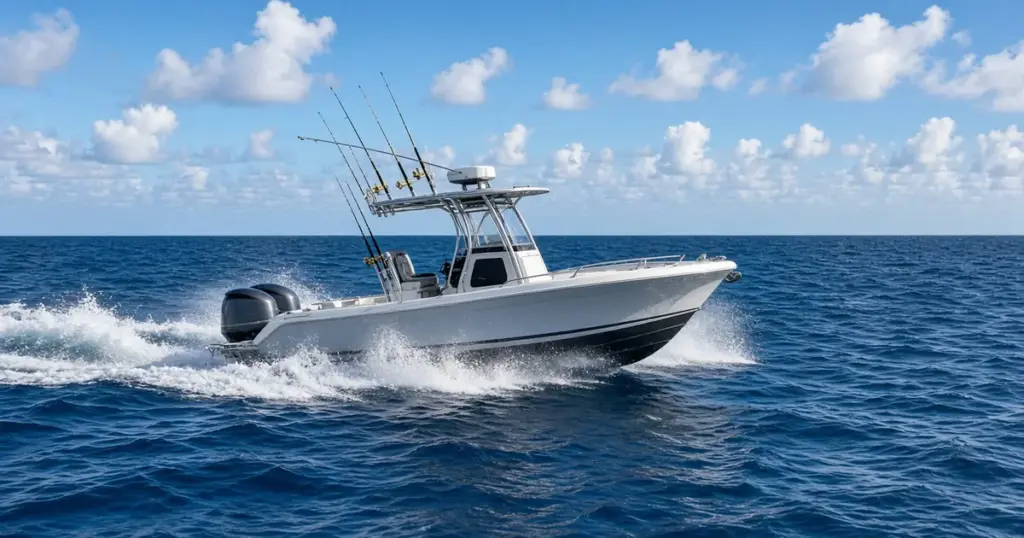
Center consoles cover a huge range, from 18-foot bay boats with a single outboard to 40-foot offshore boats with triple or quad engines. What they share is saltwater exposure, long runs offshore or across open bays, and a growing load of electronics. A solid center console battery setup keeps engines starting and electronics running far from help. This guide explains the common configurations.
Single-engine center consoles
Smaller center consoles often have one or two batteries:
- One battery: a dual-purpose battery that starts the outboard and runs electronics. Simple, but risky for long days offshore.
- Two batteries with a switch: two dual-purpose batteries, either of which can start the engine.
- Starting plus house: a starting battery for the engine and a house battery for electronics, linked by an automatic charging relay or DC-DC charger.
For boats fishing far from shore, the starting-plus-house approach is the most reliable.
Twin and triple outboards
Larger center consoles typically give each engine its own starting battery, plus a house battery or bank. A parallel or emergency switch can combine batteries if one engine’s battery fails. Our article on twin outboard battery setups explains the switching options in depth.
Battery location
Center consoles usually store batteries in the console or under the leaning post, often well forward of the engines. That keeps weight central but makes starter cables long. Builders size cables accordingly, but any re-rigging should keep cable size and connection quality in mind.
Choosing starting batteries
Meet each engine’s cranking and reserve requirements, with margin for long cable runs. AGM batteries are popular on center consoles because they’re sealed and handle pounding well. Examples from the store:
- Interstate 31M-AGM: 925 CCA, 1190 MCA, 200 minutes RC.
- Interstate 27M-AGM: 850 CCA, 975 MCA, 182 minutes RC.
Choosing the house battery
Offshore electronics, including multiple large displays, radar, sonar modules, VHF, stereo and livewell pumps, can use a lot of energy over a long day. Lithium is a popular house battery choice because it delivers more usable energy for its weight and holds steady voltage for electronics. The EPOCH 12V 172Ah dual purpose (Group 31, 40 lb, Bluetooth, 1000 CCA listed) can serve as a house battery that can also help start an engine in an emergency where the engine maker allows it. For heavier loads, the EPOCH 12V 300Ah Essential offers 3.84 kWh in a Group 31 size.
Charging
- Outboard charging for starting batteries.
- Automatic charging relay for lead-acid house batteries.
- DC-DC charger for lithium house batteries, which protects the outboard’s charging system and applies the right profile.
- Multi-bank onboard charger at the dock.
Saltwater considerations
- Use sealed batteries (AGM or lithium) where spray can reach them.
- Keep terminals coated with a protectant and covered.
- Inspect cable ends for corrosion creeping under the insulation.
- Use tinned copper cable and marine-grade lugs.
- Rinse and dry battery compartments after rough trips if water gets in.
Trolling motors on center consoles
Bay-style center consoles often add a bow-mount trolling motor, usually 24V or 36V. The trolling bank needs its own batteries and charger banks. See how to choose a trolling motor battery, and compare with the bass boat setup that pioneered many of these layouts.
Safety offshore
- Keep a jump pack aboard even with multiple batteries.
- Label switches clearly and know the emergency procedure.
- Carry spare fuses and a basic tool kit.
- Test batteries before the season and before long offshore trips.
Typical configurations
| Boat | Starting | House | Charging |
|---|---|---|---|
| 18–22 ft bay CC | One dual-purpose or starting | Optional | Outboard + onboard charger |
| 23–28 ft single-engine CC | Starting | House (lead-acid or lithium) | ACR or DC-DC + onboard charger |
| Twin-engine CC | One per engine | House bank | ACR/DC-DC + multi-bank charger |
| Triple/quad CC | One per engine | One or more house banks | DC-DC + multi-bank charger |
Sizing the house battery for offshore days
Make a simple budget for a typical offshore day. Large displays, radar, sonar modules, VHF, stereo, livewell pumps and lights can easily total 10A to 20A while running. If you fish for eight hours with the engines off for much of that time, the house battery may need to supply 50Ah to 100Ah or more. A lead-acid house battery would need roughly double that rated capacity to stay above half charge. A lithium battery of around 100Ah to 200Ah handles most single-day offshore loads with margin.
Measure your real use with a monitor or a Bluetooth battery app, then size accordingly. Remember that livewell pumps and electronics often run during long runs too, but then the outboards are charging.
Switching and labeling
Center consoles often have several battery switches in the console. Label each one clearly: which engine, which house bank, and what the parallel or emergency switch does. Keep a simple wiring diagram in the console. In an emergency, guests or crew may need to operate the switches, and clear labels prevent mistakes like leaving batteries paralleled with the engines off.
Upgrading an older center console
Many older center consoles have two batteries and a 1-2-Both switch. An easy upgrade is adding an automatic charging relay or DC-DC charger and moving electronics to a dedicated house battery. Combined with lithium, this can greatly increase electronics runtime and reliability.
Comparing other setups
Smaller boats have different priorities: see jon boat setups, the kayak battery guide and the pontoon guide.
For the overview, read battery setups by boat type and small boat electrical basics. Browse dual-purpose batteries in the store.
Frequently asked questions
How many batteries should a center console have?
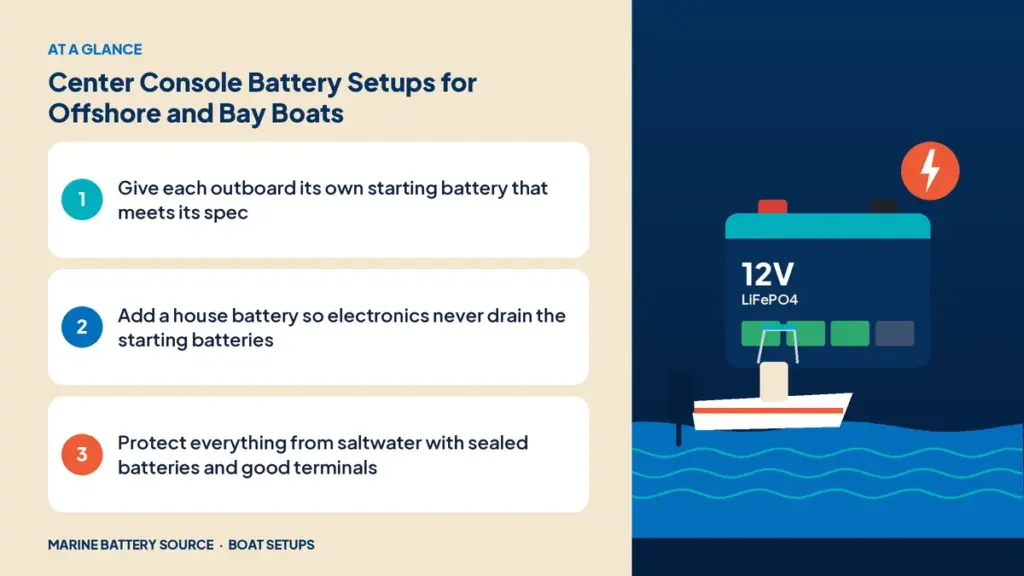
At minimum one starting battery per engine. Most offshore boats also add a house battery so electronics can’t drain the starting batteries.
What battery is best for a center console?
Sealed AGM batteries are popular for starting because of their vibration resistance. Lithium is a common house battery for electronics.
Do I need a DC-DC charger on a center console?
If your house battery is lithium, a DC-DC charger is a common way to charge it safely from the outboards.
How do I protect center console batteries from saltwater?
Use sealed batteries, cover and coat terminals, use tinned copper cable and inspect connections regularly.