


Heated Lithium Batteries and Cold-Weather Charging
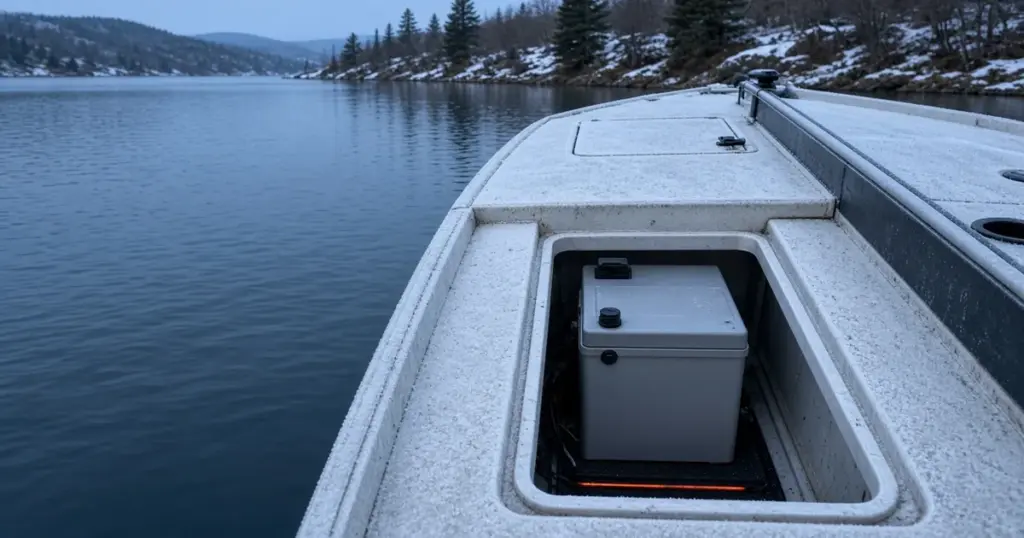
Lithium iron phosphate batteries handle heat and deep cycling well, but they have one firm rule: don’t charge them below freezing. That matters for northern anglers, ice fishermen, early-spring tournament crews and anyone who winterizes a boat outdoors. Heated lithium batteries solve the problem with built-in heaters. This guide explains why cold charging is a concern, how heated batteries work, and how to decide whether you need one.
Why LiFePO4 can’t charge in the cold
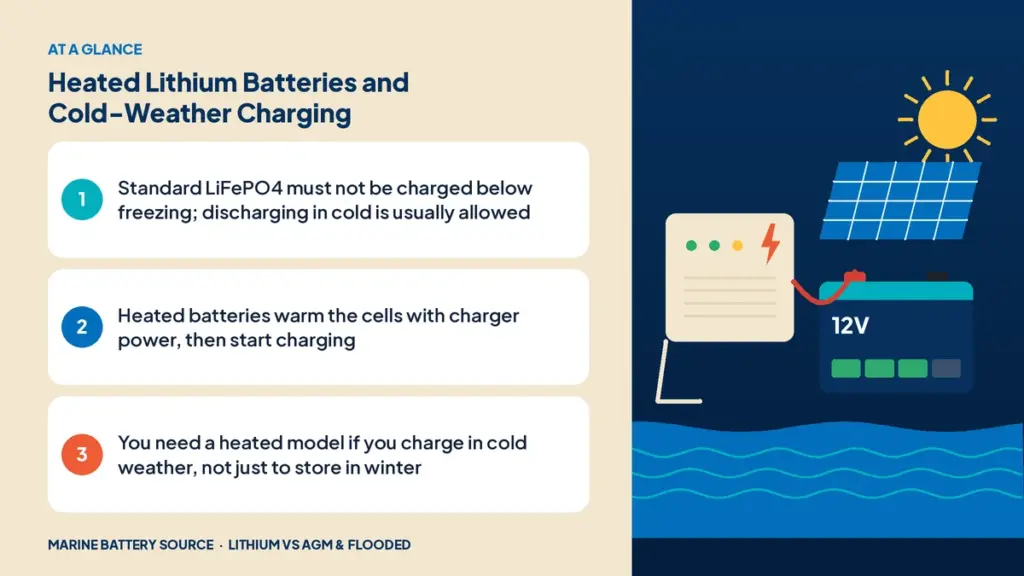
When a lithium battery charges, lithium ions move into the anode. In cold temperatures, that process slows down. Push current in too fast and lithium can plate onto the anode surface as metal instead of moving into it. Plating permanently reduces capacity and can damage cells. That’s why LiFePO4 makers generally prohibit charging below 32°F (0°C), and a good BMS blocks charging when the cells are that cold.
Discharging in the cold is a different story
Most LiFePO4 batteries can discharge at temperatures well below freezing, within the maker’s published range. You’ll see some reduction in available capacity and power when the battery is very cold, as with any battery. The problem is only charging. So a non-heated lithium battery can run a fish finder on the ice. It just can’t be recharged there until it warms up.
How heated batteries work
A heated lithium battery has heating elements inside the case, controlled by the BMS. When you connect a charger and the cells are below the charging threshold:
- The BMS diverts charger current to the heaters instead of the cells.
- Once the cells reach a safe temperature, the BMS switches to normal charging.
- Heaters may cycle on and off to maintain temperature during the charge.
The heaters run on charger power, so the battery doesn’t drain itself to stay warm. It also means a heated battery charges more slowly in very cold conditions, because some time and energy go into warming first.
Heated batteries in the store
The store’s listings flag internal heating on models including:
- The Dakota Lithium 12V 100Ah heated deep cycle.
- The Dakota Lithium DL+ 12V 135Ah heated dual purpose, also rated at 1,000 CCA.
- Most of EPOCH’s Essential and Elite batteries, such as the EPOCH 12V 105Ah Essential.
- EPOCH’s 24V and 36V batteries.
- The ECO Battery 12V 120Ah heated Bluetooth battery.
Battle Born offers heated versions in some of its lines, listed as varying by variation.
Do you need a heated battery?
You probably do if
- You charge on the boat in cold weather, such as early-season fishing up north.
- You ice fish and recharge in an unheated shack, truck bed or garage.
- Your boat stays on a cold lift or trailer with a charger connected through cold nights.
- You run solar or alternator charging in cold weather.
You probably don’t if
- You boat in warm climates and never charge below freezing.
- You bring the battery indoors to charge in winter.
- Your boat is stored in winter and not charged until spring.
Storage itself isn’t the problem. A non-heated lithium battery can sit in cold storage if the maker’s storage temperature range allows it. It just shouldn’t be charged until it’s warm.
Using a non-heated battery in the cold
If you don’t have a heated model, you can still use lithium in cold weather with a few habits:
- Charge indoors or in a heated space.
- Let a cold battery warm up before charging; large batteries take a while.
- Don’t rely on the BMS alone. It blocks unsafe charging, but if a charger keeps trying, you’ll just get no charge.
- Keep the battery insulated during use if the maker allows, but never cover vents or trap heat while charging.
Where the battery sits matters
A battery’s temperature lags the air temperature. A battery in a closed compartment may stay above freezing through a short cold snap, or stay cold well into a sunny morning after a freezing night. That’s why the BMS reads cell temperature rather than relying on the weather. If you charge on a lift or trailer through late fall, check the battery temperature in the app or with the charger’s status lights before assuming it’s charging. Mounting batteries low in the hull, away from cold drafts through open hatches, can help on cold mornings.
Charger compatibility
Heated batteries work with standard lithium chargers; the BMS handles the heater logic. Make sure the charger stays connected long enough. A charger that times out quickly may end its cycle while the battery is still warming. If your charger has a temperature sensor meant for lead-acid temperature compensation, follow the lithium battery maker’s guidance on whether to use it.
Cold weather and capacity planning
Even heated batteries deliver somewhat less capacity in extreme cold. If you’ll fish through freezing days, add margin to your capacity estimate. Watch battery temperature and charge status in the app if your battery has one. See our Bluetooth monitoring guide.
Heat is the other extreme
Cold blocks charging, but heat ages batteries faster over time. If you boat in a hot climate, focus on ventilation and placement instead of heating. Our cycle life guide explains how heat affects lifespan.
Common questions about combining heated lithium with other batteries
If your boat also has a lead-acid starting battery, keep them in separate banks with separate charging. Our guide to mixing lithium and lead-acid explains why. And if you’ve heard that lithium “doesn’t work in the cold at all,” that’s one of the lithium myths we fact-check.
For more on choosing a battery, see the lithium buyer’s guide, or browse the store’s lithium batteries to compare heated and non-heated models.
Frequently asked questions
Can you charge a lithium battery below freezing?
Standard LiFePO4 batteries should not be charged below 32°F (0°C). Heated lithium batteries warm their cells first and then charge safely.
Can I use a lithium battery in the cold?
Yes. Most LiFePO4 batteries can discharge below freezing within the maker’s stated range. Only charging is restricted.
Does a heated lithium battery drain itself to stay warm?
Typically no. The heaters run from charger power when a charger is connected and the cells are too cold to charge.
Do I need a heated battery for winter storage?
Not usually. Storage within the maker’s temperature range is fine. Heating matters when you need to charge in cold conditions.