


Battery Cycle Life Ratings: What 5,000 Cycles Really Means

Lithium marine batteries advertise impressive numbers: 3,000 cycles, 4,000 cycles, 5,000 cycles or more. Lead-acid batteries quote hundreds. But a cycle rating on its own tells you surprisingly little until you know how it was measured. This guide explains what lithium battery cycle life ratings mean, how to compare them fairly, and how to estimate how many years a battery will actually last on your boat.
What counts as a cycle
A full cycle is one complete discharge and recharge. In practice, batteries rarely do exactly that. Two days of using half the battery and recharging add up to about one full equivalent cycle. Cycle ratings are usually based on a defined depth of discharge, so shallower use generally stretches the count.
The conditions behind the number
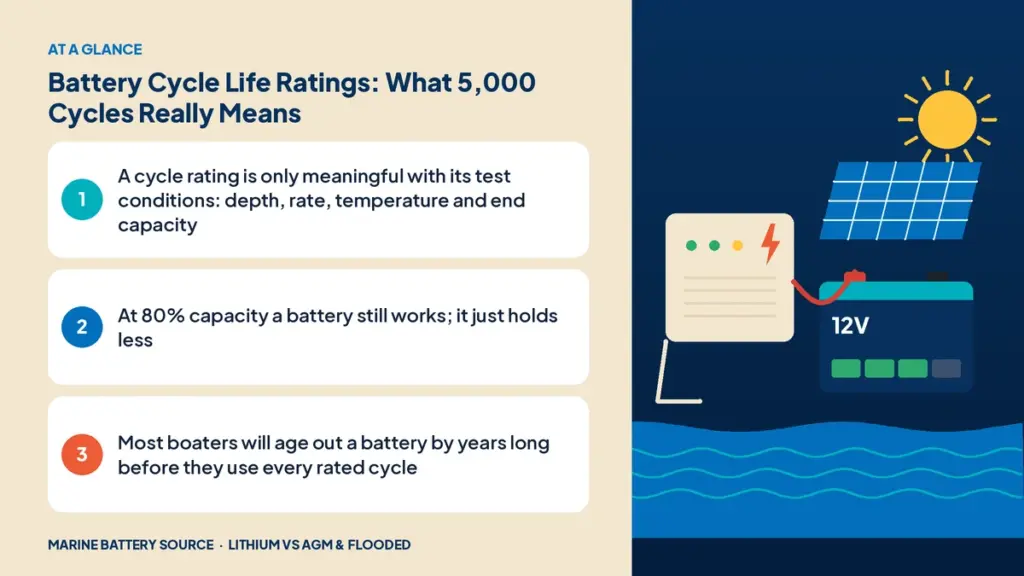
Every serious cycle rating comes with conditions. Look for:
- Depth of discharge (DoD): how deeply the battery was discharged each cycle, such as 80% or 100%.
- Charge and discharge rate: often expressed as a C-rate. 0.2C on a 100Ah battery means 20A; 1C means 100A.
- Temperature: usually around room temperature, often 25°C (77°F).
- End-of-life capacity: the point where the test stops counting, commonly 80% or 70% of original capacity.
The store’s listings show how these conditions vary:
- Many Dakota Lithium batteries: “Up to 80% capacity for 5,000 cycles in recommended conditions.”
- The Dakota Lithium 12V 10Ah Mini: “≥3,000 cycles @ 0.2C, 100% DOD; ≥6,000 cycles @ 0.2C, 80% DOD.”
- The EPOCH 12V 105Ah Essential: “4,000 cycles with ≥80% capacity remaining.”
- The EPOCH 12V 460Ah V2-T Elite: “>3,500 cycles to 70% capacity (25°C, 0.5C charge, 1C discharge, 70% DoD).”
The Dakota Mini line shows how much depth matters: the same battery is rated for twice as many cycles at 80% depth as at 100%.
What happens at end of life
A battery that reaches its rated cycle count doesn’t stop working. It has simply faded to the end-of-life capacity in the test. A 100Ah battery at 80% capacity still delivers about 80Ah. You’ll notice shorter runtime, and at some point it no longer meets your needs, but it may still be useful in a less demanding job.
Turning cycles into years
Here’s the step most buyers skip. Estimate how many full equivalent cycles you’ll use per year:
- A weekend angler who drains a trolling bank to about half on 50 trips a year uses roughly 25 full equivalent cycles.
- A tournament angler running the bank hard 100 days a year might use 80 to 100.
- A liveaboard cycling a house bank daily might use 250 to 365.
Divide the rated cycles by your yearly cycles. For the weekend angler, even 3,000 cycles is far more than a lifetime of use. For these users, calendar aging, heat and storage habits will likely limit battery life before cycles do. That’s why warranty length is a useful companion number: it’s the maker’s commitment in years. The store lists 11-year warranties for Dakota Lithium and EPOCH Essential models, for example.
What shortens lithium life
Heat
High temperatures accelerate chemical aging in every battery. Keep batteries out of engine compartments where possible, and ventilate hot consoles. This matters in places like Florida.
Storage at full charge for long periods
Many makers recommend storing lithium at a partial state of charge during long layups. Follow your battery’s guidance. Our guide to heated lithium and cold charging covers cold-weather care, and winter storage is covered elsewhere in our maintenance section.
Charging outside the limits
Charging below freezing on a non-heated battery, or at voltages above the maker’s specification, can damage cells. A good BMS blocks the worst cases, but repeated stress near the limits still costs life.
Very high current
Running a battery near its maximum current constantly generates heat and stresses the cells. Size batteries so normal loads sit comfortably below the continuous rating.
Comparing lithium with lead-acid cycle life
Lead-acid deep-cycle batteries are typically rated for hundreds of cycles at moderate depth, with figures falling sharply as depth increases. They also lose life from sulfation if left partly charged, which doesn’t affect lithium the same way. So lithium’s advantage is real, especially for hard-cycled batteries. For the cost implications, see lithium vs AGM cost per cycle and the broader chemistry comparison.
How to get the most cycles from a lithium battery
- Size the battery so you don’t routinely drain it to the cutoff.
- Charge with the correct LiFePO4 profile.
- Keep it cool and well ventilated.
- Avoid charging below freezing unless the battery is heated.
- Store it as the maker recommends.
- Keep connections tight to avoid heat at the terminals.
- Watch its health in the app over time if it has one.
Monitoring health over time
If your battery has Bluetooth, you can watch capacity, cell balance and temperature trends. Some apps also count cycles. A sudden drop in capacity or a cell drifting out of balance is worth a call to the maker under warranty. Our Bluetooth monitoring guide explains what to look at, and the BMS guide explains what the battery is doing behind the scenes.
The bottom line
Use cycle ratings to compare batteries only when the test conditions match. Then convert cycles into years for your own use, and weigh warranty length and terms alongside the cycle number. For most recreational boaters, the practical takeaway is simple: a quality LiFePO4 battery will outlast many lead-acid replacements, as long as it’s charged and stored correctly. See the lithium buyer’s guide for the other specs that matter, and browse the store’s lithium batteries or house bank batteries to compare ratings.
Frequently asked questions
What does 5,000 cycles mean on a lithium battery?
It means the battery reached a stated end-of-life capacity, often 80% of original, after 5,000 cycles under specific test conditions. Check the depth of discharge and temperature used.
How many years will a lithium marine battery last?
Divide the rated cycles by how many full equivalent cycles you use per year, then consider calendar aging, heat and warranty length. Many recreational users will see a long service life well before reaching the cycle rating.
Does shallow discharge make lithium last longer?
Generally yes. Ratings at 80% depth are usually higher than at 100%, as the store’s Dakota Lithium Mini listing shows.
Is the warranty a better guide than cycle life?
They answer different questions. Cycle life describes wear under heavy use; the warranty tells you what the maker will stand behind over time. Look at both.