


Can You Mix Lithium and Lead-Acid Batteries on a Boat?
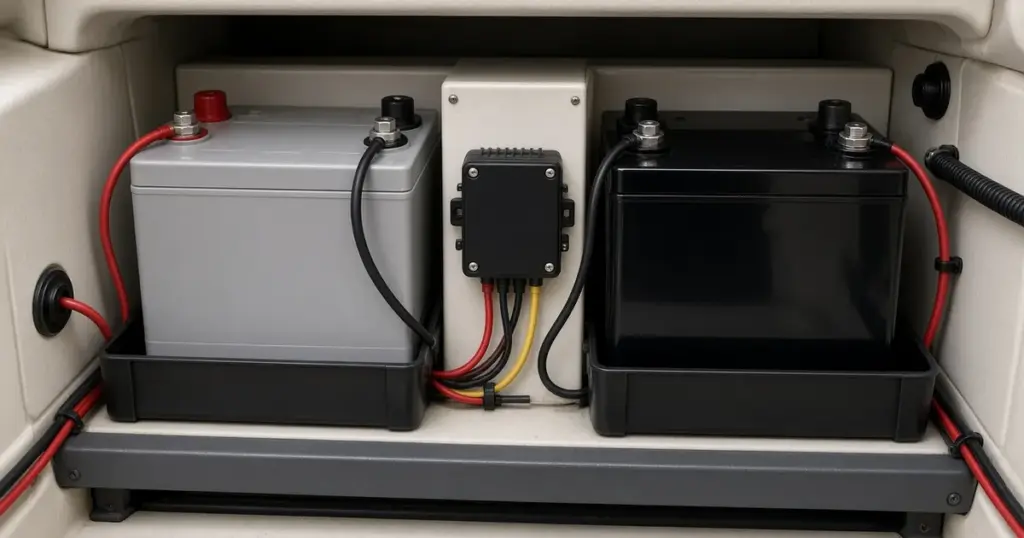
A common first lithium upgrade is the trolling motor bank, while the lead-acid starting battery stays put. That raises a reasonable question: can you mix lithium and lead-acid batteries on a boat? The short answer is yes, in separate banks with the right charging, and no, never in the same bank. This guide explains why, then shows how to set up a mixed system that works.
Why lithium and lead-acid don’t belong in one bank
Different voltages
A resting 12V LiFePO4 battery sits around 13.2 to 13.4V. A resting 12V lead-acid battery sits around 12.6 to 12.8V. Connect them in parallel and current flows from the lithium into the lead-acid until the voltages equalize. The lithium keeps discharging into the lead-acid, and the lead-acid is held at an odd partial-float voltage.
Different charging needs
Lead-acid needs long absorption and float stages, and flooded batteries may need equalization. Lithium needs a CC/CV charge to its own voltage and generally no float or equalization. One charger profile can’t do both properly in a single bank. One chemistry is always overcharged or undercharged.
Different internal resistance
Lithium’s lower internal resistance means it takes most of the current in a parallel bank, both charging and discharging. The batteries never share the load evenly.
Series banks are worse
In a 24V or 36V series bank, mismatched chemistries drift apart in state of charge. The charger sees only the total voltage, so one battery can be overcharged while another is undercharged. The lithium battery’s BMS may disconnect and drop the whole string.
Separate banks: the right way to mix
On most fishing boats, chemistries are already split by job:
- Starting bank: a lead-acid battery charged by the outboard and the onboard charger.
- Trolling bank: lithium batteries charged by the onboard charger.
- House or accessory bank: either chemistry, with its own charging plan.
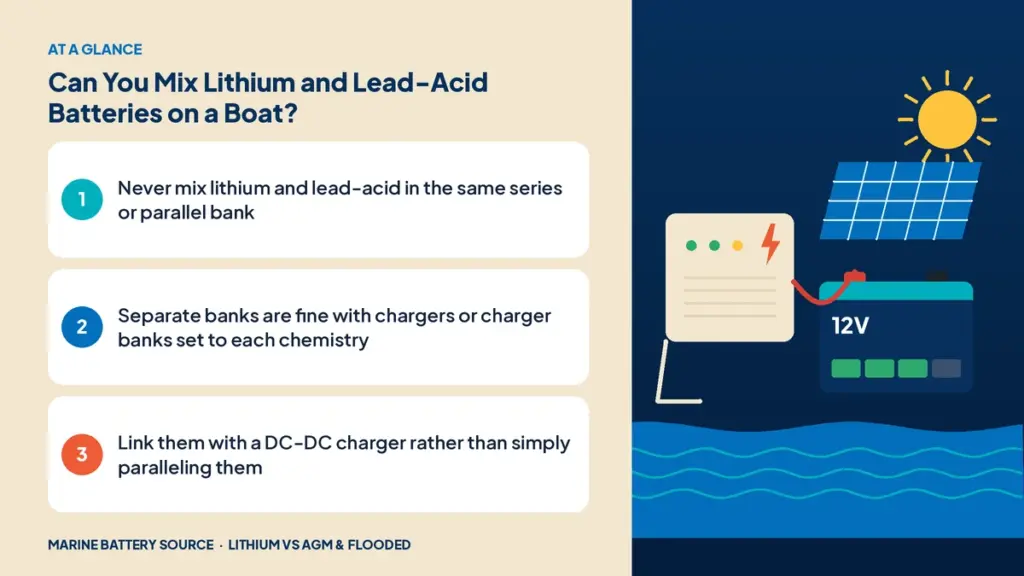
As long as each bank is isolated from the others and charged on the correct profile, mixing chemistries across banks is fine.
Charging a mixed system at the dock
Multi-bank charger with per-bank profiles
Many multi-bank chargers let you set each bank’s chemistry independently. That’s ideal: one bank charges the lead-acid starting battery on its profile, the other banks charge the lithium on a lithium profile. Check the manual. Some older multi-bank chargers apply one profile to every bank.
Dedicated chargers
Another clean option is a lithium charger for the trolling bank and a separate charger or maintainer for the starting battery. For a 36V lithium trolling battery plus a 12V starting battery, a dual-voltage unit like the EPOCH 12V and 36V onboard charger covers both in one box, with the 12V side able to charge a lead-acid or lithium starting battery.
Charging a mixed system underway
Your outboard’s alternator charges the starting battery. To use that engine output to top up a lithium bank, use a DC-DC charger between the starting battery and the lithium bank. It draws from the lead-acid side only when the engine is running, applies a lithium profile, and limits current so the alternator isn’t overworked. EPOCH’s 12V to 36V DC-DC charger even boosts 12V engine output to charge a 36V trolling battery.
Battery combiners and automatic charging relays (ACRs) join banks in parallel when they sense charging voltage. With lithium on one side, a simple combiner can leave the banks connected longer than intended and let current flow from lithium into lead-acid. If you consider an isolator or ACR approach, follow the battery and equipment makers’ specific guidance. A DC-DC charger is the more predictable solution.
Battery switches and mixed banks
Many boats have a 1-2-Both switch. In the “Both” position, it parallels the two banks. If one bank is lithium and the other is lead-acid, “Both” connects them directly, with all the problems above. Either avoid using “Both” or rewire so the lithium bank isn’t on the same switch. Our guide to battery switches explains how common switches work.
Electronics on a mixed boat
Where to power electronics? Options include the starting battery, a dedicated 12V lithium electronics battery like the Dakota Lithium 12V 54Ah electronics battery, or a DC-DC converter from a 24V or 36V lithium bank. Don’t tap one battery in a series trolling bank for 12V. It unbalances the bank.
A simple mixed setup for a bass boat
- Group 24 or 27 lead-acid starting battery, charged by the outboard and one bank of the onboard charger.
- 36V lithium trolling battery, charged by a lithium charger bank or dedicated 36V lithium charger.
- Optional DC-DC charger from the starting battery to the lithium bank for charging while running.
- Fuses at each battery’s positive terminal, sized for the cables and loads.
- No direct parallel connection between the starting battery and the lithium bank.
When to convert everything instead
If you’re replacing several batteries at once, it can be simpler to go all-lithium with lithium-ready charging throughout. The drop-in replacement checklist helps you think through the swap. Cold-weather charging is a factor if you choose lithium for all banks; see heated lithium batteries.
Myths to ignore
You’ll hear that you “can’t have lithium and lead-acid on the same boat.” That’s not true. You just can’t put them in the same bank. More misconceptions are covered in lithium marine battery myths. And if you’d like to track each bank separately, Bluetooth battery monitoring helps.
For a broader buying overview, see the lithium buyer’s guide, or browse the store’s marine chargers for multi-profile options.
Frequently asked questions
Can I connect a lithium battery in parallel with a lead-acid battery?
No. Their different resting voltages, charge profiles and internal resistance mean they won’t share charge or load correctly, and one chemistry will be damaged or poorly charged.
Can a boat have a lithium trolling bank and a lead-acid starting battery?
Yes. Keep them as separate banks, charge each on its own profile, and use a DC-DC charger if you want the engine to charge the lithium bank.
Can one charger charge both lithium and lead-acid?
Yes, if it’s a multi-bank charger with independently selectable profiles, or a dual-output unit designed for both chemistries.
Is it safe to use the Both position with lithium and lead-acid banks?
It connects them in parallel, which you should avoid. Use separate switches, or rewire so the lithium bank isn’t paralleled with lead-acid.