


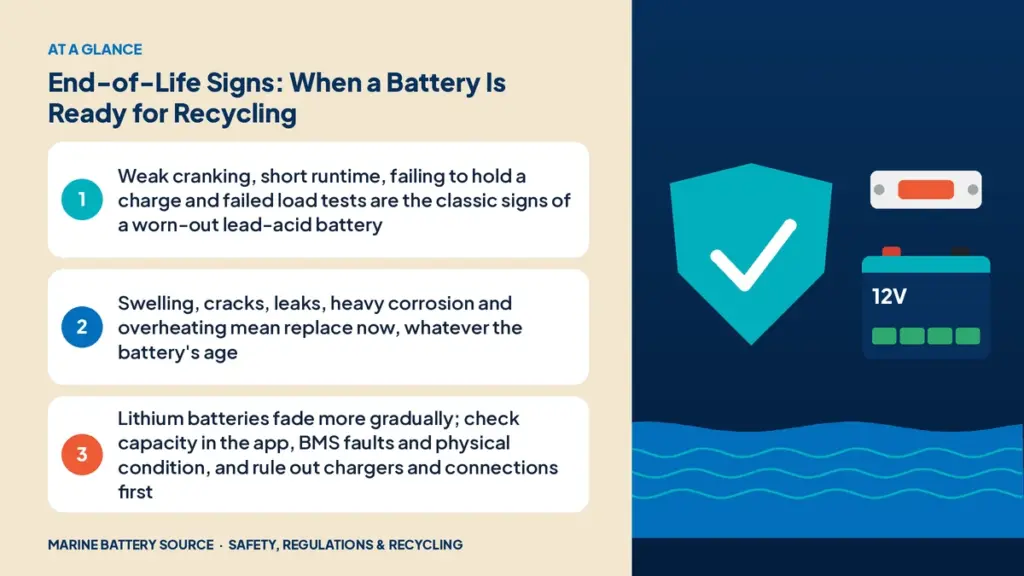
End-of-Life Signs: When a Battery Is Ready for Recycling
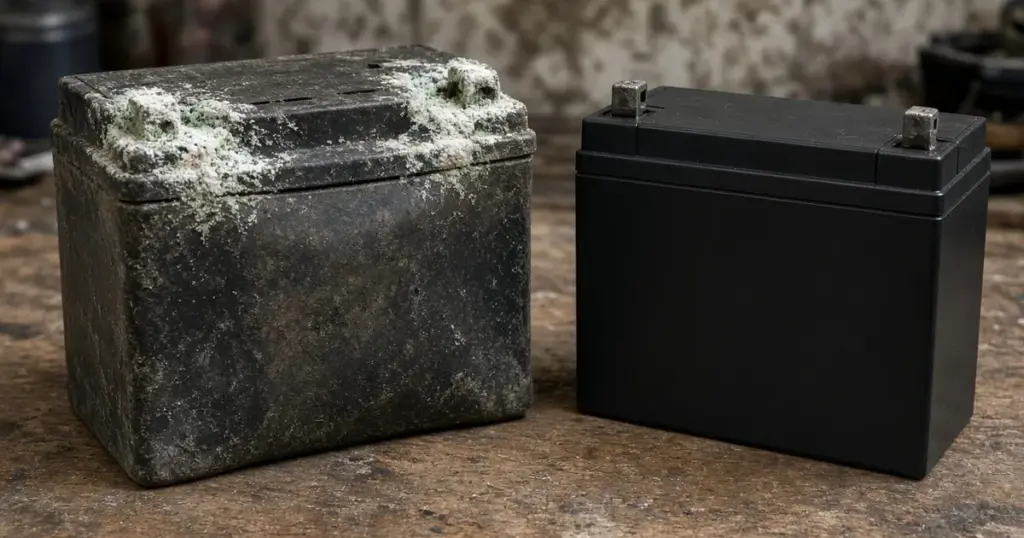
A battery rarely dies all at once. Usually, it fades: slower cranking, shorter trolling days, a charge that doesn’t last the weekend. Knowing the signs helps you replace a battery before it leaves you stranded, and avoid replacing one that just needs a good charge. This guide explains the signs and how to test.
First, rule out the easy causes
Many “dead” batteries aren’t. Before replacing:
- Charge it fully with the correct charger profile.
- Check connections: loose, corroded or undersized cables cause voltage drop that looks like a weak battery.
- Check for parasitic drain: a small constant load can flatten a battery between trips. With everything off, typical drain should be small, often under about 25 mA.
- Check the charger and alternator: a charger that isn’t finishing its charge or an alternator that isn’t charging will leave any battery weak.
Lead-acid and AGM: signs of end of life
Slow or weak cranking even after a full charge.
Short runtime: your trolling motor or house loads drain the battery much faster than they used to.
Doesn’t hold a charge: a fully charged battery drops noticeably overnight with everything off. A healthy 12V flooded battery should rest at about 12.6–12.7V when full.
Failed load test: under a load of half the CCA rating for 15 seconds, a healthy 12V battery stays above about 9.6V. Many battery shops will test for you.
Won’t reach full voltage: after a full charge cycle, resting voltage stays low, which can indicate sulfation or a shorted cell.
Uneven cells: in flooded batteries, a hydrometer reading that’s much lower in one cell than the others points to a failing cell.
Heavy water loss: a flooded battery that needs water much more often than before may be failing, or may be overcharged. See overcharging a boat battery.
Physical signs: replace now
- Swollen or bulging case
- Cracks or leaks
- Heavy corrosion that returns quickly after cleaning
- Hot battery during normal charging
- Strong sulfur smell
- Damaged terminals
A battery with these signs should be removed and recycled, whatever its age.
Lithium: signs of end of life
LiFePO4 batteries usually fade gradually over many cycles. Many makers rate cycle life to a percentage of original capacity, such as Dakota Lithium’s 5,000 cycles to 80%. Signs a lithium battery is nearing end of life or has a problem:
- Reduced capacity: the app or a battery monitor shows less usable capacity than before.
- BMS shutdowns under loads the battery used to handle.
- Cell imbalance warnings in the app.
- Won’t charge even with a correct LiFePO4 charger, after ruling out low-temperature charge protection.
- Physical damage, swelling or heat.
Before deciding a lithium battery is finished, check the maker’s troubleshooting, try a compatible charger, and contact the maker if it’s under warranty.
Age and service life
Lead-acid batteries in marine use often last a few seasons, depending on heat, depth of discharge and charging habits. Florida heat tends to shorten their life. Lithium batteries can last many years and thousands of cycles. Use age as a reason to test more often, not as the only reason to replace. A five-year-old battery that tests well can keep working; a two-year-old battery that fails a load test should be replaced.
Testing tools
- Multimeter: resting voltage and charging voltage.
- Load tester: cranking performance for starting batteries.
- Hydrometer: specific gravity of each cell in flooded batteries.
- Battery monitor or app: amp-hours used and state of charge, the best way to track capacity over time.
Keep a simple battery log
Write down each battery’s install date, and note resting voltage after a full charge and how long a typical trip lasts. A few lines in a notebook or a phone note each month is enough. When runtime or resting voltage starts sliding, you’ll see the trend before the battery fails on the water.
Replace in sets
For series banks, like 24V and 36V trolling banks, replace all the batteries at once. A new battery paired with old ones will be dragged down and wear out faster.
What to do with the old battery
Recycle it. Lead-acid batteries can’t go in Florida landfills, and lithium batteries are a fire hazard in trash. See Florida battery disposal, and get your core refund if you paid one. Don’t store dead batteries at home for months; see storing spare batteries at home.
Transporting it
Move old batteries upright, terminals protected, in a leak-proof container. See how to transport a marine battery safely.
Environmental impact
Batteries that last longer mean fewer to recycle. See lithium vs lead-acid environmental impact for how chemistry affects that.
Quick decision table
| Symptom | Likely cause | Action |
|---|---|---|
| Weak after sitting, fine after charging | Discharge or parasitic drain | Find the drain; use a maintainer |
| Weak even after full charge | Worn battery | Load test; replace if it fails |
| Swollen, cracked, leaking | Damaged battery | Replace and recycle now |
| Short runtime only on hot days | Heat, or connections | Check connections; consider lithium |
| Lithium BMS shutdowns | Overload, cold, imbalance or fault | Check loads and temperature; contact maker |
Off-season checks
Batteries often fail in spring after a winter of neglect. A full charge and a test before storage, and again before the first trip, catches most problems. See winter storage for marine batteries.
More reading
The marine battery recycling guide covers disposal, and the marine battery safety guide covers safe handling.
Shop replacements
Browse trolling motor batteries, starting batteries, dual-purpose batteries and lithium batteries.
Frequently asked questions
How do I know if my boat battery is bad?
After a full charge, it cranks weakly, runs out quickly, drops voltage overnight or fails a load test.
How long do marine batteries last?
Lead-acid often lasts a few seasons; lithium can last many years and thousands of cycles.
Can a dead battery be revived?
A deeply discharged battery may recover with a full charge. A sulfated, damaged or shorted battery usually can’t.
Should I replace all batteries in a bank at once?
Yes, for series banks. Mixing new and old shortens the new battery’s life.
Is a swollen battery dangerous?
Yes. Stop using it, and replace and recycle it.