


Series vs Parallel Battery Wiring on Boats
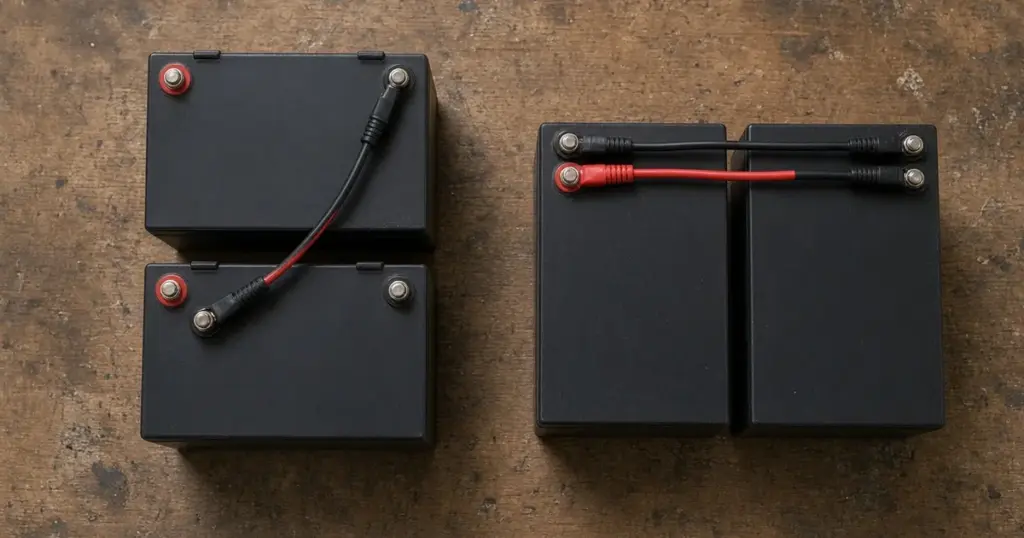
Whether you’re wiring a 24V trolling motor or doubling a house bank, you’ll need to choose between series and parallel connections, or a combination. The choice changes your system voltage and capacity and affects how you charge, fuse and maintain the batteries. This guide explains series vs parallel battery wiring with clear examples for boats.
Series wiring
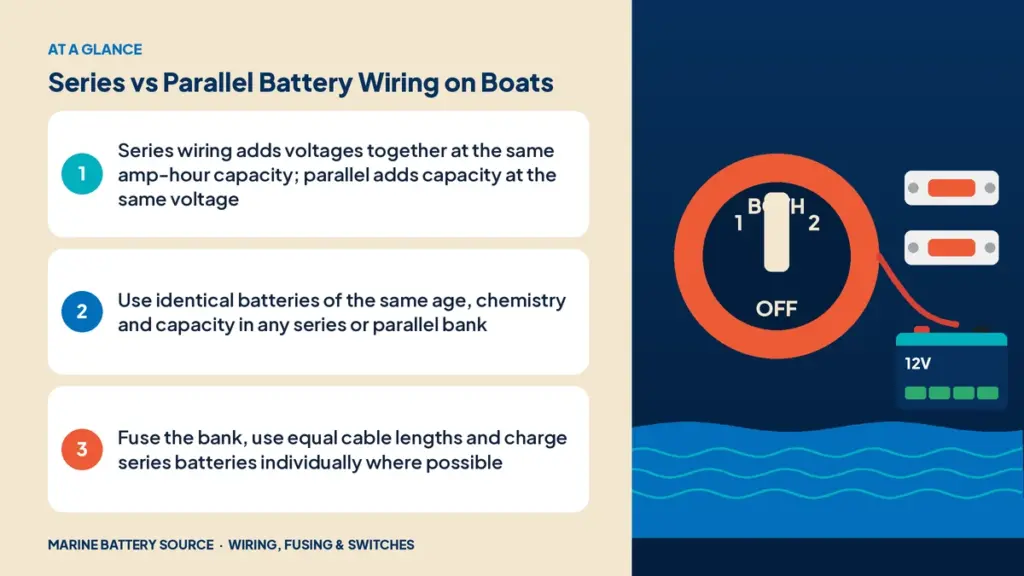
In series, the positive of one battery connects to the negative of the next. Voltages add; amp-hour capacity stays the same.
Example: two 12V 100Ah batteries in series = 24V 100Ah. Three in series = 36V 100Ah.
Used for: 24V and 36V trolling motors, some 24V house systems, and 6V golf-cart batteries combined into 12V.
Wiring steps for 24V:
- Connect battery 1 positive to battery 2 negative with a short jumper cable.
- The system positive comes from battery 2 positive.
- The system negative comes from battery 1 negative.
- Fuse the system positive close to battery 2.
For 36V, add a third battery the same way.
Parallel wiring
In parallel, positives connect together and negatives connect together. Voltage stays the same; capacity adds.
Example: two 12V 100Ah batteries in parallel = 12V 200Ah.
Used for: larger house banks, accessory banks, and some trolling setups where more runtime at 12V is needed. See wiring batteries in parallel on a boat for best practices.
Wiring tip: take the system positive from one end of the bank and the system negative from the opposite end, or use busbars with equal cable lengths, so each battery shares the load evenly.
Series-parallel
Combining both methods gives higher voltage and capacity. Four 6V batteries in a 2-series, 2-parallel arrangement make 12V with double capacity. Four 12V batteries in 2S2P make 24V at double capacity.
Comparing series and parallel
| Feature | Series | Parallel |
|---|---|---|
| Voltage | Adds | Same |
| Capacity (Ah) | Same | Adds |
| Energy (Wh) | Adds | Adds |
| Common use | 24V/36V trolling | House banks |
| Charging | Per battery or at bank voltage | At battery voltage |
Note that total energy in watt-hours adds either way. Two 12V 100Ah batteries store about 2.4 kWh, whether in series or parallel.
Match your batteries
Any series or parallel bank should use batteries of the same:
- Chemistry.
- Capacity.
- Age and condition.
- Brand and model, ideally.
Mismatched batteries charge and discharge unevenly, shortening life. Never mix lithium and lead-acid in the same bank.
Lithium in series or parallel
Many lithium batteries can be connected in series or parallel, but each maker sets limits on how many and in which configuration. Follow those limits and use batteries with similar state of charge before connecting them. Alternatively, a single higher-voltage lithium battery, such as a EPOCH 36V 50Ah Essential, avoids series wiring entirely. Connection kits like the Dakota Lithium 36V trolling motor connection kit simplify series hookups.
Charging series banks
A single 24V or 36V charger charges the whole string, but batteries can drift out of balance. A multi-bank charger with one bank per 12V battery keeps them balanced. A single high-voltage lithium battery is charged with a charger matched to its voltage.
Fusing and switches
- Fuse the system positive close to the battery.
- For parallel banks, consider fusing each battery’s positive to protect against an internal short in one battery feeding into others.
- Install a disconnect switch rated for the system voltage and current. See battery switch basics.
Cable sizing
Series jumpers carry full system current and should be the same size as the main cables. Parallel interconnects should be heavy and equal length. See marine battery cable sizing and voltage drop.
Negative connections
In mixed systems, such as a 24V trolling bank and a 12V starting battery, negatives may or may not be connected depending on motor and charger requirements. Follow the trolling motor and charger instructions. See negative busbars and grounding.
Example: 24V trolling bank plus starting battery
A boat with two 12V deep-cycle batteries in series for a 24V trolling motor and a separate 12V cranking battery. A three-bank onboard charger connects one bank to each battery. The trolling motor’s fused 24V cable runs from the series pair to the bow plug. The cranking battery stays separate. See how to install a marine battery for mounting.
Example: doubling a house bank
A cruiser has one 12V 100Ah AGM house battery and wants more capacity at anchor. The owner adds a second identical AGM battery of the same age in parallel, connecting positives with a heavy cable and negatives with another of equal length. The bank positive is taken from the first battery and the bank negative from the second, so current flows evenly through both. A fuse on the bank positive and a disconnect switch complete the job. The result is a 12V 200Ah bank with roughly double the runtime.
Checking a bank’s balance
Once a bank is running, check it periodically. With the bank at rest, measure each battery’s voltage separately. In a healthy series or parallel bank, voltages should be very close. A battery that reads noticeably higher or lower than its neighbors may be failing, may be connected with a loose or corroded cable, or may be carrying a load the others don’t. Catching an imbalance early can prevent one weak battery from shortening the life of the whole bank.
Common mistakes
- Tapping 12V accessories from one battery of a series bank, which unbalances it.
- Mixing old and new batteries.
- Unequal cable lengths in parallel banks.
- Forgetting the fuse on the system positive.
Quick reference
- Need more voltage? Wire in series.
- Need more runtime at the same voltage? Wire in parallel.
- Need both? Series-parallel, with matched batteries throughout.
For an overview of the whole electrical system, read the marine battery wiring guide, and browse battery accessories in the store.
Frequently asked questions
What’s the difference between series and parallel battery wiring?
Series adds voltage at the same capacity; parallel adds capacity at the same voltage.
How do I wire batteries for a 24V trolling motor?
Connect battery 1 positive to battery 2 negative. Use battery 2 positive and battery 1 negative as the system terminals.
Can I wire lithium batteries in series?
Many can, within the maker’s limits. A single high-voltage lithium battery is often simpler.
Can I take 12V from one battery in a 24V bank?
It’s not recommended because it unbalances the bank. Use a DC-DC converter instead.