


Wiring Batteries in Parallel for Balanced Charging
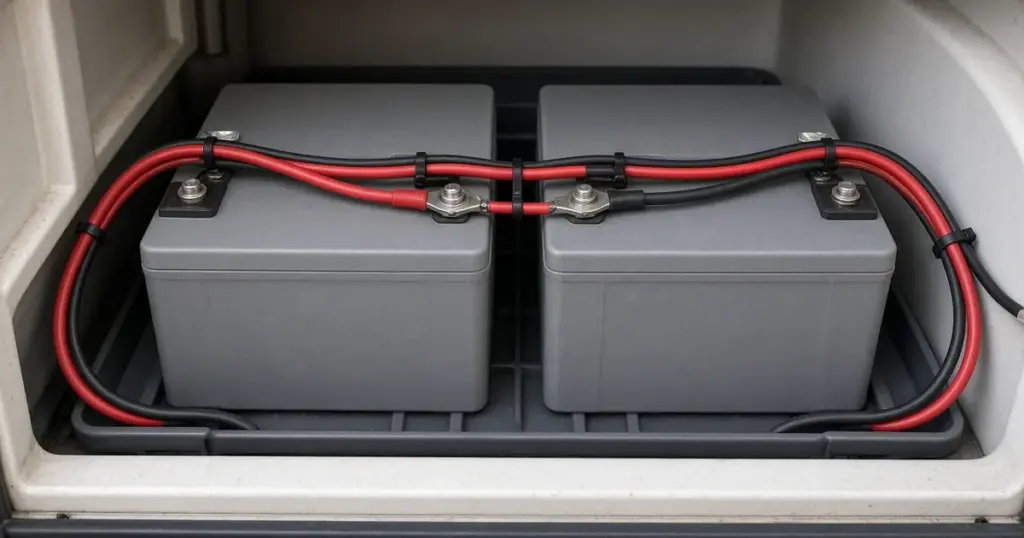
Wiring batteries in parallel is the most common way to build a bigger house bank on a boat. It lets you run electronics, a fridge or an inverter longer without changing system voltage. Done right, a parallel bank behaves like one large battery. Done wrong, one battery works harder than the others, wears out early and drags the whole bank down. This guide covers how to wire batteries in parallel on a boat, which batteries can be paralleled, and how to protect the bank.
What parallel wiring does
In a parallel connection, all positive terminals are joined together and all negative terminals are joined together. The result:
- Voltage stays the same. Two 12V batteries in parallel are still 12V.
- Capacity adds up. Two 100Ah batteries give a 200Ah bank. Three give 300Ah.
- Current capacity adds up. Each battery shares the load, so the bank can supply more current than one battery alone.
That’s different from series wiring, which adds voltage for 24V and 36V trolling motors. If you’re not sure which you need, read series vs parallel battery wiring first.
When parallel wiring makes sense
- House banks on cruisers, sailboats and liveaboards that need more amp-hours at 12V.
- Inverter systems where the current draw is more than one battery should supply.
- Accessory banks on pontoons and fishing boats with long days of electronics and livewell use.
- Expanding capacity without replacing your 12V equipment.
Sometimes one larger battery is the better choice. A single EPOCH 12V 300Ah LiFePO4 or 12V 460Ah battery avoids the balancing issues of a parallel bank and uses fewer connections. Parallel banks make sense when space, weight per battery or redundancy matters.
Rules for batteries in a parallel bank
Batteries in parallel should be as close to identical as possible:
- Same chemistry. Don’t parallel lithium with lead-acid, or flooded with AGM. Their charge voltages differ, and one will always be overcharged or undercharged.
- Same capacity. Mixing a 100Ah with a 50Ah means the smaller one cycles harder.
- Same age and condition. A new battery paralleled with a tired one will keep trying to charge the old one and wear down faster.
- Same brand and model, ideally from the same production batch, especially for lithium.
- Same state of charge before connecting. Fully charge each battery separately before joining them, so a large current doesn’t rush from one into the other.
The diagonal (cross) connection
The single most important wiring detail in a parallel bank is where you take the main cables from. If both main cables connect to the same battery, that battery does most of the work, because the others are farther away through extra cable and connections.
The fix is the diagonal connection:
- Join all positives with equal-length links.
- Join all negatives with equal-length links.
- Connect the main positive to the first battery in the row.
- Connect the main negative to the last battery in the row.
Now current flowing to and from every battery travels through roughly the same total cable length, so they share the load and charge evenly.
Even better: busbar connections
For banks of three or more batteries, or high-current systems with an inverter, a pair of busbars is the cleanest layout. Each battery gets its own positive cable to a positive bus and its own negative cable to a negative bus, with all cables the same length and gauge. The main cables then leave from the busbars. This gives the most even sharing and makes it easy to isolate one battery. The EPOCH heavy-duty power distribution block is built for this kind of high-current collection point. See our busbar guide for layouts and our negative bus guide for the return side.
Cable sizing for parallel banks
- Link cables between batteries should be the same gauge as the main cables, or heavier. They carry a share of the full bank current.
- Main cables must be sized for the total bank current and the round-trip length to the load. Use our cable size guide to choose the gauge.
- Equal lengths matter. A link that’s twice as long as the others adds resistance and unbalances the bank.
- Use tinned copper cable and properly crimped lugs, and torque every terminal to spec.
Fusing a parallel bank
The main positive cable leaving the bank needs a fuse close to the battery, sized to protect that cable. On larger lithium banks, or any bank with an inverter, a fuse on each battery’s positive is also smart. If one battery or link shorts internally, the other batteries can push enormous current into the fault, and individual fuses stop it.
Common options:
- A marine-rated 300A battery fuse on the main positive.
- Terminal-mounted MRBF fuses on each battery in a lithium bank.
- A fuse block for MRBF fuses where several battery cables meet.
After the main fuse, the cable goes to the battery switch, then on to the distribution system.
Paralleling lithium batteries
LiFePO4 batteries parallel well, with a few extra rules:
- Check the manufacturer’s limit on how many batteries can be paralleled. Most allow several, but some have a stated maximum.
- Charge each battery fully on its own before connecting. Lithium’s flat voltage curve hides differences in state of charge, and connecting mismatched batteries can trip a BMS.
- Each battery has its own BMS. If one disconnects, the others carry the full load. Size the bank so the remaining batteries can handle your peak current, or keep loads within one battery’s rating.
- Use a charger set for lithium and a charge current the whole bank can accept. A 12V bank charges fine with a single charger connected at the bank’s main cables, such as the EPOCH 12V 50A lithium charger for larger banks.
- Some batteries support communication between units. If yours do, connect them as instructed so the bank reports as one.
Paralleling lead-acid batteries
Flooded and AGM banks work in parallel too, but they’re more sensitive to imbalance over time. A weak cell in one battery drags down the others, and you won’t know until the bank capacity drops. Check each battery separately once or twice a season by disconnecting the links and testing voltage after a rest. When one fails, replace the whole bank if the others are more than a couple of years old.
Step-by-step: wiring two batteries in parallel
- Turn off all loads and chargers, and open the battery switch.
- Fully charge both batteries separately and confirm similar resting voltages.
- Mount and secure the batteries side by side in trays or boxes. Our marine battery installation guide covers mounting.
- Connect a positive link cable between the two positive terminals.
- Connect a negative link cable between the two negative terminals, the same length and gauge.
- Connect the main positive (through the main fuse) to battery 1’s positive.
- Connect the main negative to battery 2’s negative.
- Check torque on every terminal, apply terminal protectant and fit terminal covers.
- Close the switch and test voltage at both batteries and at the load.
Common mistakes
- Both main cables on one battery. That battery wears out first.
- Mixed batteries. Old with new, AGM with flooded, lithium with lead-acid.
- Unequal link cables. The battery with the longer cable does less work.
- Undersized links. Thin jumpers get hot and cause voltage drop.
- No main fuse. A parallel bank can deliver huge short-circuit current.
- Connecting a discharged battery to a full one. The rush of current can damage terminals or trip a BMS.
Paralleling for higher voltages
You can combine series and parallel to build a bigger 24V or 36V bank, such as two 36V strings in parallel. Each string must be built identically, then the strings are paralleled at the bank’s main terminals. In most cases, buying one battery at the higher voltage, like a 36V lithium, is simpler and avoids balancing multiple strings. See our marine battery wiring guide for full system diagrams.
Frequently asked questions
Does wiring batteries in parallel increase voltage?
No. Parallel wiring keeps the voltage the same and adds capacity. Two 12V 100Ah batteries in parallel make a 12V 200Ah bank.
Can I parallel a new battery with an old one?
It’s not recommended. The older battery drags the new one down and both wear out faster. Replace batteries in a parallel bank together.
Can I parallel lithium and AGM batteries?
No. They have different charging voltages and discharge curves, so one will always be overcharged or undercharged. Keep chemistries separate, or use a DC-DC charger between them.
Where do the main cables connect on a parallel bank?
Main positive on the first battery, main negative on the last, with equal-length links between them. This diagonal connection keeps the batteries sharing the load evenly.
Do I need a fuse on each battery?
On a lithium bank or any bank feeding an inverter, a fuse on each battery’s positive is a good idea. At minimum, fuse the main positive cable close to the bank.