


Fall Fishing Battery Tips

Fall is many anglers’ favorite season: baitfish move, fish feed hard, crowds thin out and the weather cools. It’s also a season that exposes weak batteries. Summer heat has taken its toll, days on the trolling motor get long, and cool mornings reduce cranking power. This guide covers how to keep your batteries strong through the fall run.
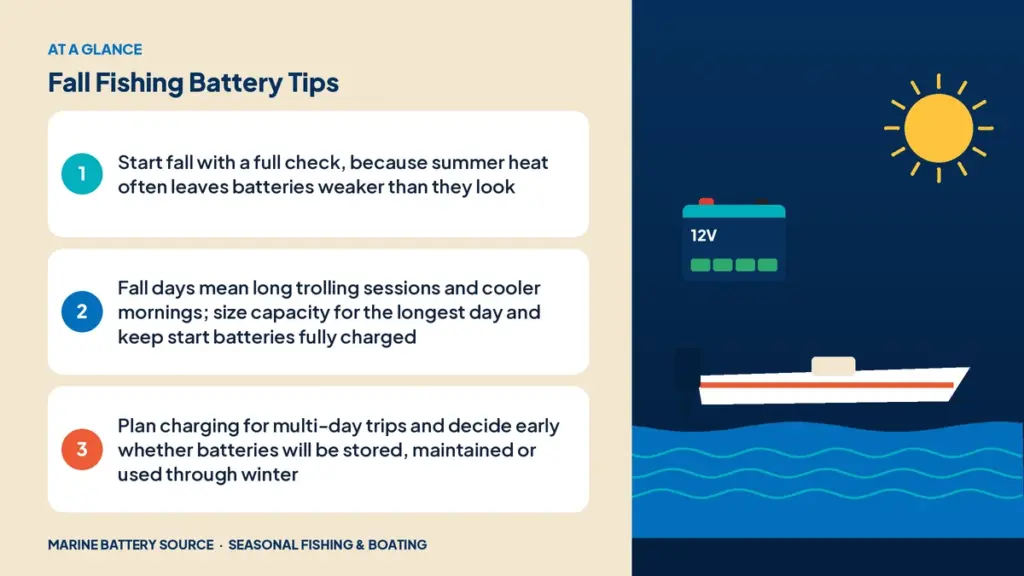
Start with a post-summer check
Summer heat accelerates lead-acid aging. Before the fall season:
- Fully charge each battery.
- Check resting voltage after a few hours off the charger. A healthy 12V flooded battery reads about 12.6–12.7V; AGM about 12.8V; LiFePO4 about 13.3–13.4V.
- Load test start batteries. A healthy 12V battery stays above about 9.6V at half its CCA rating for 15 seconds.
- Check flooded water levels and top up with distilled water.
- Inspect cases for swelling or cracks, and terminals for corrosion.
If a battery struggled in August, it won’t get better in October, and the cooler weather will only make its weakness more obvious. Replace weak batteries, in matched sets for series banks.
Long trolling days
Fall fishing often means long sessions on the trolling motor: following schools, working shorelines, holding on points in wind. Estimate your average draw and hours:
| Motor | Average draw | Hours | Amp-hours used |
|---|---|---|---|
| 12V, light use | 10A | 6 | 60Ah |
| 24V, moderate | 15A | 7 | 105Ah |
| 36V, heavy spot-lock | 25A | 8 | 200Ah |
Lead-acid banks should stop at about half their rated capacity, so double those numbers for lead-acid. Lithium can use most of its rating. If your bank comes up short, consider lithium, a larger bank or charging on the run with a DC-DC charger.
Cool mornings and cranking
Cold reduces a battery’s ability to deliver cranking current. Fall mornings are rarely cold enough to cause serious problems, but a start battery that’s partly discharged or aging will show it first. Keep start batteries fully charged and connections clean. CCA ratings are measured at 0°F; MCA at 32°F. If you fish northern waters into late fall, choose a start battery with a comfortable margin over your engine’s requirement.
Charging lithium in the cold
LiFePO4 batteries generally shouldn’t be charged below freezing unless they have internal heating. In the North, late-fall nights can drop below freezing. If your lithium battery isn’t heated, charge it in a garage or heated space, or wait until it warms up. Heated models, such as EPOCH Essential batteries and the Dakota DL+ 135Ah, handle cold charging automatically.
Multi-day trips
Fall camping and fishing trips often mean several days with limited charging. Plan:
- How many amp-hours you’ll use each day.
- How you’ll recharge: shore power, a generator, DC-DC charging while running, or nothing at all.
- Whether you need extra capacity to cover the gap.
See fishing trip power planning for a worksheet.
Shorter days, more lights
As days shorten, you may run navigation lights more, launch in the dark and return after sunset. Lights don’t draw much, but add them to your load estimate, and make sure your start battery is strong for that pre-dawn launch. Check that every navigation light works before the first dark run of the season; a dim light can be a sign of corroded connections.
Fall tournaments
Fall tournament series can be demanding. Use the same preparation as spring: test, match, size and plan charging. See tournament season battery prep.
Florida’s fall
In Florida, fall brings relief from the heat and some of the best inshore fishing of the year, but hurricane season runs through November. Keep batteries charged so bilge pumps can run in storms, and inspect batteries after any severe weather. See summer battery tips for heat recovery.
Plan for winter now
Before the season ends, decide what you’ll do with your batteries:
- Northern boaters: plan winter storage: full charge, disconnect loads, maintainer or bring them home. See winter storage for marine batteries.
- Florida boaters: keep fishing, and keep maintaining. See winter fishing in Florida.
- Holiday shopping: a new charger, a battery monitor or a lithium upgrade makes a good gift. See gifts for boaters.
Livewells and bait in fall
Fall baitfish runs mean full livewells and long days running pumps and aerators. A livewell pump can draw a few amps, and recirculating systems may run most of the day. Add those amp-hours to your daily estimate, and make sure the circuit is fused and the pump’s wiring is in good condition after a summer of hard use. If your start battery also runs the livewell, a long day of bait-keeping can leave it lower than you’d expect at the end of the day.
Fall checklist
- ☐ Full charge and test after summer
- ☐ Replace weak batteries in matched sets
- ☐ Size trolling capacity for long fall days
- ☐ Keep start battery fully charged for cool mornings
- ☐ Don’t charge unheated lithium below freezing
- ☐ Plan charging for multi-day trips
- ☐ Decide on winter storage or maintenance
Fall is a good time to upgrade
If your lead-acid batteries are near end of life, fall is a smart time to replace them, before winter storage rather than after. A new battery that’s charged and stored properly will be ready in spring. Ordering ahead also avoids the spring rush. See the seasonal battery calendar and the Memorial Day checklist for how the year fits together.
Products mentioned
- EPOCH 36V 100Ah (heated)
- Dakota DL+ 12V 135Ah Heated
- EPOCH dual-output DC-DC charger
- Browse trolling motor batteries.
Frequently asked questions
Why do batteries fail in fall?
Summer heat weakens lead-acid batteries, and long fall days and cooler mornings reveal the damage.
Can I charge a lithium battery in cold fall weather?
Not below freezing unless it has internal heating. Charge in a warmer space if needed.
How much trolling capacity do I need for fall?
Estimate average draw times hours. Double it for lead-acid; lithium can use most of its rating.
Should I replace batteries in fall or spring?
Fall is often better, so the new battery is stored properly and ready in spring.
Do Florida boaters need to winterize in fall?
Usually not, but keep batteries charged through hurricane season and the winter fishing season.