


Buying a Marine Battery Online: What to Check
Buying a marine battery online gives you more choice than most local shops can stock: more brands, more sizes, more lithium options and detailed specs to compare. It also puts more of the checking on you. This guide covers what to confirm before you order, what to expect with shipping and delivery, and how to make the switch go smoothly.
Before you order: confirm the basics
The battery’s job. Starting, dual purpose or deep cycle? See the marine battery buying guide if you’re unsure.
Voltage. 12V for most starting and house batteries; 24V or 36V for single-case trolling batteries.
Capacity. Work out the amp-hours you need. Read amp-hours explained and lithium vs lead-acid amp-hours, because a lithium battery needs fewer rated amp-hours for the same runtime.
Cranking. For starting, meet or exceed your engine maker’s CCA or MCA requirement.
Fit. Measure your tray or box and compare with the listing’s dimensions, not just the group size. See BCI group sizes for typical sizes.
Terminals. Posts, studs or M8 threads? Check that your cable ends fit, or plan new lugs.
Charging. Make sure your charger has the right profile, especially for lithium.
Read the listing carefully
Good product listings give you everything a counter clerk would: dimensions, weight, capacity, cranking ratings, discharge and charge limits, temperature ranges, IP rating and warranty. Compare them line by line. Our guide to reading a battery spec sheet explains each one. If something important isn’t listed, ask before ordering.
Lithium shipping
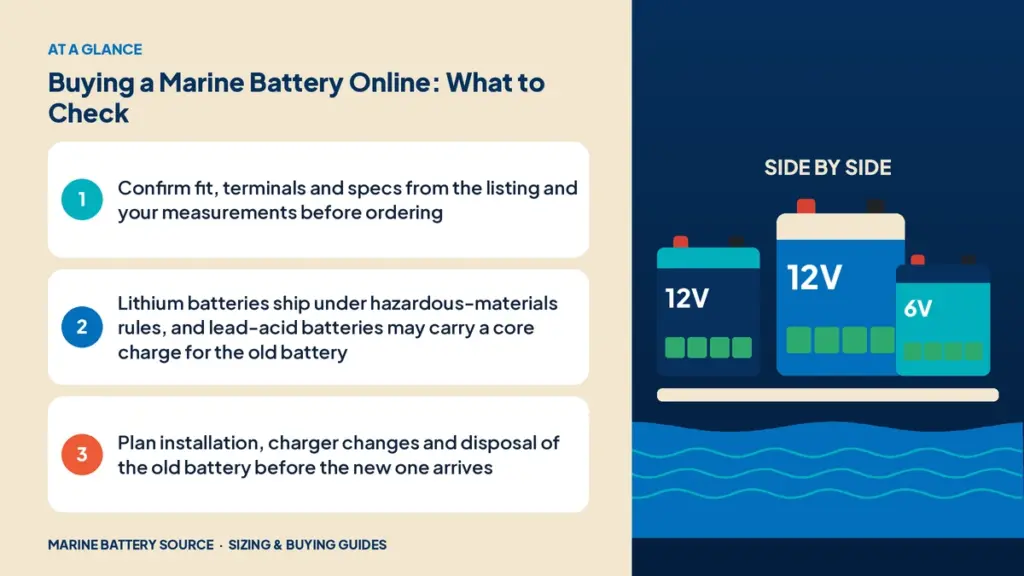
Lithium batteries are regulated for shipping as hazardous materials. In practice, that means:
- They ship by ground services that accept lithium batteries.
- Packaging and labeling follow carrier rules.
- Delivery may take a little longer than for ordinary parcels.
- Some destinations or expedited options may not be available.
Check our shipping page for current details. If you need a battery by a certain date, such as for a tournament or trip, order early.
Lead-acid shipping and core charges
Lead-acid and AGM batteries are heavy, so they ship by freight or ground. Many sellers add a core charge to encourage recycling of the old battery; it’s refunded or waived when the old battery is returned. When you book our installation, we take your old battery away and waive the $18 core charge.
Local installation
We offer flat-price installation (from $99 per battery) anywhere from Venice to Gainesville, FL. That can be the easiest way to handle a heavy lead-acid bank or a lithium conversion that includes a new charger. See our local installation page for details. Elsewhere, we ship across Florida and the U.S.
When the battery arrives
- Inspect the package for damage before signing, if possible.
- Check the model against your order.
- Check the voltage with a multimeter. Lead-acid batteries may need a full charge before installation; lithium batteries often ship partly charged and should be fully charged before first use.
- Read the manual for installation and charging instructions.
- Keep the packaging until you’re sure the battery fits and works.
Installing it yourself
- Turn off the battery switch and all loads.
- Remove the old battery: negative cable first, then positive.
- Clean cable ends and the tray.
- Install the new battery, secure it, then connect positive first and negative last.
- Fit terminal boots and a fuse close to the positive terminal.
- Update chargers to the new chemistry’s profile.
- Test everything before your next trip.
Disposing of the old battery
Lead-acid batteries are widely recycled, and it’s illegal to throw them in the trash in many places. Return the old battery to a retailer, a recycling center or, when we install your new battery, our installer. Lithium batteries also need proper recycling. See marine battery recycling.
Warranty and returns
Before ordering, know the warranty length and terms, which differ widely by brand, and how claims work. Keep your order confirmation and note the installation date. See our warranty page for how we help with claims, and our FAQ for common questions.
Avoiding common mistakes
- Ordering by group size alone. Check exact dimensions and terminal layout.
- Forgetting the charger. A lithium battery on a lead-acid charger won’t charge correctly.
- Underestimating weight. A 70-pound battery is hard to lift into a deep locker. Plan help.
- Mixing old and new. Replace all batteries in a series bank at once.
- Waiting until the last minute. Allow time for shipping, especially for lithium.
Ordering for a tournament or trip
If you need a battery for a specific date, give yourself a buffer. Order at least a week or two ahead so there’s time for shipping, a full first charge and a test run on the water. Install and test the new battery on a short local trip before relying on it for a long day offshore or a tournament.
Questions to ask before buying
- Will this battery fit my tray, and will my cables reach?
- Is my charger compatible?
- Does my engine’s charging system work with this battery?
- What’s the warranty, and how are claims handled?
- How do I return or recycle my old battery?
If you’re unsure about any of these, send us your boat details and photos through our contact page.
More reading
Size your bank with how many batteries does my boat need, and compare energy in amp-hours to watt-hours. For lithium specifics, read the lithium marine battery buyer’s guide.
Where to start shopping
- Browse trolling motor batteries, starting batteries and dual-purpose batteries.
- Compare lithium batteries with AGM and lead-acid options.
- Don’t forget chargers and accessories like trays, fuses and terminal hardware.
Frequently asked questions
Is it safe to buy a lithium battery online?
Yes, from a reputable seller. Lithium batteries ship under hazardous-materials rules with proper packaging.
What is a core charge?
A deposit added to lead-acid batteries to encourage recycling, refunded or waived when the old battery is returned.
Do you install batteries locally?
Yes, in the Tampa Bay and Sarasota areas, to your dock, ramp or driveway. Installation is a flat $99 per battery ($249 for a 24V or 36V lithium bank).
Should I charge a new battery before installing it?
Usually yes. Check the voltage and follow the manual’s instructions.
What if the battery doesn’t fit?
Check our return terms before installing, and keep the packaging until you’re sure it fits.