


Hurricane Season Battery Prep for Boat Owners
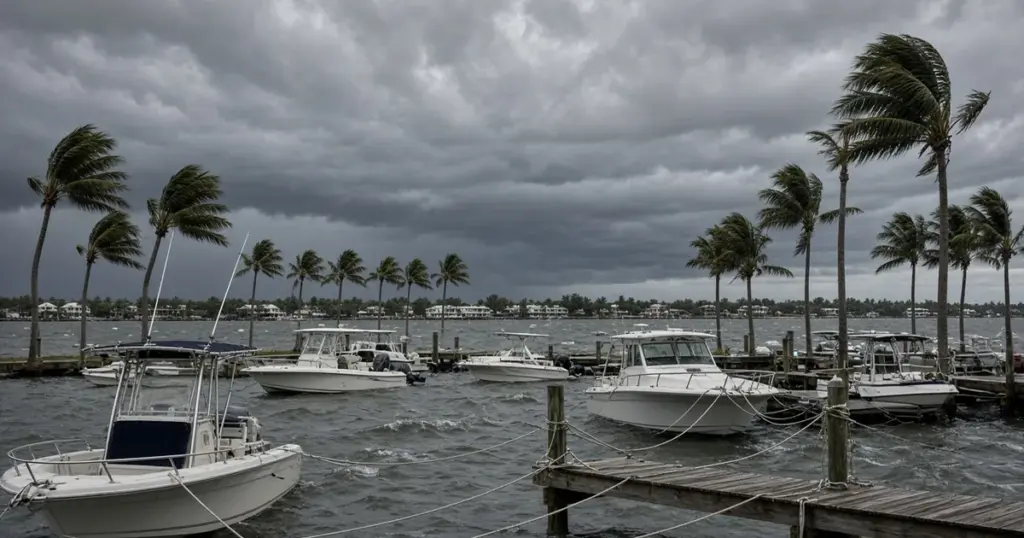
Atlantic hurricane season runs from June 1 through November 30, and for boaters in Florida and along the Gulf Coast, battery decisions are part of every storm plan. The right move depends on where the boat rides out the storm: in a slip, on a mooring, on a lift, on a trailer or in a rack. This guide covers what to do with your batteries before a hurricane, how to keep bilge pumps working, and what to inspect afterward. Always follow your marina’s hurricane plan and any evacuation orders first. No boat is worth risking your safety.
Start early in the season
Hurricane prep is easier when it’s done before a storm is in the forecast.
- Test every battery in June. Replace weak ones before you need them. See Florida heat and marine battery life for why batteries in the South often fail sooner than expected.
- Check bilge pumps and float switches on automatic and manual.
- Confirm the bilge pump’s automatic circuit is wired to stay powered when the main battery switch is off, with its own fuse.
- Write down your plan: where the boat goes, who handles it, what comes off the boat.
- Photograph your electrical system and serial numbers for insurance.
Put these on your seasonal boat battery calendar so they happen every year.
If the boat stays in the water
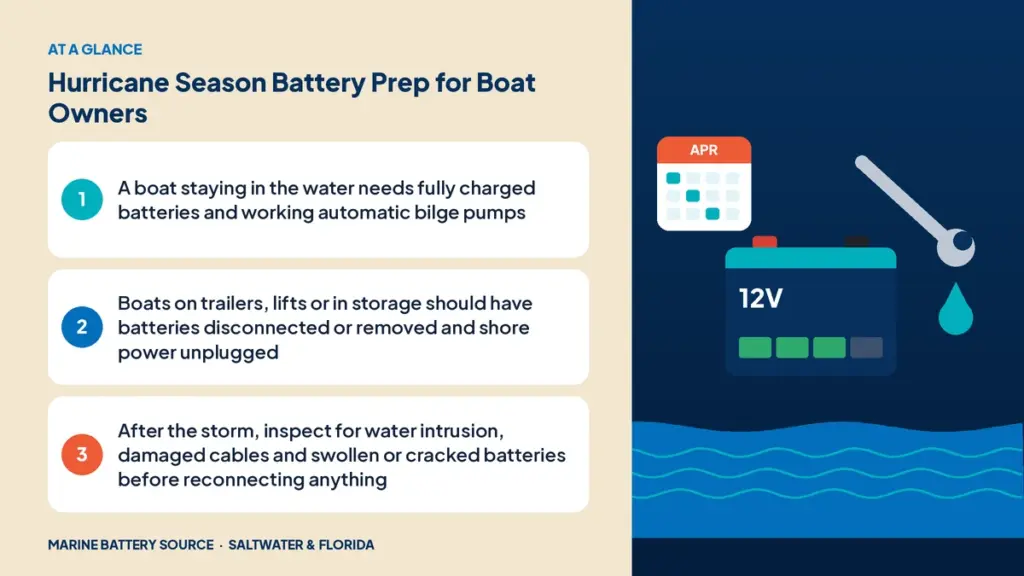
Boats riding out a storm in a slip or on a mooring depend on their bilge pumps, and the pumps depend on the batteries.
- Fully charge every battery before the storm. A full battery runs a bilge pump far longer than a half-charged one.
- Unplug shore power before the storm arrives. Storm surge, broken pedestals and damaged cords make shore power dangerous, and many marinas cut power anyway. Stow the cord.
- Turn the main battery switch off, leaving only the automatic bilge pump circuit live.
- Test the float switches one last time.
- Remove or secure loose electronics, antennas and canvas to reduce windage and damage.
- Close seacocks that don’t need to be open, and check cockpit drains are clear.
How long will the batteries run the pumps? It depends on how much water comes in. A bilge pump drawing several amps that runs continuously can drain a single battery within a day. That’s why a full charge, clear drains and a dry boat matter. If you have a house bank, leaving it connected to the bilge circuit gives more reserve.
If the boat is on a trailer, lift or rack
- Disconnect the batteries, negative cable first, or remove them. A boat on land doesn’t need bilge pumps running, and a disconnected battery can’t short if water or debris gets in.
- Remove batteries if the boat might flood. Batteries submerged in salt water are ruined and can create hazards.
- Store removed batteries in a dry, ventilated place off the floor, away from anything flammable, and give them a full charge first.
- Pull the drain plug on a trailered boat if your plan calls for it, so rain doesn’t fill it. Follow your own plan on this; some owners fill boats with water to keep them from blowing over, which changes the equation.
- Unplug any shore power or trickle charger on the lift or trailer.
Boat lifts are a special case. Many lift manufacturers and marinas recommend taking the boat off the lift before a hurricane, because surge can float the boat off the cradle. Check the guidance for your lift and location.
Lithium batteries and storms
Lithium batteries are sealed and can sit disconnected for long periods with little self-discharge. Before a storm:
- Charge to the level the manufacturer recommends for storage if the boat won’t be used for a while, or to full if the batteries are needed for bilge pumps.
- Disconnect them if the boat is on land.
- After the storm, inspect for water intrusion before reconnecting. If a lithium battery was submerged, don’t reconnect or charge it; contact the manufacturer.
Snowbirds and absentee owners
If you’re out of state during hurricane season, line up a person or service to carry out your plan. A boat left with batteries connected and no one checking can end up with dead batteries and a full bilge. Our snowbird boat battery storage guide covers long-term setups.
After the storm
Don’t rush to switch everything on. Water, debris and impact can cause damage you won’t see at first.
- Wait until it’s safe to access the boat. Don’t approach downed shore power or flooded docks.
- Look before you touch. Check for water in battery compartments, signs of fire, and a strong sulfur (rotten egg) smell from lead-acid batteries.
- Inspect batteries for cracks, swelling, leaks or corrosion. Any of these means replacement. See hot, swollen or smelly batteries for the warning signs.
- Inspect cables and connections for damage, chafe and corrosion.
- Rinse salt off the deck and exterior with fresh water, keeping it out of electrical areas.
- Dry compartments before reconnecting.
- Reconnect positive first, then negative, and check voltage.
- Charge and test before relying on the batteries.
- Check bilge pumps and float switches again.
If saltwater flooded the electrical system, have it inspected before use. Salt keeps corroding connections long after the water is gone. Our saltwater corrosion prevention guide covers cleanup.
Insurance and documentation
- Take photos before and after the storm.
- Keep receipts for prep work and replacement batteries.
- Check whether your policy has a hurricane haul-out or prep requirement.
Local considerations
Tampa Bay and Sarasota boaters face surge-prone bays, canals and barrier islands. See our Tampa Bay boat battery guide and Sarasota boat battery guide for local tips. Flats and bay boat anglers can find more in Florida flats fishing power.
If your batteries need replacing after a storm and you’re in our local area, we offer local installation anywhere from Venice to Gainesville, FL. Elsewhere, we ship batteries across Florida and the U.S.
Hurricane battery checklist
- ☐ Batteries tested in June
- ☐ Bilge pumps and float switches tested
- ☐ Batteries fully charged before the storm
- ☐ Shore power unplugged and cord stowed
- ☐ Main switch off, automatic bilge circuit live (boat in water)
- ☐ Batteries disconnected or removed (boat on land)
- ☐ Electrical system photographed
- ☐ Post-storm inspection before reconnecting
Replacement batteries
If you’re replacing a battery before the season, sealed batteries handle Florida heat and humidity well. A dual-purpose AGM like the Interstate 27M AGM can serve a single-battery boat, while a lithium house battery like the EPOCH 12V 105Ah LiFePO4 adds reserve for bilge pumps and electronics. Browse dual-purpose marine batteries.
Frequently asked questions
Should I disconnect my boat batteries for a hurricane?
If the boat is on land, yes. If it stays in the water, keep fully charged batteries connected to the automatic bilge pump circuit and turn off the main switch.
Should I leave shore power connected during a hurricane?
No. Unplug and stow the cord before the storm. Damaged pedestals and surge make shore power dangerous.
How long will a battery run a bilge pump?
It depends on the pump’s draw and how often it runs. Continuous pumping can drain a single battery within a day, so start with a full charge and a dry boat.
Can I use a battery that was submerged in salt water?
It’s not recommended. Replace lead-acid batteries that were submerged, and contact the manufacturer before touching a submerged lithium battery.
What should I check after a hurricane?
Water intrusion, damaged or swollen batteries, corroded or chafed cables, and bilge pump function, all before reconnecting and charging.