


Marine Battery Troubleshooting Guide
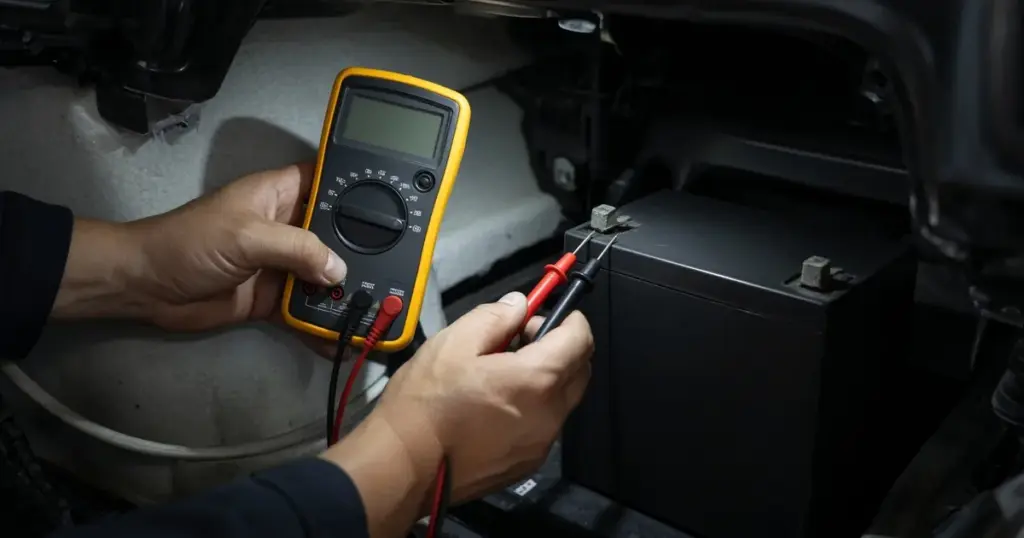
A boat battery problem usually shows up at the worst moment: a click at the ramp, a trolling motor that fades by mid-morning, electronics that reset every time the engine cranks. The good news is that most battery problems can be traced with a few simple tools and a logical order of checks. This pillar guide walks through how to troubleshoot a marine battery from the first symptom to the fix, and points you to detailed guides for each step.
Safety first
- Turn off the battery switch and loads before working on connections.
- Remove jewelry and use insulated tools.
- Wear eye protection around lead-acid batteries; they can contain acid and release hydrogen.
- Never create sparks near a flooded battery that’s been charging.
- If a battery is hot, swollen, leaking or smells like rotten eggs, stop and read hot, swollen or smelly batteries before doing anything else.
Tools you’ll need
- A digital multimeter (see multimeter battery testing for boaters)
- A battery load tester or access to one
- Terminal brush and wrench set
- A clamp meter, if you have one, for current measurements
- The battery’s voltage chart and datasheet
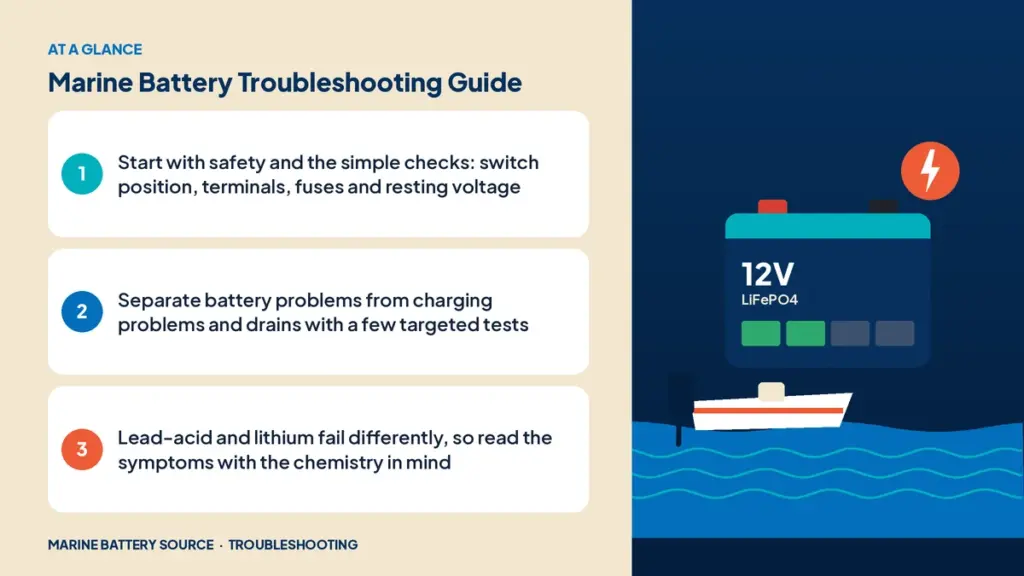
Step 1: Define the symptom
Write down what actually happens. Different symptoms point to different causes.
| Symptom | Likely areas to check |
|---|---|
| Engine clicks or cranks slowly | Start battery charge, terminals, cables, starter |
| Battery dead after sitting | Parasitic drain, self-discharge, failing battery |
| Battery won’t hold charge | Aged or sulfated battery, failed cell |
| Battery never reaches full | Charger, charging profile, alternator, wiring |
| Lithium battery shuts off | BMS protection: low voltage, high current, temperature |
| Battery hot or swollen | Overcharging, internal fault, high current |
| Electronics reset at start | Voltage dip, shared start and house loads, weak battery |
Step 2: The simple checks
Before testing anything, rule out the obvious:
- Battery switch position. Many “dead batteries” are switches left in the wrong position.
- Terminals. Loose or corroded connections cause most intermittent problems.
- Fuses and breakers. Check the main fuse and any inline fuses.
- Charger status lights. A fault light tells you a lot.
- Visual inspection. Cracks, bulging, leaks, burned insulation.
Step 3: Measure resting voltage
Disconnect loads and chargers and let the battery rest (a few hours is best for lead-acid). Measure across the terminals and compare with the chart. Our marine battery voltage chart covers flooded, AGM and lithium.
- Flooded lead-acid: about 12.6–12.7V is full; about 12.2V is roughly half.
- AGM: slightly higher than flooded at the same charge.
- LiFePO4: about 13.3–13.4V at rest when full, but the curve is flat, so voltage alone says little in the middle.
If voltage is low, charge fully and measure again after resting.
Step 4: Test under load
Voltage alone can fool you. A battery can show a healthy resting voltage and still collapse under load. A load test or a capacity test tells you whether the battery can actually deliver. See battery load test vs voltage test and our full guide on how to test a marine battery.
Step 5: Decide which problem you have
Problem A: The battery is failing
- Won’t reach full voltage after a proper charge
- Fails a load test
- Loses charge quickly with no loads
- Old, swollen or damaged
Replace it. Lead-acid batteries that have sat discharged often sulfate beyond recovery.
Problem B: Something is draining it
- Battery tests fine after charging but is dead after sitting
- See parasitic drain test for boats and boat battery keeps dying.
Problem C: It isn’t being charged
- Battery tests fine when charged on the bench but never gets full on the boat
- See boat battery not charging.
Problem D: The lithium BMS is protecting it
- Battery suddenly shows zero volts or disconnects under load
- See lithium battery BMS shutdown.
Problem E: It’s not the battery
- The battery tests fine but things still don’t work
- Voltage drop in cables, corroded grounds, failing switches or bad connections
- See boat electrical problems troubleshooting.
Lead-acid vs lithium troubleshooting
| Lead-acid (flooded/AGM) | LiFePO4 | |
|---|---|---|
| State of charge by voltage | Reasonably accurate at rest | Poor in the middle range; use a monitor |
| Typical failure | Sulfation, lost capacity, dead cell | BMS shutdown, cell imbalance, damaged BMS |
| Sudden zero volts | Rare | BMS disconnect; often resettable |
| Charger issues | Wrong profile shortens life | Wrong profile may not reach full or may trip BMS |
| Heat signs | Gassing, water loss, swelling | BMS stops charging |
Common fixes
- Clean and tighten terminals. Clean to bright metal and protect afterward.
- Charge fully and properly. Use a smart charger with the right profile.
- Find and remove drains. Add a switch or disconnect for always-on loads.
- Repair charging. Fix wiring, replace failed relays or chargers.
- Replace failed batteries. Match the type and charger profile.
When to replace
- Fails a load or capacity test after a full charge
- Physical damage, swelling or leaks
- Age plus declining performance
- Repeated BMS faults on a lithium battery that won’t clear
Replacement options: a sealed Interstate 27M AGM for a single-battery boat, or an EPOCH 12V 105Ah LiFePO4 for house and trolling use. A smart charger like the EPOCH 12V 15A lithium charger prevents many problems in the first place.
Keeping a troubleshooting log
Note symptoms, voltages, test results and what you changed. Patterns become obvious: a battery that drops 0.2V every night has a drain; one that fails only on hot days points to heat. Pair it with a regular maintenance routine so small problems get caught early.
When to call a professional
- Burned wiring or repeated blown fuses
- Problems you can’t isolate after these steps
- Lithium batteries with damaged BMS or repeated faults
- Anything involving AC shore power systems
Shop dual-purpose marine batteries or marine battery chargers when it’s time to replace.
Frequently asked questions
What’s the first thing to check when a boat battery is dead?
The battery switch position, then the terminals and fuses, then resting voltage.
Can a battery show good voltage and still be bad?
Yes. A failing battery can show normal resting voltage but collapse under load. A load test confirms it.
Why did my lithium battery suddenly read zero volts?
The BMS likely disconnected it to protect the cells. Check the reason, such as low voltage, high current or temperature, and follow the reset procedure.
How do I tell if it’s the battery or the charger?
Charge the battery with a known-good charger and test it. If it holds charge and passes a load test, the boat’s charging system is the problem.
How often should I test my marine battery?
At least twice a year, plus any time you notice symptoms.