


Storing Lead-Acid Batteries Through the Off-Season
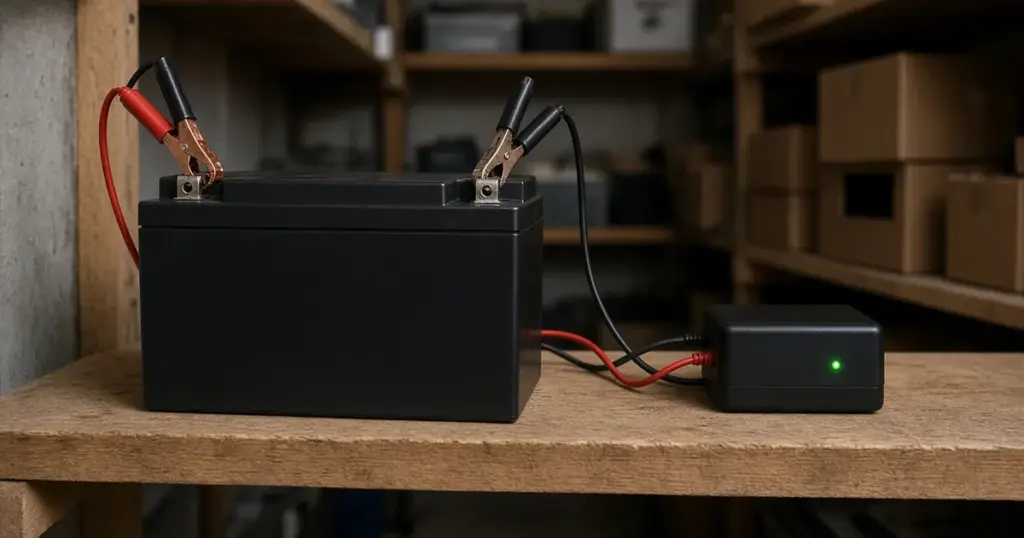
Off-season storage is where many lead-acid marine batteries quietly die. A battery that’s put away partly charged and forgotten until spring can sulfate, freeze or drain past the point of recovery. The good news is that proper storage is simple. This guide explains how to store flooded and AGM lead-acid marine batteries through the off-season so they’re ready to go in spring.
Why lead-acid storage matters
Lead-acid batteries self-discharge, typically 3% to 5% per month for flooded and somewhat less for AGM, faster in warm conditions. As they discharge:
- Sulfate crystals harden on the plates, permanently reducing capacity. See battery sulfation explained.
- Freezing risk increases. A discharged battery’s electrolyte is mostly water and can freeze, cracking the case. See can a marine battery freeze?.
Keeping the battery fully charged prevents both.
Step 1: Fully charge
Charge each battery fully with a smart charger set to the correct profile (flooded or AGM). Let it complete the absorption phase.
Step 2: Clean
- Clean terminals with baking soda solution and a wire brush.
- Wipe the battery top; dirt and moisture can create a slow discharge path between terminals.
- Apply terminal protectant.
Step 3: Water (flooded only)
After charging, check electrolyte levels and top up with distilled water to the correct level.
Step 4: Disconnect
Disconnect the battery from the boat’s electrical system to stop parasitic drains. Either:
- Remove the negative cable, or
- Remove the battery from the boat. See removing a boat battery for winter.
Step 5: Choose a storage location
- Cool and dry, ideally 40°F to 60°F. Cold slows self-discharge, but avoid freezing.
- Ventilated, especially for flooded batteries on a maintainer.
- Away from sparks and flames.
- Out of reach of children and pets.
- On a shelf or wooden surface for convenience. Modern battery cases won’t discharge on concrete, but a shelf keeps them clean.
Step 6: Maintain the charge
Option 1: Smart maintainer
A smart battery maintainer monitors voltage and applies a small charge as needed, keeping the battery full without overcharging. This is the best option. Make sure it’s set for the battery type.
Option 2: Periodic charging
If you can’t leave a maintainer connected, recharge every four to six weeks. Check voltage monthly, and recharge if it drops below about 12.4V.
Step 7: Check monthly
- Voltage (should stay at 12.6V or above on a maintainer)
- Water levels (flooded)
- Terminals and case condition
- Maintainer working
Flooded vs AGM storage
- Flooded: needs water checks and more frequent charging because of higher self-discharge. Ventilation is important while charging.
- AGM: lower self-discharge and no watering. Use an AGM profile; overcharging an AGM is harmful.
Compare the two in more detail in our AGM vs flooded maintenance guide.
Storing in the boat
If you leave batteries in the boat:
- Disconnect them or turn off the battery switch (confirm nothing bypasses it)
- Connect an onboard charger in maintenance mode, if available, with shore power
- Make sure the compartment is ventilated
- In freezing climates, keep the batteries fully charged
On boats in covered storage with power, an onboard charger like the EPOCH 4-bank charger can maintain several batteries at once. See trailer boat battery storage for trailered boats.
Storing trolling batteries
Series trolling banks should be disconnected from each other and from the motor, with each battery maintained individually. See storing trolling motor batteries.
Self-discharge rates
Knowing how fast your battery loses charge helps plan maintenance. See battery self-discharge rates.
Spring prep
- Charge fully.
- Check water (flooded).
- Load test.
- Clean terminals.
- Reinstall and reconnect.
Storing several batteries at once
If you’re storing a starting battery and a trolling bank, give each battery its own maintainer output or rotate a single maintainer between them every couple of weeks. Label each one so it goes back into the right spot in spring. Keep them a few inches apart on the shelf for airflow, with terminal covers on the positives.
Common mistakes
- Storing partly charged
- Leaving connected to the boat’s parasitic loads
- Using a non-smart charger left on all winter, which overcharges
- Wrong maintainer setting for AGM
- Forgetting water checks on flooded batteries
- Storing in a freezing location while discharged
Lithium comparison
Lithium batteries store differently: partial charge, disconnected, with no maintainer needed. See how to winterize a lithium battery.
Is it time to replace?
If your battery struggled last season, storage is a good time to test it and decide. Replacing in the off-season avoids a spring scramble. Options include the Interstate 27M AGM and the Trojan 31-AES AGM. Browse our AGM and lead-acid batteries.
Choosing a maintainer
Not every charger makes a good storage maintainer. Look for:
- Automatic float or maintenance mode that drops to a low voltage once the battery is full
- Battery type selection for flooded and AGM
- Low output, typically 1A to 3A, which is plenty to offset self-discharge
- Reverse polarity and short protection
- Weather resistance if it will be used in a shed or boat
Avoid old manual chargers that hold a constant voltage. Left on for months, they can boil a flooded battery dry or overcharge an AGM.
Storage voltage guide
Use resting voltage to track charge during storage:
- 12.7V or above: fully charged
- 12.5V: about 85%; fine
- 12.4V: about 75%; recharge soon
- 12.2V or below: about 50%; recharge immediately to avoid sulfation and freezing risk
Measure after the battery has rested off the charger for a few hours for accurate readings.
For the full storage guide covering all types, see winter storage for marine batteries and our marine battery maintenance guide.
Frequently asked questions
Should I leave my lead-acid battery on a charger all winter?
Yes, if it’s a smart maintainer set for the battery type. Avoid non-smart chargers left on indefinitely.
How often should I charge a stored lead-acid battery?
If not on a maintainer, every four to six weeks, or whenever voltage drops below about 12.4V.
Can I store a battery in the boat over winter?
Yes, if it’s disconnected and kept charged. In freezing climates, it must stay fully charged.
What temperature is best for storing batteries?
Cool and dry, ideally 40°F to 60°F, without freezing.
Do AGM batteries need a maintainer?
They self-discharge more slowly than flooded, but a maintainer set for AGM is still recommended for long storage.