


Sizing an Inverter for Your Boat’s House Bank
An inverter turns your boat’s DC battery power into 120V AC, so you can run household appliances, chargers and tools away from the dock. Choosing the right size matters: too small and it trips when you start the coffee maker; too big and you pay for capacity, idle losses and cabling you don’t need. This guide explains boat inverter sizing step by step, including the battery side that’s often overlooked.
Step 1: List the AC loads you’ll run at the same time
Inverter size is about the maximum combined load at any one moment, not total daily energy. List the AC loads you might run simultaneously and their wattage:
- Coffee maker or kettle.
- Microwave. Note that a microwave’s input power is usually higher than its cooking power rating; check the label.
- Hair dryer.
- TV and streaming device.
- Laptop and phone chargers.
- Power tools.
If you’ll never run the microwave and hair dryer together, you don’t need an inverter that can handle both.
Step 2: Account for surge
Motors and compressors draw a surge of current at startup that can be several times their running watts. Most inverters list a continuous rating and a short-term surge rating. Make sure the surge rating covers startup of motor loads like blenders, refrigerators, pumps and air conditioners. A soft-start device can reduce air conditioner startup surge substantially.
Step 3: Pick a size with margin
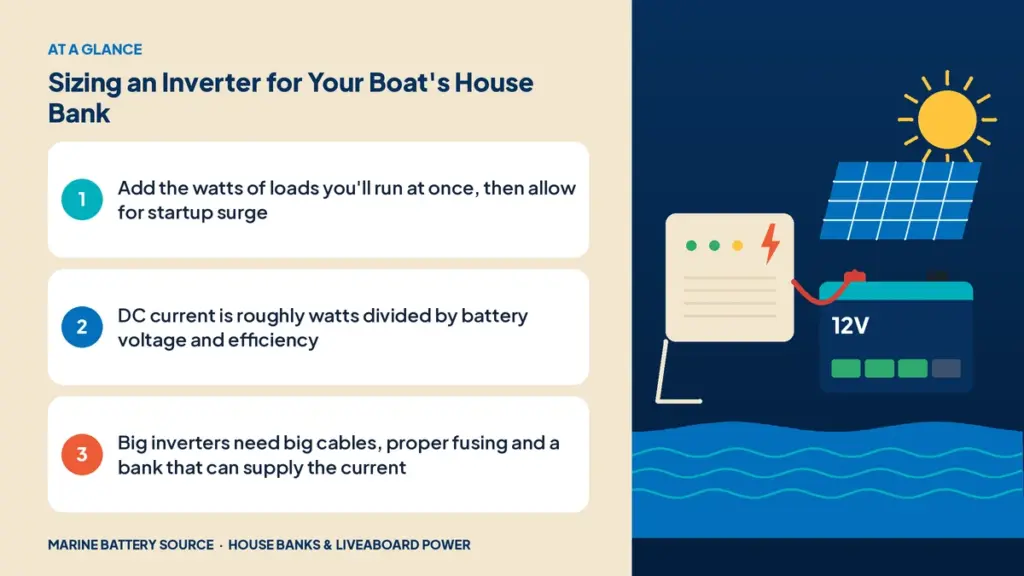
Choose an inverter whose continuous rating exceeds your largest simultaneous load with some margin, often 20% or so. Running an inverter continuously at its limit makes it hot and less efficient.
Step 4: Do the DC math
This is where many installations go wrong. The inverter pulls DC current from the battery:
DC amps ≈ AC watts ÷ battery voltage ÷ inverter efficiency
| AC load | 12V system (at ~90% efficiency) | 24V system | 48V system |
|---|---|---|---|
| 500W | about 46A | about 23A | about 12A |
| 1,000W | about 93A | about 46A | about 23A |
| 2,000W | about 185A | about 93A | about 46A |
| 3,000W | about 278A | about 139A | about 69A |
These are approximate. Actual efficiency varies with the inverter and the load.
At 12V, a 3,000W load pulls nearly 300A. That requires very heavy cables, a large fuse and a battery bank that can deliver that current continuously. That’s why larger AC systems often move to 24V or 48V; see 12V vs 24V house banks.
Step 5: Check the battery can deliver the current
Lead-acid
High currents reduce effective lead-acid capacity, and voltage sags under heavy load, which can trigger the inverter’s low-voltage shutdown. A bank of several large batteries in parallel spreads the load. Golf-cart 6V batteries in series pairs are a traditional choice; see 6V batteries for a house bank.
Lithium
Lithium holds voltage well under load, but each battery’s BMS has a maximum continuous discharge rating. The bank’s combined rating must exceed the inverter’s maximum DC draw. Check each battery’s spec. Large-format lithium batteries suited to inverter loads include:
- EPOCH 12V 460Ah Essential: 5.89 kWh in an 8D size, 84 lb, with Bluetooth and heating.
- EPOCH 24V 230Ah Essential: the same 5.89 kWh at 24V, halving the current for a given load.
- Dakota Lithium DL 12V 320Ah heated: 3,840 Wh, 200A maximum continuous listed.
Step 6: Size cables and fusing
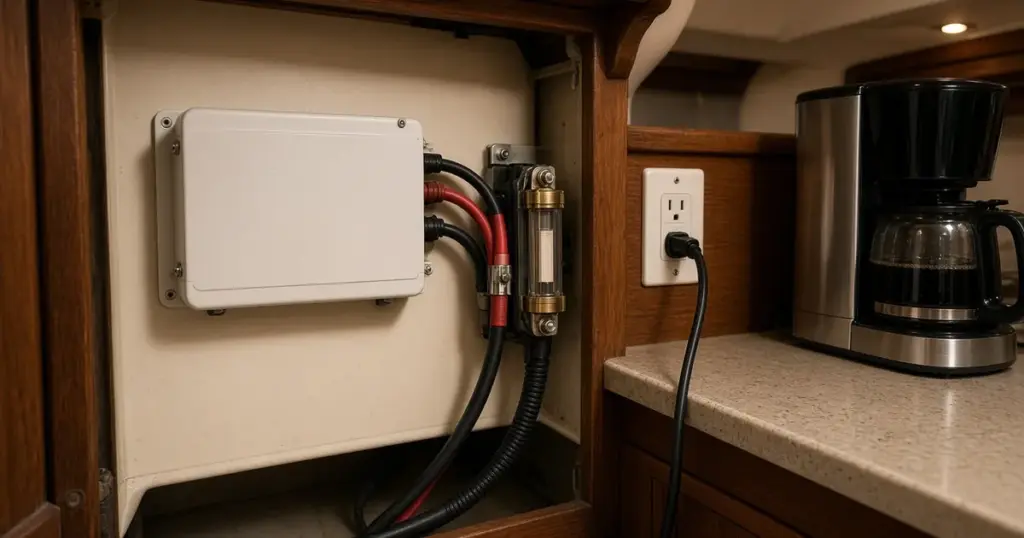
High DC current requires heavy cable, kept short. Follow the inverter maker’s cable size and fuse recommendations, which assume a specific cable length. Use a fuse rated for the DC current and the interrupting capacity required, mounted close to the battery. A Class T or similar high-interrupting-capacity fuse is often specified for large lithium banks. Keep the inverter close to the batteries to shorten the high-current cables.
Step 7: Choose sine wave type
Pure sine wave inverters produce clean AC that runs all household devices properly, including sensitive electronics and motors. Modified sine wave inverters are cheaper but can make some devices run hot, buzz or fail. On boats, pure sine wave is the standard choice.
Step 8: Consider inverter/chargers
An inverter/charger combines an inverter with a shore-power battery charger and an automatic transfer switch. When shore power or a generator is connected, it passes AC through and charges the batteries; when it’s disconnected, it inverts. That’s the most common setup on cruising boats.
Don’t forget idle draw
Inverters draw current even with no load, sometimes an amp or more at 12V. Over 24 hours, that can add up to a meaningful part of your daily budget. Switch the inverter off when not needed, or use a model with a low-power search mode.
Daily energy vs inverter size
An inverter’s size tells you what it can run at once. Your battery bank’s capacity tells you how long. Running a 1,000W load for an hour uses about 1,000Wh plus losses, roughly 93Ah at 12V. Add your inverter loads to your energy audit; see how to do a boat energy audit. A fridge running on AC through the inverter all day can use far more than a 12V compressor fridge; see powering a boat fridge.
Installation and safety
- Follow ABYC standards for AC and DC installations, including grounding and the AC neutral-to-ground bond.
- Install a transfer switch or inverter/charger so the inverter output can never back-feed shore power.
- Mount the inverter in a dry, ventilated space.
- Consider having a qualified marine electrician install larger systems.
Charging the bank after inverter use
Inverter loads can drain a bank quickly. Plan how you’ll recharge: shore power, generator, alternator or solar. For lithium banks, see charging lithium batteries on a boat.
Quick sizing example
A couple wants coffee, a microwave and laptop charging at anchor. The largest simultaneous load is the microwave plus a laptop. If the microwave’s input is about 1,200W, plus 100W for the laptop, a 2,000W pure sine inverter gives comfortable margin. At 12V that’s up to roughly 185A at full load, so the bank, fuse and cables must handle that.
For the bigger picture, read house bank sizing for overnight boating and running a boat air conditioner on batteries. Our pillar on sailboat and liveaboard battery systems covers complete systems. Browse house bank batteries.
Frequently asked questions
What size inverter do I need for my boat?
Add up the watts of AC loads you’ll run at the same time, add margin, and check the surge rating for motor loads.
How many amps does a 2,000W inverter draw at 12V?
Roughly 185A at full load, assuming about 90% efficiency. Actual draw depends on load and inverter efficiency.
Is a pure sine wave inverter necessary on a boat?
It’s strongly recommended. Pure sine wave power runs all devices properly; modified sine wave can cause problems with motors and electronics.
Can lithium batteries run an inverter?
Yes, and they hold voltage well under load. Make sure the bank’s combined continuous discharge rating exceeds the inverter’s maximum DC draw.