


Crappie Spider-Rigging and Long Trolling Days: Battery Planning
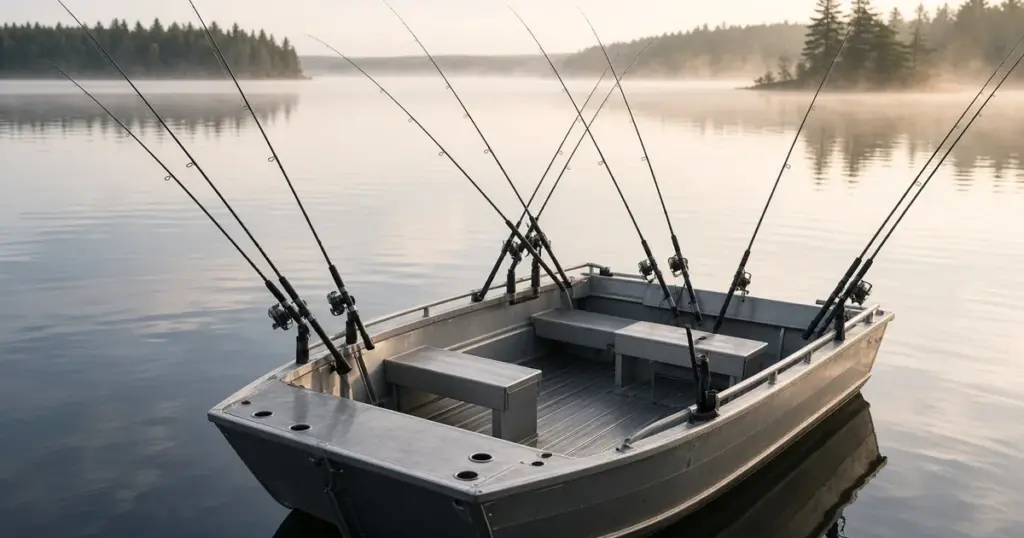
Spider rigging is one of the most effective ways to catch crappie. You set a fan of long rods off the bow and slowly push or pull baits through brush, along channel edges and over flats, often at well under 1 mph. It’s also one of the most consistent loads you can put on a trolling motor. Unlike bass fishing, where the motor stops and starts, a spider rigger may run the motor nearly the whole day. That makes battery capacity, not thrust, the deciding factor.
This guide explains how to size a trolling motor battery for spider rigging, how to power the electronics that go with it, and what changes in cold weather.
How spider rigging uses power
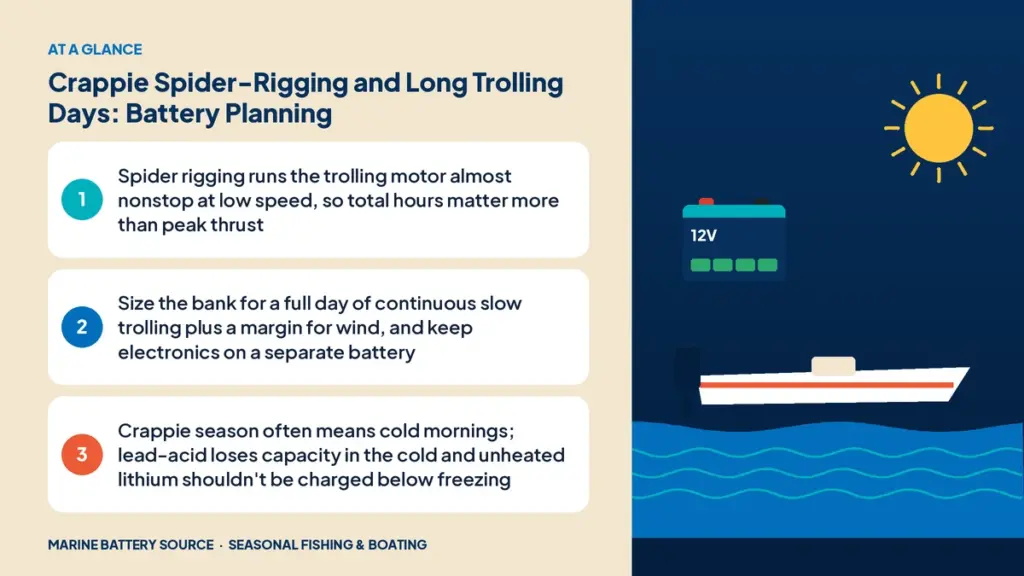
At very low speeds, a trolling motor draws relatively little current, often a small fraction of its maximum. The challenge is hours. A crappie angler might troll for eight hours or more with only short breaks. Wind makes it harder: keeping a slow, steady speed with a crosswind or into a breeze can push current draw up considerably, and spot-lock on a brush pile in wind uses even more.
| Factor | Effect on battery use |
|---|---|
| Hours of trolling | The biggest factor; nearly continuous use |
| Wind and current | Can double or triple draw on a breezy day |
| Boat size and load | Heavier boats with more anglers need more thrust |
| Pushing vs pulling | Pulling (stern first) may use the main motor’s kicker or a stern trolling motor |
| Spot-lock use | Frequent corrections add up |
Sizing the trolling bank
Start with the motor’s average current at your typical trolling speed. A battery monitor or a Bluetooth lithium battery will show this directly; it’s the best way to stop guessing. If you don’t have one, a rough estimate is 5–15A at slow speeds for many 12V and 24V motors in calm water, more in wind.
Then multiply by hours:
- 8A average × 8 hours = 64Ah per day at the motor’s voltage.
- 15A average × 8 hours = 120Ah.
Lead-acid batteries should only be discharged about 50% regularly, so a lead-acid bank needs about twice the capacity you plan to use. Lithium delivers most of its rated capacity. A 100Ah lithium battery at the right voltage covers many calm days; a windy day may need more.
For the full method, see fishing trip power planning.
12V, 24V or 36V?
The motor sets the voltage. Many crappie boats use 24V motors, with some 12V on smaller boats and 36V on larger ones. If you’re buying a new motor, higher voltage gives more thrust and usually better efficiency at the same power, but requires more battery weight with lead-acid. A single 24V or 36V lithium battery replaces two or three lead-acid batteries in a much smaller, lighter package. See battery setup by boat type for typical configurations.
Electronics for spider rigging
Crappie anglers often run large side-imaging and forward-facing sonar to find fish suspended over brush. These can draw several amps continuously. Running them from the start battery for eight hours can leave it too weak to crank. Options:
- A dedicated 12V lithium battery for electronics.
- A larger dual-purpose battery that handles cranking and electronics.
- A charging relay or DC-to-DC charger to recharge the electronics battery when the outboard runs.
If you also fish at night under lights, add those loads too; see night fishing lights.
Cold-weather crappie
Crappie bite well in cool weather, and many anglers fish winter and early spring. Cold affects batteries:
- Lead-acid loses capacity and cranking power as temperatures fall. A battery that lasts all day in fall may fall short on a freezing morning.
- Lithium discharges well in cold, but unheated LiFePO4 batteries shouldn’t be charged below freezing. Heated lithium batteries warm themselves before charging. If you charge in an unheated garage in winter, consider a heated model or bring batteries inside.
In Florida, winter crappie fishing on lakes and rivers rarely faces freezing charging conditions, but cooler water and air still reduce lead-acid performance on early mornings.
Multi-day crappie trips
Crappie trips to big reservoirs often last several days. Plan nightly charging with a multi-bank onboard charger and shore power at the campground or marina. See multi-day fishing trip batteries.
Measuring what you really use
The most useful upgrade for many crappie anglers isn’t a bigger battery but a way to measure. A shunt-based battery monitor, or the app on a Bluetooth lithium battery, shows how many amp-hours you used on a real day. After a few trips, you’ll know whether your bank is right-sized, too small for windy days, or larger than you need.
Tips to extend run time
- Troll at the slowest speed that presents baits well.
- Use the wind to drift when it pushes in the right direction.
- Keep the boat light; remove unneeded gear.
- Keep the motor’s prop clean of weeds and line.
- Check connections for corrosion, which wastes power as heat.
- Test each battery in a lead-acid series string; one weak battery limits the whole bank.
Spider rigging vs bass fishing
Bass anglers often run the motor harder but in shorter bursts, and they rely on big thrust in wind. Spider riggers run softer but longer. Both need a well-sized bank, but crappie anglers benefit even more from lithium’s usable capacity. For bass comparisons, see bass tournament battery planning. Offshore anglers face a different mix of big electronics and livewells; see offshore electronics.
Season planning
Plan maintenance before crappie season peaks: test capacity, clean terminals, update charger settings and replace weak batteries. See the seasonal battery calendar.
Products that help
- EPOCH 24V 60Ah Pro lithium battery
- EPOCH 36V 50Ah lithium battery
- Dakota Lithium 12V 135Ah heated dual-purpose battery
- Browse trolling motor batteries.
Frequently asked questions
What size battery do I need for spider rigging?
Multiply your average trolling current by hours of use, add a margin for wind, and size for usable capacity: about 50% for lead-acid, most of the rating for lithium.
Why does spider rigging drain my battery so fast?
The motor runs almost nonstop, and wind makes it work harder to hold a slow, steady speed.
Is lithium better for crappie fishing?
For long days of slow trolling, lithium’s usable capacity and steady voltage are a big advantage.
Can I charge lithium in the cold?
Unheated LiFePO4 batteries shouldn’t be charged below freezing. Heated models warm themselves before charging.
Should electronics run off the trolling battery?
Usually not. Most electronics run on 12V from the start or a dedicated house battery.