


Winter Fishing in Florida: Battery Tips for Cold Fronts

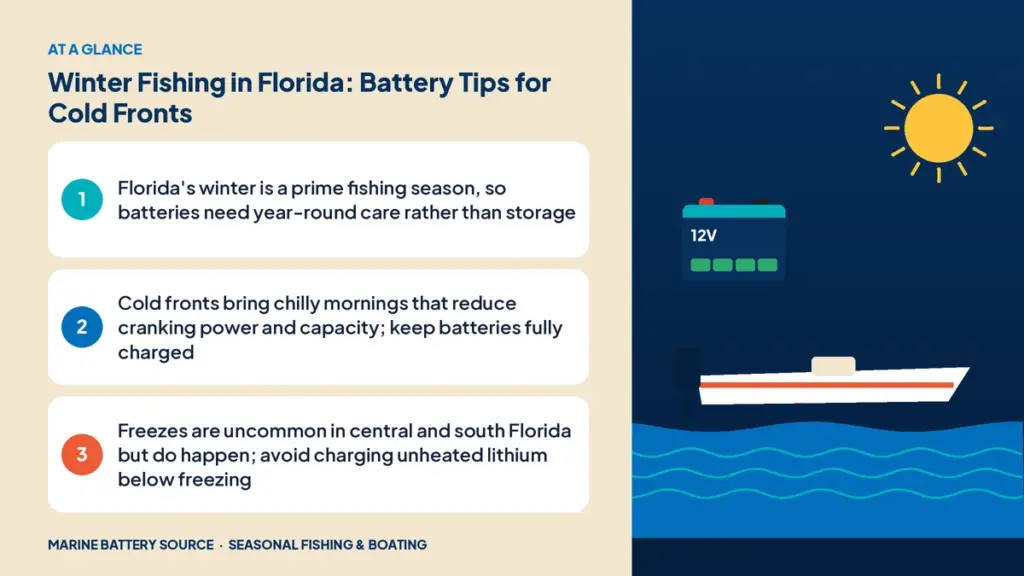
While northern boaters winterize, Florida anglers keep fishing. Winter brings cooler weather, clearer water and some of the year’s best fishing for many species. It also brings cold fronts, gusty winds and occasional chilly mornings that test batteries. This guide covers how to keep batteries strong through Florida’s winter season.
Florida winter conditions
Most of Florida’s winter is mild, but cold fronts regularly sweep through, bringing north winds, falling temperatures and a few chilly days. North Florida sees freezes more often; Tampa Bay and Sarasota see them occasionally, and South Florida rarely. Mornings in the 40s are common after a front, and the wind often blows hard for a day or two.
Cold and lead-acid batteries
Cold slows the chemistry in lead-acid batteries:
- Cranking power drops. A battery that starts the engine easily in July may crank slowly on a 40-degree morning.
- Available capacity drops. Trolling batteries deliver somewhat less in the cold.
- A partly discharged battery is affected more than a fully charged one.
Keep start and trolling batteries fully charged, especially before a front. A fully charged 12V flooded battery reads about 12.6–12.7V at rest.
Cold and lithium batteries
LiFePO4 batteries can discharge in cool weather, but they generally shouldn’t be charged below freezing unless they have internal heating. On most Florida winter mornings, temperatures stay above freezing, so this rarely matters. On the occasional freeze, especially in North Florida:
- Don’t charge an unheated lithium battery until it warms above freezing.
- Heated models, such as EPOCH Essential batteries and the Dakota DL+ 135Ah Heated, handle cold charging automatically.
- If your charger or BMS stops charging in the cold, that’s protection working, not a fault.
Wind and longer trolling days
Winter fronts bring wind, and wind means heavy trolling motor use for spot-lock and boat control. If you’re holding position on a flat or a dock line in 15-knot north winds, expect higher average draw than on a calm summer day. Size capacity accordingly, and check state of charge at midday. See fishing trip power planning.
Year-round maintenance
Because Florida batteries never get a rest, they need regular care all year:
- Check charge and connections monthly.
- Keep chargers or maintainers connected between trips.
- Check flooded water levels; even in winter, Florida’s warmth means some water loss.
- Clean terminals and apply protectant, especially on saltwater boats.
See the seasonal battery calendar for a full plan.
Winter is a good time to test
After a long, hot summer and a busy fall, winter is a good time for a thorough battery check. Load test start batteries, check trolling batteries’ capacity and replace any that are weak before spring.
Snowbirds and seasonal boats
If you only use your Florida boat in winter, the boat likely sat through the summer. Before your first trip:
- Fully charge every battery.
- Test them; summer storage in Florida heat is hard on lead-acid.
- Check for corrosion and parasitic drains.
- Replace batteries that fail.
When you leave in spring, set the boat up for summer storage with a maintainer or with batteries disconnected. See summer battery tips.
Winter species, winter power
Many Florida winter fisheries involve long days of slow trolling, drifting or holding position: sheepshead on structure, trout on deeper flats, and inshore species in canals and rivers on cold days. Plan battery capacity for slow, steady fishing with plenty of spot-lock.
Electronics in winter
Clear winter water often means anglers rely more on sonar and live imaging to find fish in deeper, slower spots. Large displays and live sonar can draw several amps each for the whole day. If you’ve added electronics since last winter, recheck your daily load and consider a dedicated electronics battery so the trolling motor and start battery aren’t sharing that burden.
Boats kept on lifts and in dry storage
Many Florida boats live on lifts or in dry-stack storage. Lift boats often have no shore power at the boat, so batteries rely on the engine or a portable charger. Check charge before every trip, and turn the battery switch off when you leave. For dry-stack boats, ask the marina whether they can connect a maintainer, or plan a charging routine. Winter’s cooler temperatures slow self-discharge a little, but a parasitic drain can still flatten a battery over a few weeks.
Holiday trips and gifts
Winter includes the holidays, when many families fish and cruise. If you’re shopping for a boater, a charger, battery monitor or lithium upgrade makes a practical gift.
Looking ahead to spring
Spring brings tournament season and busy holiday weekends. Use winter to get batteries ready:
- Replace weak batteries now, before the spring rush.
- Plan lithium upgrades and charger changes.
- Review the Memorial Day checklist and Fourth of July power tips ahead of the busy season.
- Revisit fall fishing tips to compare how your batteries held up.
Local installation
We offer flat-price installation (from $99 per battery) anywhere from Venice to Gainesville, FL. When you book our installation, we take your old battery and waive the core charge. See our local installation page.
Winter checklist
- ☐ Batteries fully charged before fronts
- ☐ Start battery tested for cool mornings
- ☐ Unheated lithium not charged below freezing
- ☐ Trolling capacity sized for windy days
- ☐ Monthly maintenance continued
- ☐ Weak batteries replaced before spring
Products mentioned
Frequently asked questions
Do I need to winterize my boat batteries in Florida?
Usually not. Keep them charged and maintained year-round instead.
Can I charge my lithium battery on a cold Florida morning?
Yes, if it’s above freezing. On a freeze, wait or use a heated battery.
Why does my boat crank slowly on cold mornings?
Cold reduces cranking power, especially if the battery is partly discharged or aging.
Does wind affect trolling battery life?
Yes. Holding position in wind increases average draw significantly.
When should I replace batteries in Florida?
Winter is a good time to test and replace, before the busy spring season.