


Preventing Electrical Fires on Boats
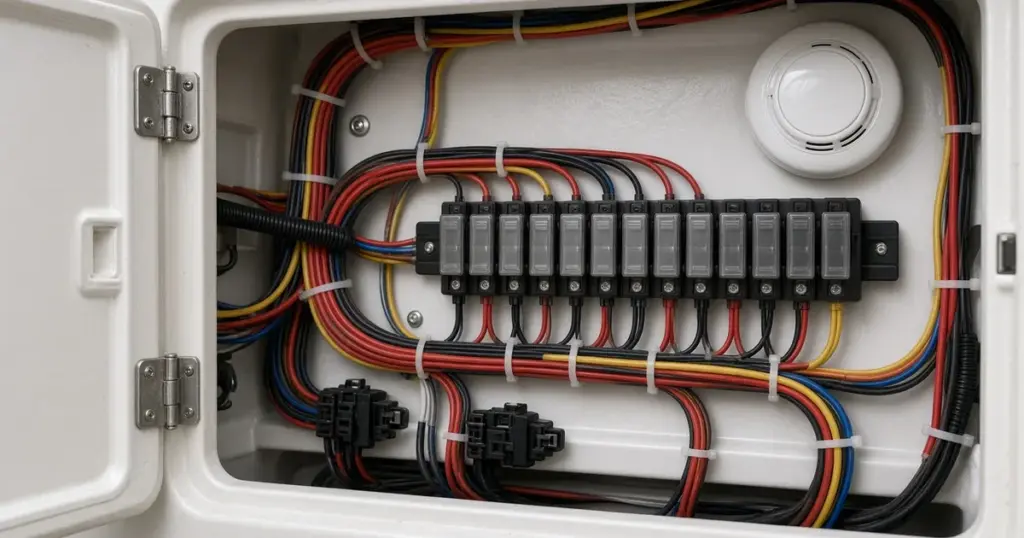
Electrical faults are a leading cause of boat fires, and many of them start at or near the batteries. The good news is that most are preventable with sound installation and regular inspection. This guide explains the common causes and the habits that prevent them.
How electrical fires start
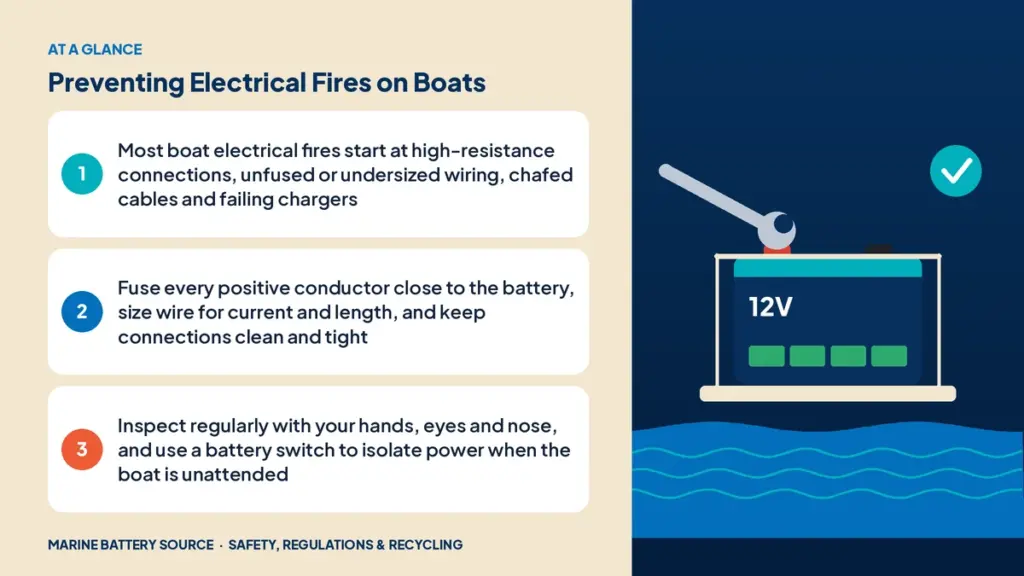
High-resistance connections. A loose, corroded or poorly crimped connection resists current flow, turning electrical energy into heat. Over time, it can get hot enough to melt insulation and ignite nearby materials. This is the most common cause.
Short circuits. A chafed cable rubbing through its insulation against a metal part or another conductor can draw huge current. Without a fuse, the cable itself becomes a heating element.
Overloaded wiring. Wire that’s too small for the current, or circuits with more loads added over the years, run hot.
Charger and inverter faults. Failing chargers, wrong charger settings or poorly ventilated inverters can overheat. Overcharging can also overheat batteries; see overcharging a boat battery.
Water and corrosion. Saltwater intrusion into connections and fuse holders speeds corrosion and creates leakage paths.
DIY additions. Accessories wired directly to the battery without fuses, household wire, wire nuts and twisted connections are common culprits.
Prevention 1: Fuse close to the battery
Every positive conductor leaving the battery, except the engine cranking cable, should have a fuse or breaker as close to the battery as practical. ABYC’s E-11 standard sets a general limit of seven inches, with exceptions. Terminal-mounted fuses, such as MRBF fuses, make this easy. Size each fuse to protect the wire, not the device.
Prevention 2: Size wire correctly
Wire size depends on current and the total round-trip length of the circuit. Undersized wire overheats and causes voltage drop. Use marine-grade tinned copper wire and size it for no more than about 3% voltage drop on critical circuits like navigation lights and electronics, and 10% on less critical loads. Wire size charts from wire makers and ABYC make this straightforward.
Prevention 3: Make good connections
- Use crimp terminals sized for the wire and crimped with the right tool.
- Seal connections with adhesive-lined heat shrink.
- Use ring terminals on studs and bolts, not spade or fork terminals for high-current connections.
- Torque battery terminal nuts to the maker’s spec.
- Don’t stack too many ring terminals on one stud; use a bus bar or distribution block.
- Avoid wire nuts and twisted connections.
Prevention 4: Protect wiring from chafe
Support cables every 18 inches or so, use grommets where wires pass through bulkheads, and keep wires away from sharp edges, moving parts and hot engine components. Check for chafe where wiring bends or rubs.
Prevention 5: Use a battery switch
A battery switch lets you cut power when the boat is unattended, so a fault can’t develop while no one’s watching. Leave only essential circuits, like automatic bilge pumps, on the battery side, with their own fuses. See what a marine survey checks for how surveyors look at switches.
Prevention 6: Use the right chargers
Use marine-rated chargers with the correct profile for each battery. Mount them where they get airflow, and keep their DC output fused near the battery. Replace chargers that run unusually hot or show fault lights you can’t clear.
Prevention 7: Inspect regularly
At least each season, and after any electrical work:
- Look for discolored insulation, melted terminal boots, green corrosion and chafe.
- Feel cables and connections after running high loads, carefully, with the back of your hand. Warm is a warning; hot is a problem.
- Smell for hot plastic or burning insulation.
- Tug gently on connections to check they’re tight.
- Measure voltage drop across connections under load with a multimeter. More than a few tenths of a volt across a single connection suggests resistance.
An infrared thermometer is a handy way to spot hot connections.
Lithium-specific points
LiFePO4 batteries can deliver very high current into a fault, so fuses must have an interrupt rating suited to lithium. Terminal-mounted marine-rated fuses or Class T fuses are common. See lithium battery fire safety.
What to do if you smell burning
- Turn off the battery switch and disconnect shore power.
- Shut down the engine and chargers.
- Locate the source if it’s safe to do so.
- Have your fire extinguisher ready, and call for help if there’s smoke or fire.
- Don’t restore power until the fault is found and fixed.
Safety gear
Keep a marine-rated fire extinguisher near the helm or entrance, and protective gear for battery work. See battery handling safety gear.
Acid and corrosion
Acid spills and vapors corrode connections near batteries, creating the high resistance that causes fires. Clean up spills promptly; see battery acid spill cleanup.
Disposing of damaged batteries
Batteries damaged in a fire or electrical fault should be recycled through proper channels. See marine battery recycling.
Inspection checklist
- ☐ Every positive conductor fused near the battery (except cranking)
- ☐ Fuse sizes match wire sizes
- ☐ Wire sized for current and length
- ☐ Crimped, sealed terminals; no wire nuts
- ☐ Cables supported and protected from chafe
- ☐ Terminals clean, tight and covered
- ☐ Battery switch working
- ☐ Chargers ventilated and fused
- ☐ No hot spots under load
- ☐ Fire extinguisher accessible and charged
More reading
The marine battery safety guide covers safe installation and handling, and marine battery switch basics explains switch types.
Products that help
- Battle Born marine-rated MRBF fuse
- Battle Born MRBF fuse block
- EPOCH power distribution block
- Browse marine chargers.
Frequently asked questions
What causes most boat electrical fires?
Loose or corroded high-resistance connections, followed by short circuits, undersized wire and charger faults.
Where should fuses go on a boat?
On each positive conductor, as close to the battery as practical. ABYC’s general limit is seven inches, with exceptions.
Does the starter cable need a fuse?
Cranking motor conductors are exempt from the overcurrent protection requirement in ABYC E-11.
How do I find a hot connection?
Feel carefully after running loads, look for discoloration, or use an infrared thermometer.
Should I turn off my battery switch when I leave the boat?
Yes, leaving only essential circuits like bilge pumps powered through their own fuses.