


What Marine Surveyors Look for in Battery Installations
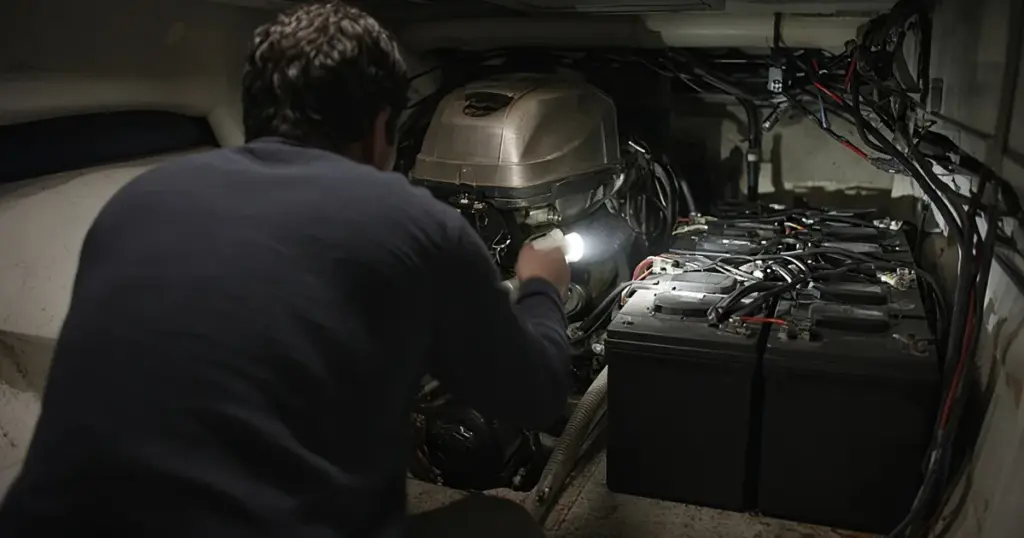
Whether you’re buying a boat, insuring it or financing it, a marine survey is likely, and the battery installation is one of the first places a surveyor looks. Battery findings are among the most common items on survey reports, and most are inexpensive to fix. This guide explains what surveyors typically check and how to prepare.
What surveyors measure against
Surveyors usually compare a boat with ABYC standards and, for many gasoline boats, U.S. Coast Guard regulations in 33 CFR Part 183. See the ABYC battery standards overview and Coast Guard battery requirements. Survey reports often list findings by priority, with safety items at the top. Insurers may require those items to be corrected.
Battery securing
Surveyors check that each battery is in a tray or box and held down with a strap or bracket. A battery that moves when pushed or lifted is a common finding. The standard benchmark is no more than one inch of movement under a pulling force of 90 pounds or twice the battery’s weight, whichever is less.
Terminal protection
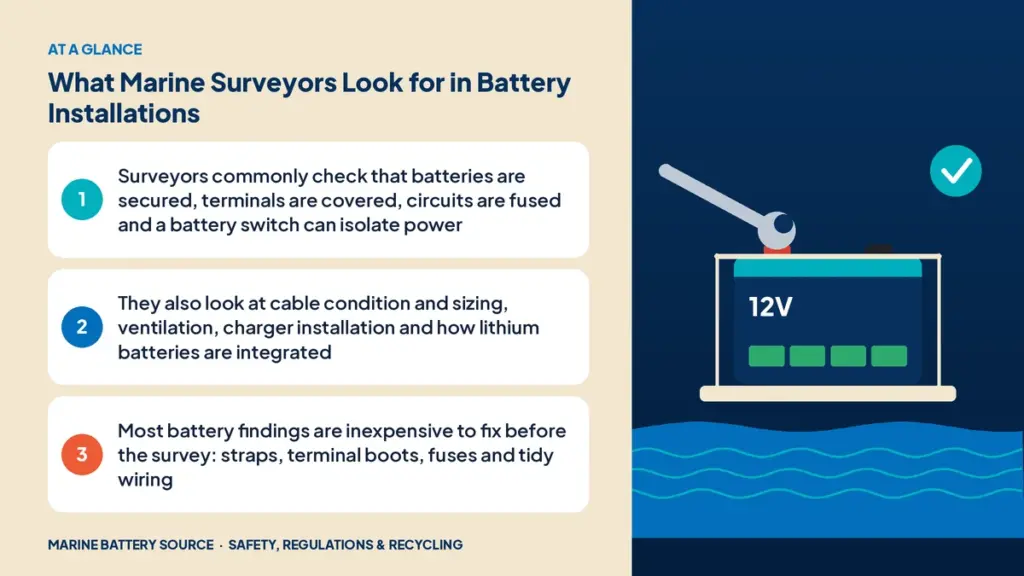
Uncovered positive terminals are another very common finding. Surveyors look for terminal boots, covered battery boxes or dedicated battery compartments that prevent accidental contact.
Battery location
Surveyors check that batteries aren’t directly above or below fuel tanks, filters or fuel fittings, are protected from water and bilge flooding, and are reasonably accessible for inspection and service.
Overcurrent protection
A surveyor will look for fuses or breakers close to the battery on positive conductors, except cranking cables. Unfused accessory wires connected directly to battery terminals are a frequent finding, often from DIY installations of fish finders, stereos and lights. See boat electrical fire prevention.
Battery switches
Surveyors check for a battery switch that can disconnect each battery or bank, that it’s accessible and correctly rated, and that it works. They’ll also note which circuits bypass the switch, such as bilge pumps, and whether those circuits are fused. See marine battery switch basics.
Cables and connections
Common findings:
- Corroded or loose terminals
- Too many ring terminals stacked on one stud
- Wing nuts on high-current connections
- Cables without proper support or chafe protection
- Undersized cables for the load
- Household wire, wire nuts or twisted connections
- Melted or discolored insulation
Ventilation
For flooded lead-acid batteries, surveyors check that the compartment is ventilated and the battery box vents are clear. See battery hydrogen gas and ventilation.
Chargers
Surveyors check that onboard chargers are marine-rated, securely mounted, ventilated and fused on their DC outputs, and that settings match the battery chemistry. Chargers that are hot, corroded or showing faults may be noted. Overcharging evidence, such as swollen batteries or heavy gassing, is a red flag. See overcharging a boat battery.
Battery condition
Surveyors may note battery age, case condition, swelling, leaks and corrosion. Some test voltage or load, and many will ask when the batteries were last replaced. A battery with a date code several years old might be flagged as near end of life.
Lithium installations
Lithium conversions are getting more attention in surveys. Surveyors may look for:
- Batteries from recognized makers with documented BMS protections
- Overcurrent protection suited to lithium’s high fault current
- Chargers and alternator charging set up for LiFePO4, often with a DC-DC charger
- Secure mounting and appropriate IP rating for the location
- Documentation of the installation
ABYC’s E-13 standard covers lithium-ion batteries, and some insurers have their own requirements for lithium installations. If you’ve converted to lithium, keep records of who installed it and what components were used.
How to prepare for a survey
- Secure every battery with a strap or bracket.
- Cover positive terminals.
- Fuse unfused accessory wires close to the battery.
- Clean and tighten terminals; replace corroded cable ends.
- Tidy wiring: support cables, add chafe protection, remove abandoned wires.
- Check the battery switch works and is labeled.
- Clear ventilation openings.
- Confirm charger settings match the batteries.
- Gather documentation: battery purchase dates, charger manuals and any installation records.
After the survey
Review the findings with your surveyor. Many battery items are quick DIY fixes. For larger issues, such as relocating batteries, rewiring or lithium integration, use a qualified marine electrician and keep records to show your insurer.
Recycling replaced batteries
If the survey leads you to replace old batteries, recycle them properly; see marine battery recycling.
Typical survey findings and fixes
| Finding | Typical fix |
|---|---|
| Battery not secured | Add a tray, box strap or bracket |
| Positive terminal uncovered | Fit terminal boots or a covered box |
| Unfused accessory wiring | Add a terminal fuse or fuse block close to the battery |
| Corroded terminals | Clean, replace cable ends, apply protectant |
| No battery switch, or a faulty one | Install or replace a correctly rated switch |
| Charger set to wrong chemistry | Change settings or replace the charger |
Buyer’s tip
If you’re buying a boat, the battery section of the survey tells you a lot about how the boat has been maintained. Tidy, fused, labeled wiring usually means a careful owner. A tangle of unfused wires suggests other shortcuts too.
Seller’s tip
If you’re selling, spend an afternoon on the battery compartment before the buyer’s survey. A clean, secure, well-labeled installation makes a good first impression and avoids price renegotiation over small items.
More reading
The marine battery safety guide covers safe installation and handling.
Products that help
- Battle Born marine-rated MRBF fuse
- Battle Born MRBF fuse block
- Dakota Lithium group 24 battery tray
- EPOCH power distribution block
Frequently asked questions
What do surveyors look for in a battery installation?
Secure batteries, covered terminals, fuses near the battery, a working battery switch, sound cables, ventilation and proper chargers.
Will a survey fail my boat for uncovered terminals?
Surveys don’t usually pass or fail, but uncovered terminals are a common safety finding insurers may require you to fix.
Do surveyors check lithium batteries?
Increasingly, yes. Keep documentation of the installation and components.
How can I prepare my batteries for a survey?
Secure them, cover terminals, fuse accessory wires, clean connections and confirm charger settings.
Does battery age matter in a survey?
Surveyors may note old batteries as near end of life.