


Coast Guard Battery Requirements for Recreational Boats

Boat owners often ask what the U.S. Coast Guard actually requires for batteries. The main federal rule is in Title 33 of the Code of Federal Regulations, Part 183, the electrical system requirements that builders of many recreational boats must meet. This guide explains the battery section in plain terms and what it means for owners. It’s a summary for general information, not legal advice; read the current regulation text and consult a qualified marine professional for your situation.
Who the rule applies to
33 CFR Part 183 sets construction standards for recreational boats. The electrical system subpart applies mainly to boats with gasoline engines for propulsion, generation or mechanical power, because gasoline vapors create a fire and explosion risk. Builders must comply when the boat is built. Owners aren’t usually inspected against Part 183, but following it is good practice, and surveyors and insurers often look for it. ABYC standards cover similar ground for a wider range of boats; see the ABYC battery standards overview.
The battery rule: 33 CFR 183.420
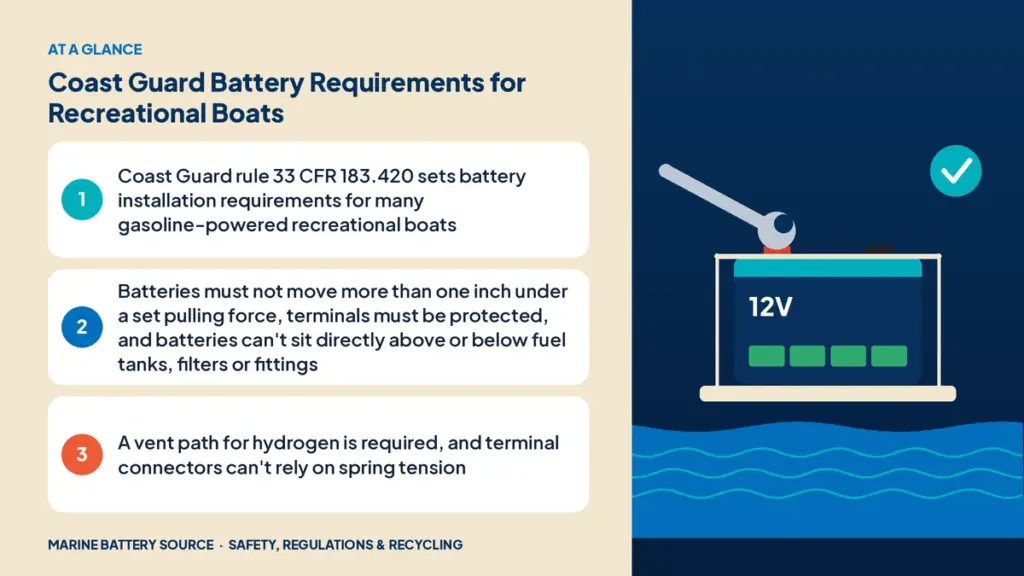
Section 183.420 covers batteries. Its requirements, summarized:
1. Batteries must be secured. Each installed battery must not move more than one inch in any direction when a pulling force of 90 pounds, or twice the battery’s weight, whichever is less, is applied through its center of gravity. The force is applied vertically for one minute, fore and aft for one minute each, and to port and starboard for one minute each.
2. Terminals must be protected. Each battery must be installed so metallic objects can’t contact the ungrounded battery terminals. On most boats, that’s the positive terminal.
3. Fuel lines near batteries must be shielded. Each metallic fuel line and fuel system component within 12 inches of the battery and above the horizontal plane of the battery top must be shielded with dielectric (non-conductive) material.
4. No batteries directly above or below fuel components. A battery must not be directly above or below a fuel tank, fuel filter or fitting in a fuel line.
5. Hydrogen must be vented. A vent system or other means must let hydrogen gas released by the battery discharge from the boat.
6. No spring-tension terminal connectors. Battery terminal connectors must not depend on spring tension for their mechanical connection. Clamp-style connectors tightened with a nut and bolt, or ring terminals on studs, meet this; spring clips don’t.
What this means in practice
| Requirement | Common way to meet it |
|---|---|
| Secured battery | Battery box or tray with a strap, or a bolted bracket |
| Terminal protection | Terminal boots or a covered battery box |
| Fuel line shielding | Keep metal fuel components away, or shield them |
| Fuel clearance | Locate batteries away from tanks, filters and fittings |
| Ventilation | Vented battery box and a ventilated compartment |
| Terminal connectors | Bolted clamps or ring terminals on studs |
Why each rule matters
- Securing: a loose battery can short against metal, crack and leak, or pull its cables loose in rough water.
- Terminal protection: a dropped tool or a loose metal object can short the positive terminal to ground, causing sparks and intense heat.
- Fuel separation: sparks at battery terminals and gasoline vapors are a dangerous combination.
- Ventilation: flooded lead-acid batteries release hydrogen during charging; trapped hydrogen can ignite. See battery hydrogen gas and ventilation.
- Bolted connectors: spring clips can loosen and arc.
Other Part 183 electrical rules that affect batteries
Part 183’s electrical subpart also includes rules on ignition protection for electrical components in gasoline engine and fuel tank spaces, conductor insulation and sizing, and overcurrent protection for circuits. In practice, that means using ignition-protected components in gasoline engine compartments, correctly sized marine wire and fuses or breakers on circuits. See boat electrical fire prevention.
Does the rule cover lithium batteries?
Section 183.420 doesn’t distinguish battery chemistries. Securing, terminal protection and fuel separation make sense for any battery. Lithium batteries don’t vent hydrogen in normal use, but they have their own installation needs, such as proper overcurrent protection and BMS behavior, which ABYC’s E-13 standard addresses. See lithium battery fire safety on boats.
Coast Guard safety checks
Coast Guard boardings and Coast Guard Auxiliary vessel safety checks focus on safety equipment such as life jackets, fire extinguishers, visual distress signals and navigation lights. A vessel safety check may also look at general electrical and fuel system condition, including whether batteries are secured and terminals covered. Check the current vessel safety check list for details.
Owner checklist
- ☐ Each battery in a tray or box with a strap or bracket
- ☐ Battery can’t move more than about an inch when you push and pull it firmly
- ☐ Positive terminals covered with boots or a covered box
- ☐ No battery directly above or below a fuel tank, filter or fuel fitting
- ☐ No unshielded metal fuel components close above the battery
- ☐ Battery compartment vented
- ☐ Terminal connectors bolted, not spring clips
If your boat doesn’t meet these
Older boats and DIY installations often fall short on terminal covers, straps or ventilation. Most fixes are inexpensive: a battery box, a strap, terminal boots and proper connectors. If a battery sits near fuel components, relocating it is worth the effort. For larger changes, consult a marine electrician. A survey will often note these items; see what a marine survey checks on batteries.
Disposing of the old battery
If you replace batteries while making these upgrades, recycle the old ones properly. See marine battery recycling.
More reading
The marine battery safety guide covers installation and handling safety in one place.
Products that help
- Dakota Lithium group 24 battery tray
- EPOCH group 31 battery tray
- Battle Born marine-rated MRBF fuse
- Browse battery accessories.
Frequently asked questions
What Coast Guard rule covers boat batteries?
33 CFR 183.420, part of the electrical system requirements for many gasoline-powered recreational boats.
How secure must a boat battery be?
It must not move more than one inch under a pulling force of 90 pounds or twice its weight, whichever is less.
Can a battery be installed above a fuel tank?
No. The rule prohibits batteries directly above or below a fuel tank, fuel filter or fuel line fitting.
Are spring-clip battery connectors allowed?
No. Terminal connectors must not depend on spring tension.
Does the rule require battery ventilation?
Yes. A vent system or other means must let hydrogen discharge from the boat.