


Marine Battery Safety: The Essential Guide
Boat batteries store a lot of energy in a small, often hard-to-reach space, surrounded by fuel, water and vibration. Most battery problems on boats are preventable with good installation and a few safe habits. This guide covers the essentials, with links to detailed articles on each topic. It’s general guidance; for installation standards, follow the battery maker’s instructions and current ABYC standards, and use a qualified marine electrician for complex work.
1. Secure every battery
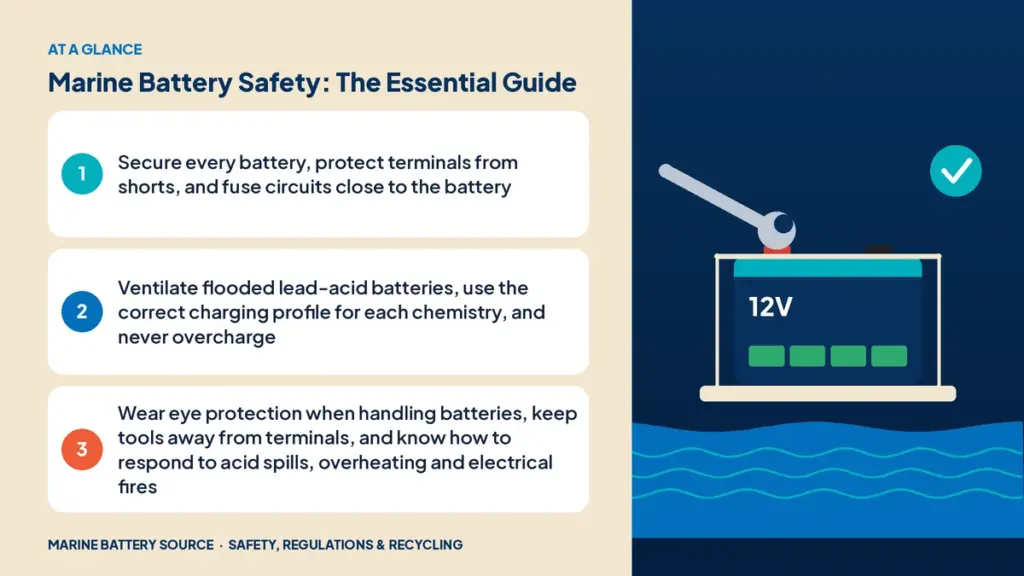
A loose battery can short against metal, crack its case, or break cables in rough water. Every battery should be held in a tray or box with a strap or bracket so it can’t shift. U.S. Coast Guard rules for many gasoline boats and ABYC standards set specific limits on battery movement. See Coast Guard battery requirements and the ABYC battery standards overview.
2. Protect the terminals
A wrench dropped across terminals can cause a dangerous short, with sparks, molten metal and burns. Cover positive terminals with boots or use a covered battery box. Keep metal tools and jewelry away from terminals, and remove rings and watches before working on batteries.
3. Fuse close to the battery
Circuit protection, a fuse or breaker, belongs as close to the battery as practical on each positive conductor, so a short in the wiring can’t turn a cable into a heating element. Starting circuits have special rules; follow your engine maker’s guidance. See boat electrical fire prevention.
4. Ventilate lead-acid batteries
Flooded lead-acid batteries release hydrogen and oxygen during charging, especially when overcharged. Hydrogen is explosive in fairly low concentrations. Battery compartments need ventilation, and sparks or flames must be kept away. AGM batteries vent much less under normal charging but can still vent if overcharged. Read battery hydrogen gas and ventilation.
5. Charge correctly
Overcharging heats batteries, boils electrolyte in flooded types, can damage AGM batteries, and can stress lithium batteries if the BMS or charger fails. Use a charger with the right profile for each chemistry, check alternator output, and replace faulty chargers. See overcharging a boat battery.
6. Understand lithium safety
LiFePO4 is the most thermally stable common lithium chemistry and is widely used on boats. Still, a lithium battery stores a lot of energy and relies on its BMS for protection. Buy from reputable brands, follow installation instructions, use correctly sized fuses and cables, and don’t charge unheated lithium batteries below freezing. See lithium battery fire safety on boats.
7. Handle batteries safely
Batteries are heavy, and lead-acid batteries contain sulfuric acid.
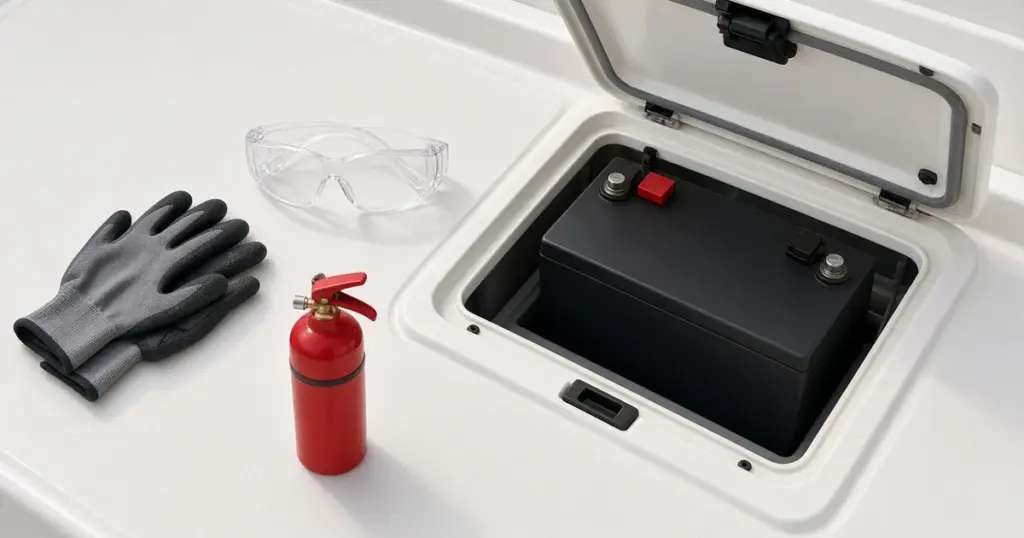
- Wear safety glasses or goggles and gloves.
- Lift with your legs, and get help with heavy batteries.
- Keep batteries upright, especially flooded types.
- Carry them by the handles or in a carrier, never by the terminals.
See battery handling safety gear for a kit list.
8. Clean up acid spills properly
If a lead-acid battery leaks or spills, neutralize the acid with baking soda and water, wear protection, and dispose of the waste properly. Flush skin or eyes with plenty of clean water and get medical help if needed. See battery acid spill cleanup.
9. Inspect regularly
Before each season and periodically during it, check:
- Batteries are secure and cases aren’t cracked or swollen.
- Terminals are clean, tight and covered.
- Cables aren’t chafed, corroded or hot.
- Fuses and breakers are the right size and in good condition.
- Ventilation openings aren’t blocked.
A marine surveyor will look at many of the same items. See what a marine survey checks on batteries.
10. Retire and recycle old batteries properly
Old batteries are more likely to fail, leak or overheat. Replace batteries that won’t hold a charge, have swollen cases or show heavy corrosion. Recycle them properly; lead-acid batteries are among the most recycled products in the U.S. See marine battery recycling.
Saltwater and corrosion
Salt air and spray speed up corrosion on terminals, lugs and fuse holders. Corroded connections add resistance, which causes heat and voltage drop. Clean terminals with a wire brush, coat them with a protectant spray, and replace green or crumbling cable ends. Keep batteries out of bilge water.
Working on batteries: safe sequence
- Turn off all loads and the battery switch.
- Disconnect shore power and chargers.
- Remove the negative cable first, then the positive.
- Do the work.
- Reconnect the positive first, then the negative.
- Refit terminal boots and covers.
- Test the system before leaving the dock.
In an emergency
- Smoke or burning smell from the battery area: turn off the battery switch if you can do so safely, shut down chargers and the engine, and prepare a fire extinguisher. If there’s fire, follow your boat’s emergency plan, and call for help on VHF channel 16 or 911.
- Hot or swelling battery: disconnect charging sources if you can do so safely and keep people away. Don’t try to move a battery that’s venting or burning.
- Acid in the eyes: flush with clean water for at least 15 minutes and get medical help.
Keep a marine-rated fire extinguisher accessible near the helm, not inside the battery compartment.
Safety checklist
- ☐ Batteries secured in trays or boxes
- ☐ Positive terminals covered
- ☐ Circuits fused close to the battery
- ☐ Compartment ventilated for flooded batteries
- ☐ Chargers set to the correct chemistry
- ☐ Cables sized correctly, in good condition
- ☐ Safety glasses and gloves on board
- ☐ Fire extinguisher accessible
- ☐ Old batteries recycled
Products that help
- Battle Born marine-rated MRBF terminal fuse
- Battle Born MRBF fuse block
- EPOCH power distribution block
- Browse battery accessories and chargers.
Frequently asked questions
What’s the biggest battery safety risk on a boat?
Short circuits and overheating from loose or unfused wiring, plus hydrogen buildup around overcharged flooded batteries.
Do battery terminals need to be covered?
Covering positive terminals prevents accidental shorts. Many standards require terminal protection.
Are lithium batteries safe on boats?
LiFePO4 batteries from reputable brands, installed correctly with proper fusing, are widely used on boats.
Do AGM batteries need ventilation?
They vent much less than flooded batteries but can vent if overcharged. Don’t seal them in airtight spaces.
What should I wear when working on batteries?
Safety glasses or goggles and gloves, and remove metal jewelry.