


How to Read a Marine Battery Spec Sheet
A battery spec sheet packs a lot into a small table. Some numbers matter a great deal for your boat; others are less important, and some need careful reading to compare fairly. This guide goes through the common specs one by one, using examples from our product listings.
Nominal voltage
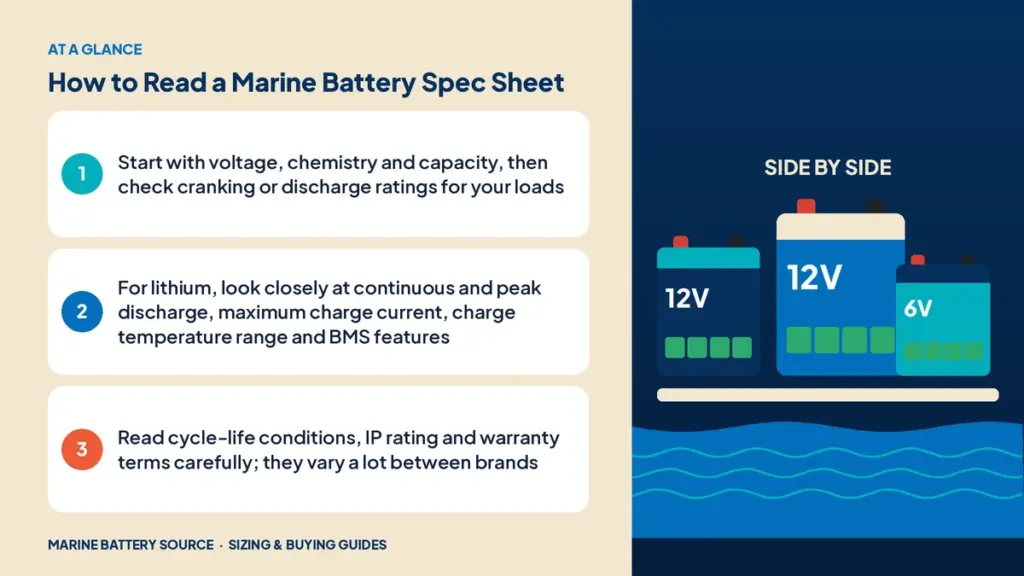
The battery’s rated voltage: 6V, 12V, 24V, 36V or 48V. It must match your system or be wired in series to reach it. LiFePO4 batteries are often described as 12.8V, 25.6V and so on, because their cells are 3.2V nominal.
Chemistry
Flooded lead-acid, enhanced flooded (EFB), AGM or lithium iron phosphate (LiFePO4). Chemistry determines charging profile, usable capacity, weight and maintenance.
Capacity (Ah)
How much charge the battery stores. Check the rating condition: lead-acid capacity is usually given at the 20-hour rate, as on Trojan’s listings (“89 Ah (20-hr rate)”). Lithium capacity is usually close to what you get across normal loads. See amp-hours explained.
Stored energy (Wh or kWh)
Some lithium listings, like EPOCH’s, give stored energy directly: 1.28 kWh for the 12V 100Ah Eco, 5.89 kWh for the 12V 460Ah. It’s the easiest number for comparing batteries of different voltages.
Cold cranking amps (CCA) and marine cranking amps (MCA)
Cranking ratings for starting batteries:
- CCA: current the battery can deliver for 30 seconds at 0°F while staying above 7.2V on a 12V battery.
- MCA: the same test at 32°F, so MCA is higher than CCA.
Interstate’s 27M-AGM lists 850 CCA and 975 MCA. Compare like with like, and match your engine maker’s requirement. Some lithium dual-purpose batteries list CCA or “CCA equivalent,” like Dakota’s DL+ 60Ah (1,000 CCA) and EPOCH’s 12V 172Ah (approximately 1,000 CCA equivalent).
Reserve capacity (RC)
Minutes a fully charged battery can deliver 25A before falling to 10.5V. Useful for comparing how long a battery will run loads with the engine off. Interstate’s 31M-AGM lists 200 minutes.
Maximum continuous discharge
The highest current the battery can deliver steadily. For lithium, the BMS enforces it. EPOCH’s 12V 105Ah lists 105A; EPOCH’s 12V 300Ah Essential lists 200A. Make sure it exceeds your largest continuous load. See battery C-rate explained.
Peak discharge
Short bursts above the continuous rating, with a time limit, like EPOCH’s 12V 100Ah Eco at 300A for 5 seconds or the 24V 100Ah at 200A for 60 seconds. Useful for motor startup surges.
Maximum charge current
The highest charging current the battery accepts. Your charger and alternator should stay within it. Lithium Rhino’s 36V kits list 50A.
Charging voltage and profile
Lithium batteries list a charging voltage or profile: Battle Born lists 14.2–14.6V for its 12V batteries, and EPOCH lists CC/CV charging with no equalization on several models. Lead-acid batteries need the correct flooded or AGM profile.
Cycle life
How many charge-discharge cycles the battery is expected to deliver. Read the conditions. EPOCH’s 12V 460Ah V2-T Elite lists more than 3,500 cycles to 70% capacity at 70% DoD under stated conditions; Dakota lists up to 5,000 cycles to 80% capacity. Different end-of-life points and test conditions make direct comparisons tricky. See depth of discharge.
Operating and charging temperature
LiFePO4 batteries generally shouldn’t be charged below freezing unless they have internal heating. Check:
- Charge temperature range: EPOCH’s 12V 100Ah Eco lists 32°F to 131°F; the 24V 230Ah V2 Elite lists -22°F to 131°F with self-heating.
- Discharge range: usually wider than the charge range.
- Internal heating: listed as yes or no on most of our lithium listings.
Ingress protection (IP rating)
Two digits: the first for dust, the second for water.
- IP54: dust-protected, splash-resistant, not submersible. Many EPOCH Essential models.
- IP65: dust-tight, resists water jets. Dakota DL+ 135Ah, EPOCH 12V 172Ah.
- IP67: dust-tight, survives temporary immersion. EPOCH Pro and Elite, Lithium Rhino.
On a boat, IP67 is the most forgiving, but no battery should sit in bilge water.
Series and parallel limits
Lithium batteries list how many can be connected:
- EPOCH 12V 105Ah: up to 4 in series (48V) and 4 in parallel.
- EPOCH 12V 172Ah dual purpose: up to 4 in parallel, series not approved.
- EPOCH 48V 100Ah V2 Elite: no series, up to 16 in parallel.
Exceeding these limits can void the warranty or cause problems.
Bluetooth and monitoring
Whether the battery reports state of charge, voltage, current and temperature to an app. EPOCH Essential, Pro and Elite list Bluetooth; Eco doesn’t. Some EPOCH listings also mention a BMS-integrated shunt for current sensing.
Terminals
Post, stud, M8 female thread or M8 bolt. Make sure your cable lugs fit.
Weight and dimensions
Check both against your compartment and your ability to lift the battery. See BCI group sizes for typical case dimensions.
Warranty
Listed as years or months, sometimes as “free replacement” (Interstate). Warranty terms often include conditions about charging, temperature or installation. Read the maker’s terms.
Spec sheet checklist
- ☐ Voltage and chemistry match the system
- ☐ Capacity meets your daily needs with margin
- ☐ CCA/MCA meets the engine requirement, if starting
- ☐ Continuous discharge exceeds your biggest load
- ☐ Charger within maximum charge current
- ☐ Charge temperature range suits your climate
- ☐ IP rating suits the location
- ☐ Series/parallel limits suit your bank
- ☐ Terminals and dimensions fit
- ☐ Warranty terms understood
More reading
Go deeper with lithium vs lead-acid amp-hours and battery price per kWh. For sizing, read how many batteries does my boat need, and the marine battery buying guide covers the full process.
Products mentioned
Frequently asked questions
What’s the difference between CCA and MCA?
CCA is measured at 0°F and MCA at 32°F. MCA numbers are higher.
What IP rating should a boat battery have?
IP67 is most forgiving. IP54 batteries need a dry, protected location.
What does maximum continuous discharge mean?
The highest steady current the battery can deliver. The BMS may shut off above it.
Why do cycle-life numbers vary so much?
Makers test at different depths of discharge and define end of life differently. Read the conditions.
Do I need Bluetooth on a lithium battery?
It’s not required, but it makes tracking state of charge much easier.