


Spring Commissioning: Waking Your Boat Batteries Up
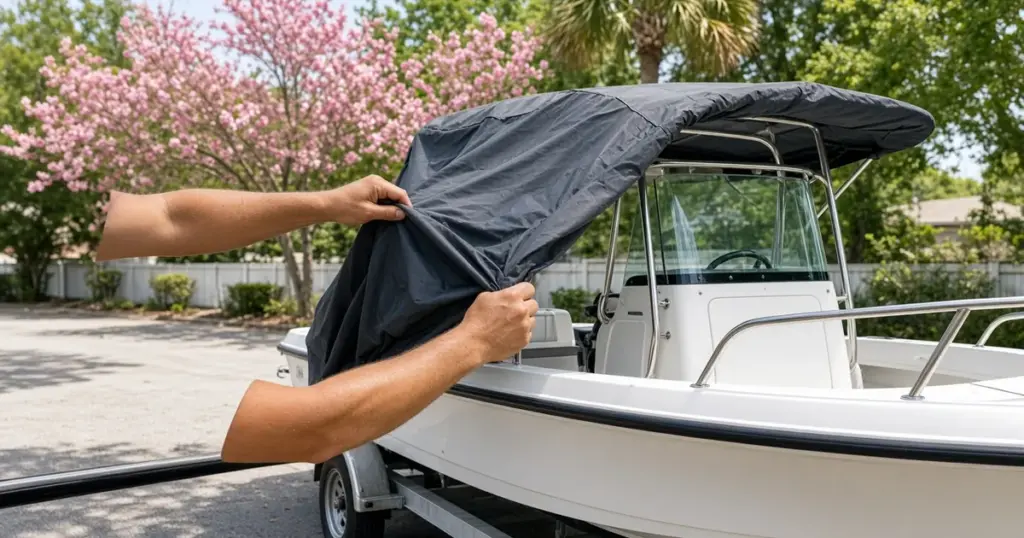
Spring commissioning is your chance to start the season with batteries you can trust. A battery that barely cranks at the ramp, or a trolling bank that dies by noon, can ruin the first trip of the year. A methodical spring check takes an hour or two and catches problems while you’re still in the driveway. This guide covers spring boat battery commissioning step by step.
Step 1: Charge everything fully
Whether your batteries spent the winter on a maintainer or sitting disconnected, start with a full charge:
- Lead-acid: charge with a smart charger set for flooded or AGM until it completes absorption.
- Lithium: charge fully with a lithium charger. If the battery was stored cold, let it warm above freezing first.
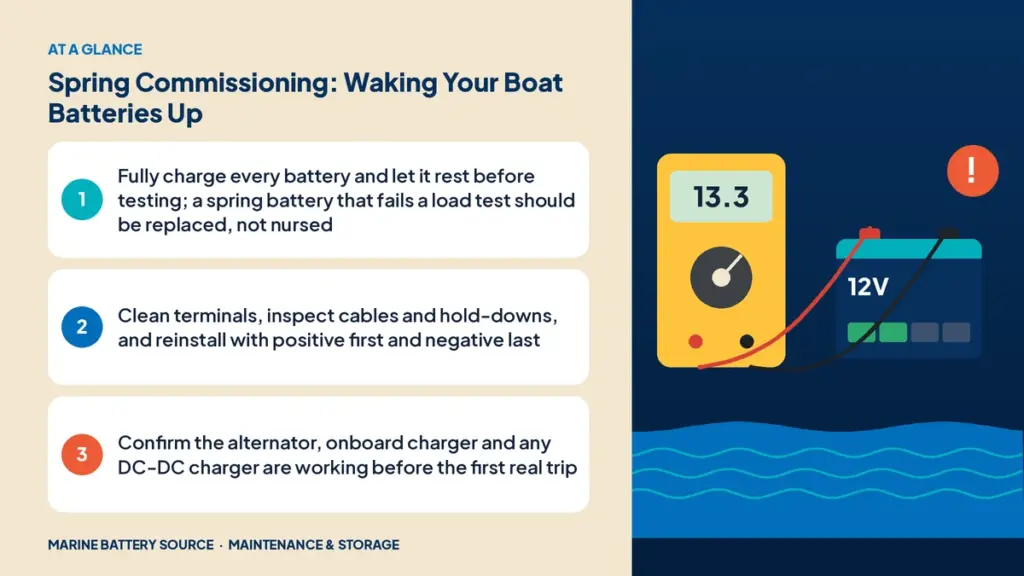
Let the batteries rest for several hours, ideally overnight, before testing.
Step 2: Test each battery
Voltage test
- 12V lead-acid: 12.6V or higher at rest means fully charged. Below 12.4V after a full charge suggests a problem.
- 12V lithium: about 13.3V to 13.4V at rest when full. Check the app for state of charge and cell balance.
Load test (lead-acid)
A load test checks the battery’s ability to deliver current. Many battery retailers will do this for free. A battery that fails should be replaced.
Hydrometer test (flooded)
Check each cell’s specific gravity. Cells should be within about 0.050 of each other. See battery hydrometer test.
Step 3: Inspect the battery
- Case: no cracks, bulges or leaks
- Terminals: clean and undamaged
- Flooded: electrolyte at the correct level; top up with distilled water if needed
Step 4: Clean terminals and cable ends
Clean battery terminals and the cable ends in the boat with baking soda solution and a wire brush. Rinse, dry and apply terminal protectant after reconnecting.
Step 5: Inspect cables, fuses and switches
- Cables: look for cracks, chafing and corrosion under the insulation
- Lugs: tight on the cable, not cracked
- Fuses: intact, holders not discolored
- Battery switch: turns smoothly and clicks firmly into each position
- Hold-downs: straps and brackets in good condition
Step 6: Reinstall
- Set the battery in its tray or box.
- Secure the hold-down.
- Connect the positive first, then the negative, following your labels.
- Torque to spec.
- Apply protectant and fit the positive cover.
For trolling banks, reconnect the series links carefully, then the motor leads and charger leads. Check total bank voltage before plugging in the motor.
Step 7: Test the charging system
- Alternator: start the engine and check voltage at the battery. It should rise to about 13.8V to 14.6V.
- Onboard charger: plug in and confirm each bank shows charging.
- DC-DC charger: confirm it turns on with the engine running.
- Solar: check the controller display in sunlight.
Step 8: Test loads
Turn on the bilge pump, navigation lights, electronics, livewell and trolling motor. Make sure everything works and that voltage at the battery stays healthy.
Step 9: Check the bilge pump
Test the automatic float switch by lifting the float. The pump should run. Make sure it’s wired to the battery through its own fuse so it works with the main switch off.
Step 10: Document
Record battery voltages, test results and any parts replaced. Update your maintenance log.
Common spring problems
- Battery won’t hold a charge: likely sulfated or at end of life. See battery self-discharge rates for what to expect.
- Corroded cable ends: clean or replace.
- Charger not charging: check AC power, fuses and settings.
- Lithium won’t charge: battery may still be too cold, or the BMS may be in protection mode.
- Bilge pump not running: check the float switch, fuse and wiring.
Boats stored on lifts or trailers
Boats that stayed on a lift or trailer with batteries aboard should get the same checks. See boat lift and slip battery care and trailer boat battery storage.
If you removed the batteries
Follow your labels and photos to reconnect correctly. See removing a boat battery for winter for the removal steps in reverse.
Time to replace?
If a battery fails a load test or won’t hold a charge, replace it before the season starts. Replace batteries in a bank together. Lithium options like the EPOCH 36V 50Ah for trolling motors or the Dakota Lithium 12V 60Ah dual-purpose for starting can transform your season. Browse our lithium marine batteries and trolling motor batteries.
First trip tips
- Bring a jump pack or know where your emergency parallel switch is.
- Check terminals after the first outing, since vibration can loosen them.
- Fully recharge after the first trip.
Spring commissioning for lithium systems
Lithium systems are easier in spring, but a few extra checks help:
- Warm before charging. If the battery sat in a cold boat, let it warm above freezing before plugging in, unless it has built-in heating.
- Check the app. Look at cell voltages after a full charge. They should be close together. A large spread may mean the BMS needs a few full charge cycles to rebalance.
- Confirm charge settings. Make sure the onboard charger, DC-DC charger and solar controller are still set for lithium, especially if someone else serviced the boat over winter.
- Resync monitors. If you use a shunt-based battery monitor, sync it to 100% after the first full charge.
A quick spring timeline
- Four weeks before launch: charge and test all batteries. Order replacements if needed.
- Two weeks before: reinstall batteries, inspect cables and test the charging system.
- One week before: test all loads, including the bilge pump and trolling motor.
- Launch day: check voltages and bring your onboard repair kit.
For the full year’s schedule, see the seasonal boat battery calendar. For winter storage practices, see winter storage for marine batteries, and for ongoing care, our marine battery maintenance guide.
Frequently asked questions
How do I prepare my boat battery for spring?
Charge fully, let it rest, test voltage and load, clean terminals, inspect cables and fuses, reinstall and test the charging system.
Can a battery that sat all winter be saved?
If it was stored charged, usually yes. If it sat discharged, it may be sulfated; charge it fully and load test to see.
How do I know if my boat battery needs replacing?
If it fails a load test, won’t hold a charge or shows low voltage after a full charge, replace it.
Should I charge my lithium battery before the season?
Yes. Warm it above freezing if needed, then charge fully with a lithium charger.
What voltage should my battery read in spring?
A fully charged 12V lead-acid battery reads 12.6V or higher at rest; a 12V lithium reads about 13.3V to 13.4V.