


Pontoon Boat Batteries: What You Need and Why
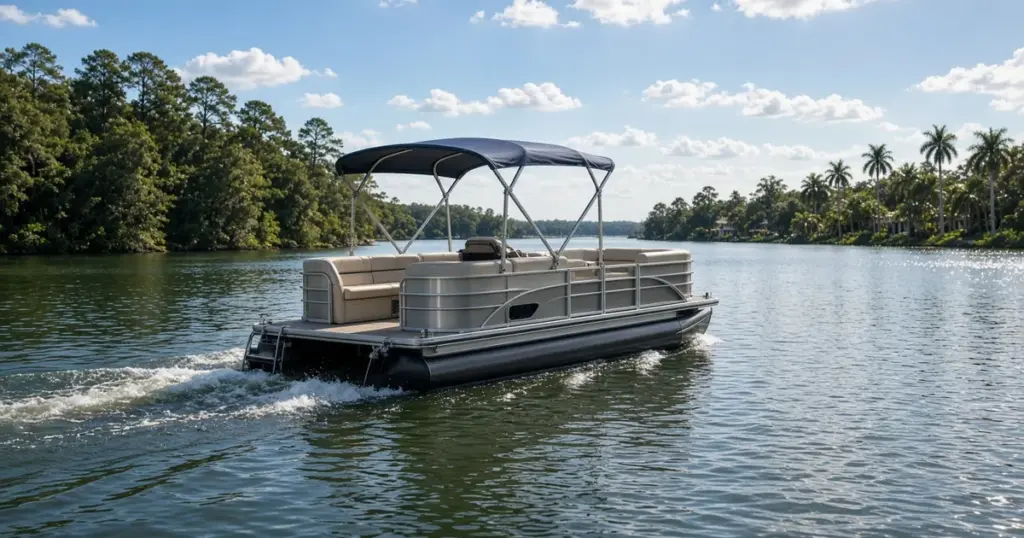
Pontoon boats are built for relaxing: cruising the lake, swimming, sandbar parties and sunset rides. Their electrical needs are simpler than a tournament bass boat, but pontoons have their own quirks: long cable runs, big stereos and long periods with the engine off. This guide explains what pontoon boat batteries you need and why.
The standard setup: one battery
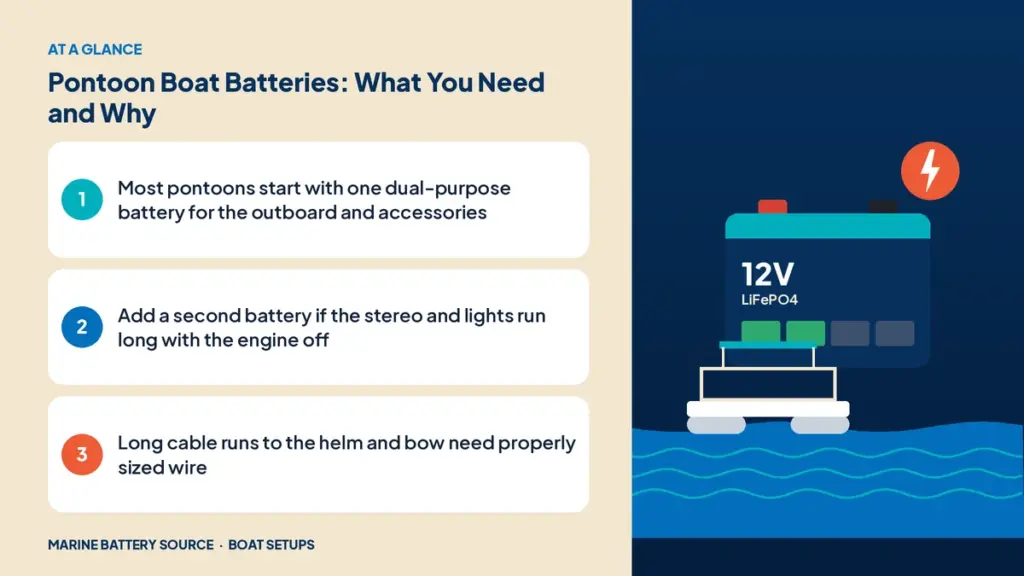
Most pontoons come from the factory with one battery near the outboard. It starts the engine and powers the gauges, navigation lights, bilge pump, horn and stereo. A dual-purpose battery is the usual choice because it handles both cranking and moderate cycling. Read our dual-purpose battery guide for how they work.
When choosing that battery:
- Meet the outboard’s minimum cranking and reserve capacity.
- Make sure it can handle your accessory use with the engine off.
- Fit the tray and terminals.
Examples from the store include the Interstate 27M-AGM-A (750 CCA, 900 MCA, 175 minutes RC) and the Interstate HD24-DP flooded dual purpose (405 CCA, 100 minutes RC).
When to add a second battery
Pontoon owners often spend hours anchored or tied up at a sandbar with the stereo playing and lights on. That can drain a single battery enough that the outboard won’t start. A second battery solves it. Common setups:
- Two batteries with a 1-2-Both switch. Simple, but you have to remember to select the right battery.
- Starting battery plus a dedicated accessory battery with an automatic charging relay or DC-DC charger, so the outboard charges both but accessories can’t drain the starting battery.
Lithium is a good choice for the accessory battery: light, deep-cycling and steady voltage for amplifiers. The EPOCH 12V 105Ah Essential is listed at 1.34 kWh and 22.1 lb with Bluetooth. For more, see our guide to separating starting and house batteries.
Stereos and amplifiers
Modern pontoon audio systems with multiple amplifiers and subwoofers can draw a lot of current, especially at high volume. Budget the stereo’s draw realistically, use proper wire size and fusing for amplifier circuits, and consider a dedicated audio battery. Our wake boat battery guide covers big-audio setups in detail, and the same principles apply.
Trolling motors on pontoons
More pontoon owners fish, and bow-mount trolling motors are common. A pontoon is heavy and catches wind, so many owners choose 24V or 36V motors. The trolling motor needs its own battery or bank, separate from the starting battery. Read how to choose a trolling motor battery for voltage and capacity. Weight is less critical on a pontoon than on a bass boat, so lead-acid remains a reasonable choice, but lithium extends runtime and reduces battery count.
Long cable runs
Pontoons are long, and the batteries usually sit at the stern near the outboard, while the helm, stereo and trolling motor may be far forward. Long runs cause voltage drop:
- Size cables for current and the full round-trip length.
- For a bow-mount trolling motor, consider placing the trolling bank forward to shorten the run.
- Keep connections clean and protected from spray.
Charging pontoon batteries
- Outboard charging: recharges the starting battery while running; often modest output at low RPM.
- Onboard charger: a multi-bank onboard charger keeps every battery topped up at the dock or on a lift with shore power.
- Solar maintainer: a small panel can offset parasitic drains on boats stored on lifts.
Pontoons on lifts and in storage
Many pontoons sit on lifts for days or weeks. Small parasitic loads, such as stereo memory and bilge pump float switches, slowly drain batteries. Use a battery switch to isolate batteries when the boat isn’t in use, or keep a charger or maintainer connected.
Electric pontoons
Some pontoons now run electric outboards. These need large propulsion banks, often 48V lithium. See the electric outboard battery guide.
Wiring a second battery on a pontoon
If you add an accessory battery, a clean installation looks like this:
- Mount the second battery in a secure tray or box near the first, keeping cables short.
- Install a battery switch or an automatic charging relay between the starting and accessory batteries.
- Move the stereo, amplifiers and accessory circuits to the accessory battery through a fused distribution block.
- Leave the engine, gauges and bilge pump on the starting side, as the builder intended.
- Add the new battery to the onboard charger as its own bank.
- Label the switch positions clearly for guests and family members.
Done this way, anyone can enjoy the stereo at the sandbar without risking a dead starting battery.
Typical pontoon setups
| Use | Setup |
|---|---|
| Cruising, light stereo use | One dual-purpose battery |
| Long sandbar days with stereo | Starting battery plus accessory battery |
| Fishing pontoon with bow trolling motor | Starting battery plus 24V or 36V trolling bank |
| Electric pontoon | 48V lithium propulsion bank plus 12V supply |
Maintenance tips
- Check terminals for corrosion each month during the season.
- Recharge after every trip.
- Test batteries before the season.
- Store charged over winter; read our winter storage guide for details.
Comparing with other boats
Pontoons share some needs with other boat types. If you fish seriously, our bass boat battery setup and multi-species boat guide cover trolling-heavy systems. Saltwater pontoons can learn from center console setups.
For the big picture, see battery setups by boat type and small boat electrical basics. Browse dual-purpose batteries in the store.
Frequently asked questions
What kind of battery does a pontoon boat need?
Usually a marine dual-purpose battery that meets the outboard’s cranking spec and can run accessories. Some owners add a second battery for the stereo.
Do I need two batteries on my pontoon?
If you run the stereo and lights for long periods with the engine off, a second battery protects your ability to start.
What size trolling motor battery for a pontoon?
Pontoons often use 24V or 36V trolling motors because of their weight and windage. Size the bank from the motor’s draw and your hours of use.
How do I keep my pontoon battery charged on a lift?
Isolate it with a battery switch when not in use, or keep an onboard charger or solar maintainer connected.