


L16 and Large-Format Deep-Cycle Batteries for House Banks
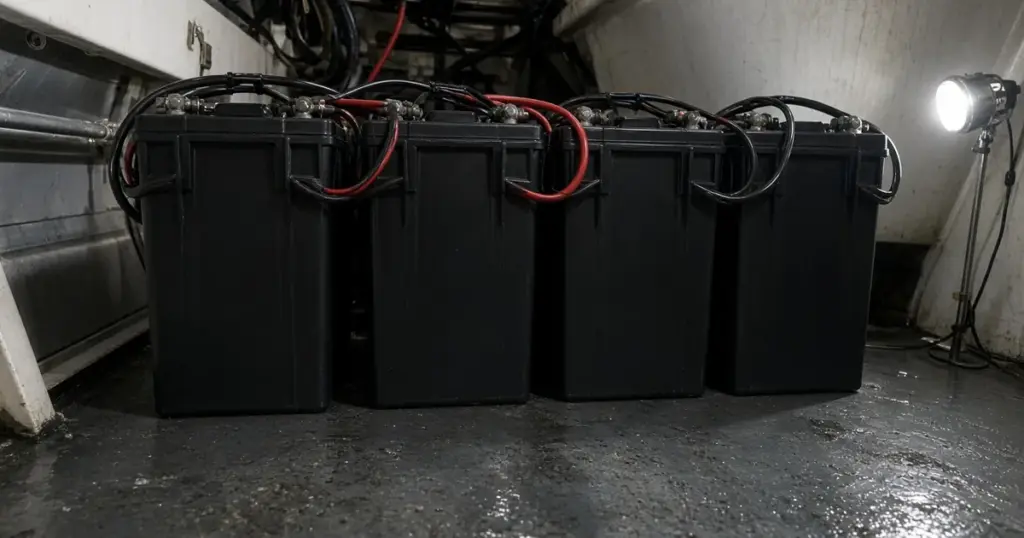
When cruisers want a big lead-acid house bank, they often look past 12V batteries to large-format 6V deep-cycle batteries like the L16. These tall, heavy batteries pack a lot of energy and are built for cycling. They’ve powered liveaboards, off-grid homes and trawlers for decades. This guide explains L16 and large-format batteries for house banks, their pros and cons, and how they compare with lithium.
What is an L16 battery?
L16 describes a large deep-cycle battery format, typically 6V, with a footprint similar to a golf-cart battery but much taller, around 16 to 17 inches. BCI group 903 covers this size. The extra height means bigger plates and more capacity per battery.
Other large formats include GC2H golf-cart batteries, taller J305-style 6V batteries in group 902, and big 8D 12V batteries.
Store examples
| Battery | Type | Group | Energy (20-hr) | RC (min) | Weight | Height |
|---|---|---|---|---|---|---|
| Trojan L16H-AC | 6V flooded | 903 | 2.89 kWh | 935 | 121 lb | 16.74 in |
| Trojan L16-AES | 6V AGM | 903 | 2.43 kWh | 735 | 114 lb | 16.41 in |
| Trojan J305H-AC | 6V flooded | 902 | 2.40 kWh | 781 | 98 lb | 14.42 in |
| Trojan J305-AES | 6V AGM | 902 | 1.92 kWh | 603 | 95 lb | 14.09 in |
| Trojan J185H-AC | 12V flooded | 921 | 2.99 kWh | 440 | 126 lb | 14.67 in |
| Trojan 8D-AGM | 12V AGM | 8D | 3.05 kWh | 460 | 161 lb | 9.08 in |
A pair of L16H-AC batteries in series gives 12V and about 5.8 kWh at the 20-hour rate. Planning to use about half, that’s roughly 2.9 kWh usable.
Advantages
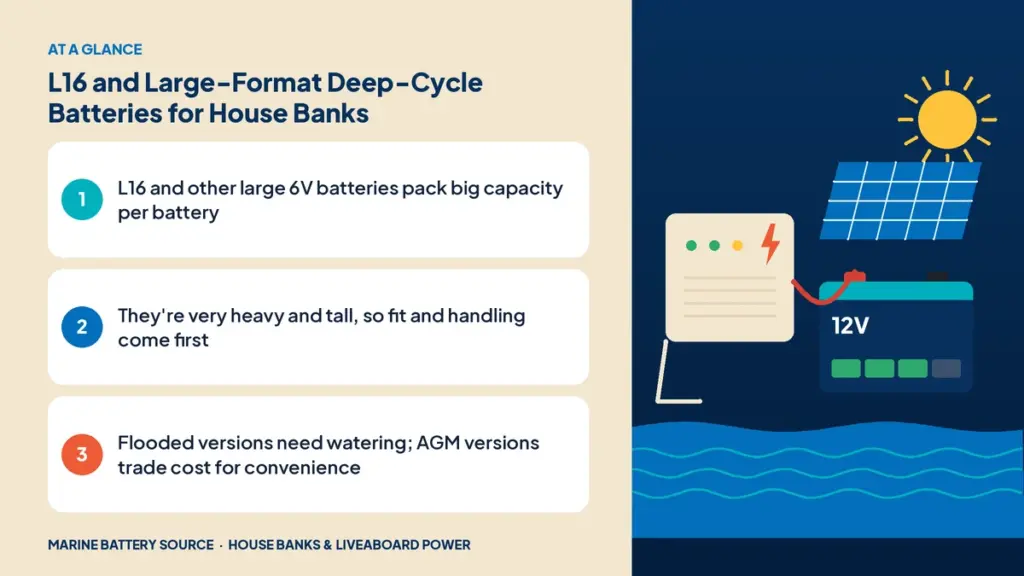
- Big capacity per battery, so fewer interconnections than many smaller batteries.
- Thick plates designed for deep cycling.
- Proven technology with decades of use in demanding off-grid applications.
- Lower up-front cost per kWh than lithium.
Disadvantages
- Weight. Over 100 lb per battery for L16s. Installing and removing them is a two-person job, and they must be secured against heavy seas.
- Height. Many boats don’t have compartments tall enough.
- Watering. Flooded versions need regular checks and distilled water; a single-point watering system helps.
- Ventilation. Flooded batteries vent hydrogen while charging.
- Usable capacity. About half of rated capacity for good life.
- Slow charging near full, which matters for solar and generator time.
Wiring a large-format 6V bank
Connect 6V batteries in series pairs for 12V, or groups of four for 24V. Add series strings in parallel for more capacity, keeping cable lengths equal so strings share load evenly. Use heavy interconnects and proper lugs. If you’re comparing voltages, see our pillar on sailboat and liveaboard battery systems.
Charging large lead-acid banks
- Use chargers with enough output for the bank. Large banks need substantial charge current to get through bulk charging in reasonable time.
- Set the correct flooded or AGM profile.
- Equalize flooded batteries per the maker’s guidance.
- Use temperature compensation.
Shore chargers and inverter/chargers are covered in shore power and chargers, and engine-free charging in charging without the engine.
Large lead-acid vs lithium
| Two L16H-AC (12V) | 12V 460Ah lithium | |
|---|---|---|
| Rated energy | about 5.8 kWh | about 5.89 kWh |
| Planned usable | about 2.9 kWh | about 4.7 kWh |
| Weight | 242 lb | 84 lb (EPOCH 12V 460Ah Essential) |
| Maintenance | Watering, equalizing | None routine |
| Charge acceptance | Slows near full | High until near full |
The lithium comparison uses the EPOCH 12V 460Ah Essential. Lithium costs more up front, but it delivers much more usable energy for the weight and charges faster.
Maintaining a large flooded bank
Large flooded banks reward consistent care:
- Water regularly. Check levels monthly, more often in heat or with heavy cycling. Add distilled water after charging, to the level the maker specifies.
- Equalize as recommended. Equalization is a controlled overcharge that helps balance cells and reduce stratification in flooded batteries. Follow the maker’s voltage and duration guidance, and never equalize AGM batteries unless the maker allows it.
- Check specific gravity. A hydrometer reading of each cell shows state of charge and reveals a weak cell long before it fails.
- Keep tops clean and dry. Acid residue and moisture create small leakage currents and corrosion.
- Recharge fully and often. Lead-acid banks that sit partially charged for long periods lose capacity to sulfation.
A single-point watering system that fills every cell from one hose makes watering large banks much faster, especially in tight compartments.
Fit check before you buy
Measure height carefully, including clearance above the terminals for cables, a wrench and a watering system. Check that the compartment floor and supports can carry the weight, and that hold-downs can be installed. Many boats that originally carried 8D or Group 31 batteries don’t have room for L16s.
Who should choose L16s?
- Boats with tall, well-ventilated battery spaces near the center of gravity.
- Owners comfortable with watering and equalizing.
- Budgets that favor lower up-front cost.
- Boats where weight low in the hull is acceptable or even helpful as ballast.
Who should look at lithium instead?
- Weight-sensitive boats.
- Owners relying heavily on solar.
- Batteries in hard-to-reach locations.
Electric propulsion and large banks
For electric propulsion, the weight of lead-acid at multi-kilowatt-hour scale is usually prohibitive. See electric sailboat motor batteries.
Planning the bank size
Use an energy budget to decide how many batteries you need. Our sample liveaboard power budget and house bank sizing guide walk through the numbers.
Handling and installation safety
- Lift with proper technique or a hoist; these batteries are very heavy.
- Keep them upright.
- Wear eye protection and gloves around flooded batteries.
- Secure with hold-downs that can resist a knockdown.
- Cover terminals.
Browse Trojan batteries in the store.
Frequently asked questions
How many L16 batteries do I need for 12V?
Two 6V L16 batteries in series make 12V. Add more pairs in parallel for more capacity.
Are L16 batteries good for boats?
They’re good for large house banks where there’s room for their height and weight. They require watering if flooded and ventilation.
How much does an L16 battery weigh?
Large-format 6V L16 batteries commonly weigh over 100 lb. The Trojan L16H-AC is listed at 121 lb.
Is lithium better than L16 for a house bank?
Lithium provides more usable energy for far less weight and charges faster, at a higher up-front cost. L16s remain a cost-effective, proven option where weight and space allow.