


Sailboat and Liveaboard Battery Systems: A Complete Guide
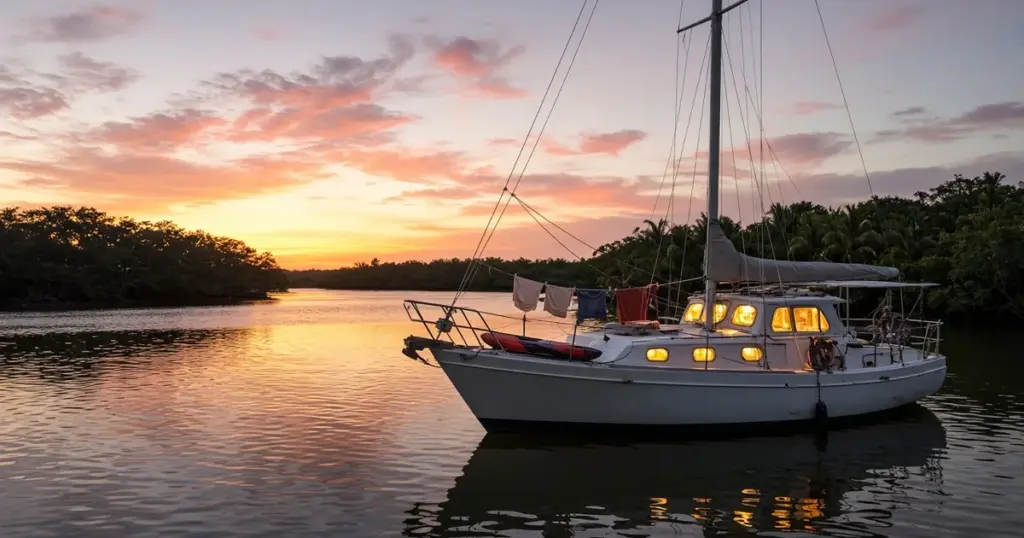
On a sailboat or liveaboard boat, the battery bank is the heart of daily life. It runs the fridge, the lights, the instruments, the water pump, the autopilot and the devices you rely on. A well-designed system means quiet nights at anchor and freedom from the dock; a poor one means constant worry about the next charge. This complete guide covers how to plan a sailboat battery bank and liveaboard power system, and links to detailed guides on every part.
Step 1: Know your energy needs
Everything starts with an energy budget: a list of every load, its current draw and the hours it runs each day. Our sample liveaboard power budget shows a line-by-line example. Typical big users are refrigeration, autopilots under way, inverters and any electric cooking or heating.
Sailboats have particular loads:
- Autopilot on passages, which can be a significant continuous load in rough seas.
- Navigation instruments and plotter while sailing.
- Anchor light every night.
- Refrigeration, often the biggest single load.
Step 2: Choose a bank chemistry
Lead-acid
Flooded and AGM banks are proven and cost less up front, but you should plan to use only about half their capacity, they charge slowly near full, and they’re heavy. Large-format lead-acid batteries such as L16 and 6V golf-cart batteries are traditional liveaboard choices; see L16 and large-format batteries.
Lithium (LiFePO4)
Lithium has become the preferred liveaboard chemistry for many owners: more usable energy, less weight, fast charging and long cycle life. It does require a charging system set up for lithium. Our guide to building a lithium house bank for liveaboard life covers design in detail, and upgrading a sailboat from AGM to lithium walks through the conversion.
Examples of large house batteries from the store:
- EPOCH 12V 460Ah Essential: 5.89 kWh, 8D size, 84 lb, Bluetooth and heating.
- Battle Born 270Ah 12V GC3: 80.8 lb.
- Trojan L16H-AC: a 6V flooded battery listed at 2.89 kWh at the 20-hour rate and 121 lb.
Step 3: Size the bank
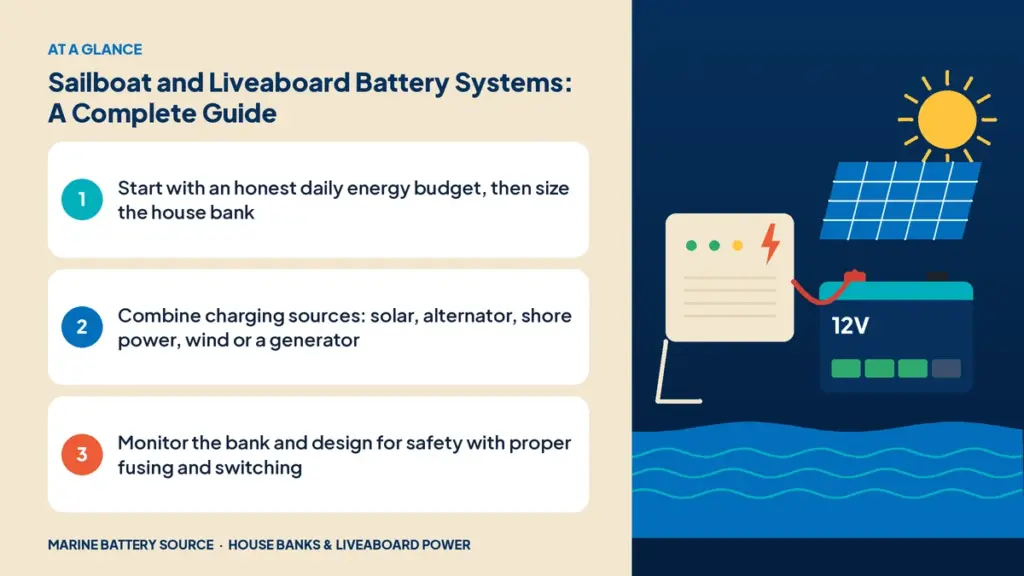
Divide your daily use by the usable fraction (about 0.5 for lead-acid and 0.8 for lithium), then add reserve for cloudy days or days without charging. Many liveaboards size for at least two days of autonomy. See house bank sizing for overnight boating for the method.
Step 4: Plan charging sources
A liveaboard system needs reliable ways to put energy back:
- Solar panels: silent, low-maintenance and often the backbone of cruising power.
- Engine alternator: with an external regulator or DC-DC charger for lithium.
- Shore power: a charger or inverter/charger at the dock; see shore power and chargers.
- Wind generators and hydrogenerators: useful on passages and in windy anchorages.
- Generators: high output, but noise and fuel.
Sailors often want to charge without running the engine; see charging sailboat batteries without the engine. Some owners are reconsidering the generator entirely; read generator vs a big lithium bank.
Step 5: Separate starting and house
Keep a dedicated engine starting battery so you can always start the engine, regardless of the house bank’s state. Charge it from the alternator directly and from the house system through a combiner or DC-DC charger.
Step 6: Decide on system voltage
Most cruising sailboats use 12V. Larger yachts with big inverter loads may choose 24V. Electric propulsion often uses 48V; see electric auxiliary propulsion.
Step 7: Monitoring
A shunt-based monitor tells you exactly how much energy you’ve used and how much your charging sources are putting back. Lithium batteries with Bluetooth add per-battery detail. Monitoring turns guesswork into planning.
Step 8: Safety and installation
- Fuse every positive conductor close to the battery, with fuses rated for the bank’s potential short-circuit current.
- Use a main battery switch for each bank.
- Secure batteries against a knockdown or capsize; heavy batteries must not break loose.
- Ventilate flooded batteries.
- Follow ABYC standards and battery makers’ instructions.
Step 9: Plan for passages vs anchorages
Energy use changes with how you use the boat. At anchor, refrigeration, lights and devices dominate, while solar has the whole day to work. On passage, the autopilot, instruments, radar and navigation lights run around the clock, and night watches mean more lighting and screen time. Solar panels may be shaded by sails, and the boat may heel away from the sun.
Plan the bank and charging for the harder case. If you make overnight passages, budget a full 24 hours of under-way loads and decide in advance when you’ll run the engine or rely on wind or hydro generation. Keep a written power plan near the nav station so everyone aboard knows the thresholds for cutting loads or starting the engine.
Step 10: Spares and redundancy
Liveaboard systems should keep working when one part fails. Carry spare fuses of each size used, a spare alternator belt, terminal lugs and a crimping tool. Know how to bypass a failed component safely. With lithium, understand what the BMS does when it disconnects and how to recover. With lead-acid, carry a hydrometer and distilled water. Simple, labeled systems are the easiest to fix far from help.
Multihulls
Catamarans often have more space for solar and more room for batteries, but also longer cable runs and sometimes two engines. See battery banks for cruising catamarans.
Common mistakes
- Sizing the bank without an energy audit.
- Too little charging for the bank size.
- Using lead-acid charging profiles on lithium.
- Loads or chargers bypassing the shunt.
- Undersized cables to inverters and windlasses.
Typical liveaboard systems
| Style | Typical bank | Main charging |
|---|---|---|
| Weekend coastal cruiser | 200–400Ah lithium | Alternator, shore power, small solar |
| Full-time liveaboard at anchor | 400–800Ah lithium | Large solar array, alternator, shore |
| Bluewater cruiser | 400Ah+ lithium or large lead-acid | Solar, wind or hydro, alternator |
These ranges are illustrative; your energy budget sets the real number. Browse house bank batteries in the store.
Frequently asked questions
How big should a sailboat battery bank be?
Base it on your daily energy use. Divide daily amp-hours by about 0.5 for lead-acid or 0.8 for lithium and add reserve for days without charging.
Is lithium worth it for a liveaboard?
For many liveaboards, yes: more usable energy, less weight, faster charging and longer life. It requires a charging system designed for lithium.
How do sailboats charge batteries without the engine?
Mainly with solar panels, plus wind generators or hydrogenerators. Shore power or a generator fills gaps.
Do I need a separate starting battery on a sailboat?
It’s strongly recommended so you can always start the engine, regardless of the house bank’s state.