


Powering an Anchor Windlass: Battery Location and Wiring
An electric anchor windlass saves your back and makes anchoring safer, but it’s one of the heaviest electrical loads on a boat. It draws high current for a few minutes at a time, often at the far end of the boat from the batteries. Getting the battery location and wiring right is essential for reliable operation. This guide covers how to power an anchor windlass, including battery choices, cable sizing and charging.
How much current does a windlass draw?
Windlass current depends on the motor size, the load on the rode, and the voltage. Manufacturers list current draw at rated working load and often a maximum draw at stall or overload. Larger windlasses on cruising boats can draw well over 100A at 12V. Always use the maker’s figures for cable and breaker sizing.
Although the current is high, windlasses run for only a few minutes per anchoring, so the energy used per day is usually modest. That’s why a windlass is more about current capacity and wiring than about amp-hour capacity. Include it in your daily budget anyway; see how to do a boat energy audit.
Option 1: Long cables from the house bank
The most common approach is to run heavy cables from the house bank (or the starting battery, on some boats) to the windlass at the bow.
Pros: no extra battery, and the alternator can support the load directly when the engine is running. Cons: long, heavy cables. On a 40-foot boat, the round trip to the bow might be 60 to 80 feet, requiring very heavy cable to keep voltage drop acceptable.
Option 2: A dedicated bow battery
Some owners install a battery near the windlass to keep the high-current cables short.
Pros: short, heavy cables at the bow; less voltage drop at the windlass. Cons: the bow battery must be charged. That requires a charging cable from the main system, an automatic charging relay or a DC-DC charger. It also adds weight in the bow.
A compact lithium battery can reduce the weight penalty. The Dakota Lithium DL 12V 135Ah heated is listed at 27.2 lb with 1000 CCA and 135A continuous, with higher short pulse ratings, a profile that suits high-current, short-duration loads. Always confirm the battery’s continuous and pulse discharge ratings exceed the windlass’s draw, including stall current.
Cable sizing for windlasses
Windlass cables must handle high current over long distances. Follow the windlass maker’s recommended cable size for your run length; they publish tables for this. ABYC standards treat voltage drop limits differently for different circuits, and many installers aim for a low drop on windlass circuits because voltage at the motor directly affects pulling power.
Remember that a 12V windlass loses a larger percentage of its voltage over the same cable than a 24V windlass. On larger boats, a 24V windlass can significantly reduce cable size; see 12V vs 24V house banks.
Circuit protection
- Install a breaker or fuse rated per the windlass maker’s instructions, close to the battery.
- Many windlasses use a dedicated circuit breaker that doubles as an isolation switch.
- The windlass control circuit (switches and solenoid or contactor) has its own small fuse.
Battery choice
Lead-acid
Lead-acid batteries can deliver high current, but voltage sags under heavy load, and capacity is reduced at high discharge rates. A large AGM battery is a common choice for windlass duty.
Lithium
Lithium holds voltage better under load, which gives the windlass more consistent power. Check the BMS’s continuous and surge ratings, as noted above. For house banks that also feed the windlass, large-format batteries like the EPOCH 12V 460Ah Essential have the capacity to absorb windlass loads easily, provided the BMS rating is adequate.
Charging a bow battery
- ACR or combiner: connects the bow battery to the main system when charging voltage is present.
- DC-DC charger: applies a controlled profile, good for lithium bow batteries or long cable runs where voltage drop would otherwise limit charging.
- Dedicated charger bank: an extra output on the shore charger.
Charging cables can be much smaller than the windlass cables because charge current is lower. Our guide to charging lithium batteries on a boat explains DC-DC charging.
Monitoring windlass loads
If the windlass draws from the house bank through a shunt, your battery monitor will record its use. If it draws from a separate bow battery, that battery needs its own monitoring or regular checks. See battery monitors and shunts.
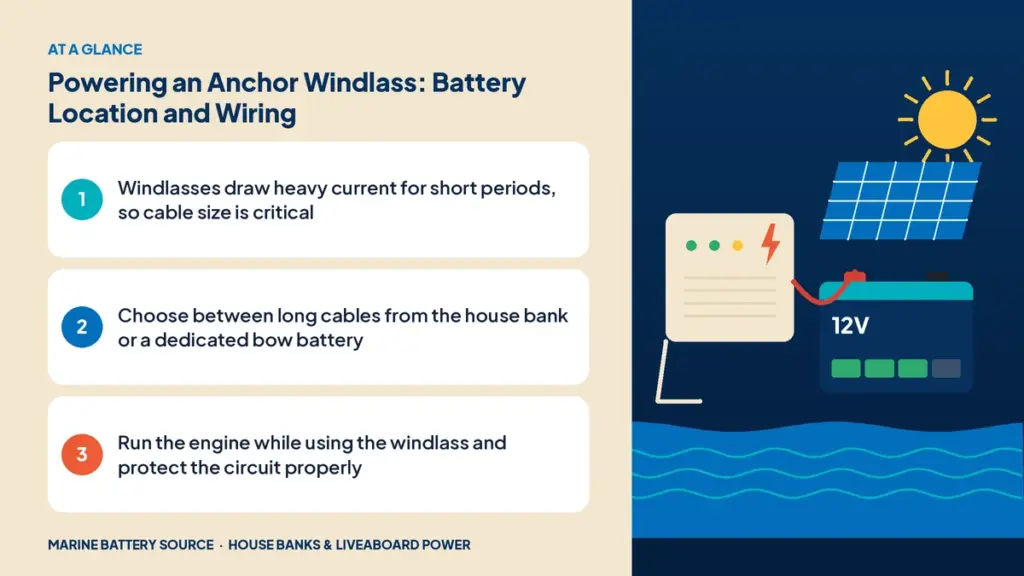
Run the engine while using the windlass
Running the engine while operating the windlass lets the alternator support the load, keeping voltage up and protecting the battery. It also means you can maneuver if the anchor drags or the rode snags. Many windlass makers recommend it.
Operating tips
- Motor the boat toward the anchor to take load off the rode rather than using the windlass to pull the boat.
- Use the windlass in short bursts and let it cool if it labors.
- Never use the windlass as the primary load-bearing point when riding at anchor; use a chain stopper or snubber.
- Keep hands and feet clear of the gypsy and rode.
Wiring checklist
- Read the windlass maker’s current draw and cable size recommendations.
- Decide between a long cable run or a bow battery.
- Size cables for current and run length.
- Install the breaker close to the battery.
- Use proper crimps, heat-shrink and cable support.
- Plan charging for any bow battery.
Windlasses and weekend planning
At anchor, a windlass is used briefly but at a critical moment. Plan so it always has power: see power planning for anchoring out, and if a fridge and other loads share the bank, read powering a boat fridge. For larger systems, see house bank sizing for overnight boating and sailboat and liveaboard battery systems. Browse house bank batteries.
Frequently asked questions
What battery should power my anchor windlass?
Either the house bank through properly sized cables, or a dedicated bow battery with short cables and its own charging. The battery must handle the windlass’s high current.
How many amps does an anchor windlass draw?
It depends on the model and load. Check the maker’s specs; larger windlasses can draw well over 100A at 12V.
Should I run the engine while using the windlass?
Yes, it is generally recommended. The alternator supports the load and you can maneuver if needed.
What size wire do I need for a windlass?
Follow the windlass maker’s table for your run length and voltage. Long runs on larger boats often require very heavy cable.