


AGM Starting Batteries for Boats: Pros and Cons
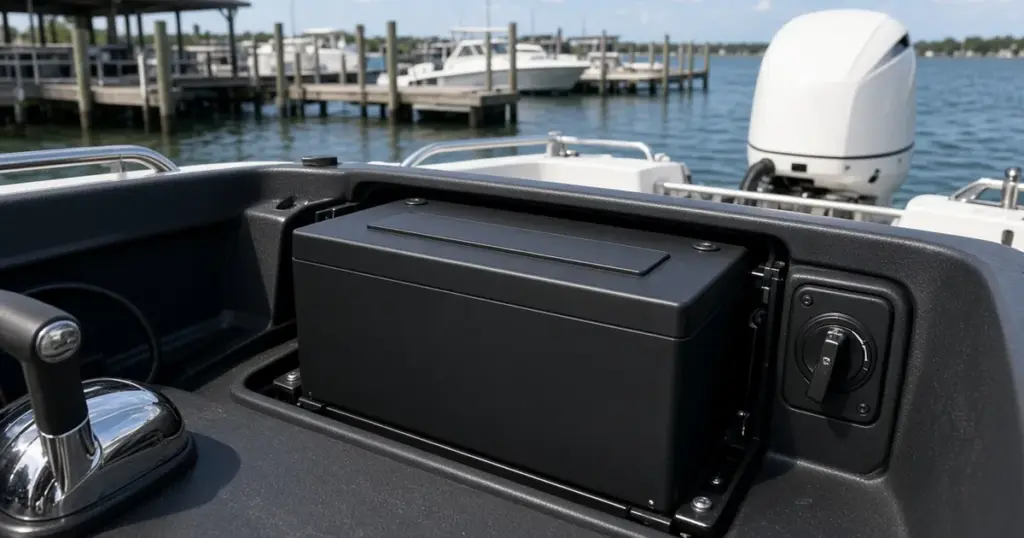
An AGM starting battery is one of the most popular upgrades for boats. It’s sealed, it doesn’t need watering, it handles vibration and pounding better than many flooded batteries, and it delivers strong cranking power. It also costs more and needs the right charging. This guide covers the pros and cons of AGM starting batteries for boats and helps you decide if one is right for you.
What is an AGM battery?
AGM stands for absorbent glass mat. The electrolyte is absorbed into fiberglass mats packed tightly between the lead plates. Because the electrolyte is held in the mats, there’s no free liquid, and the battery is sealed with pressure-relief valves. AGM is a type of valve-regulated lead-acid (VRLA) battery.
Advantages
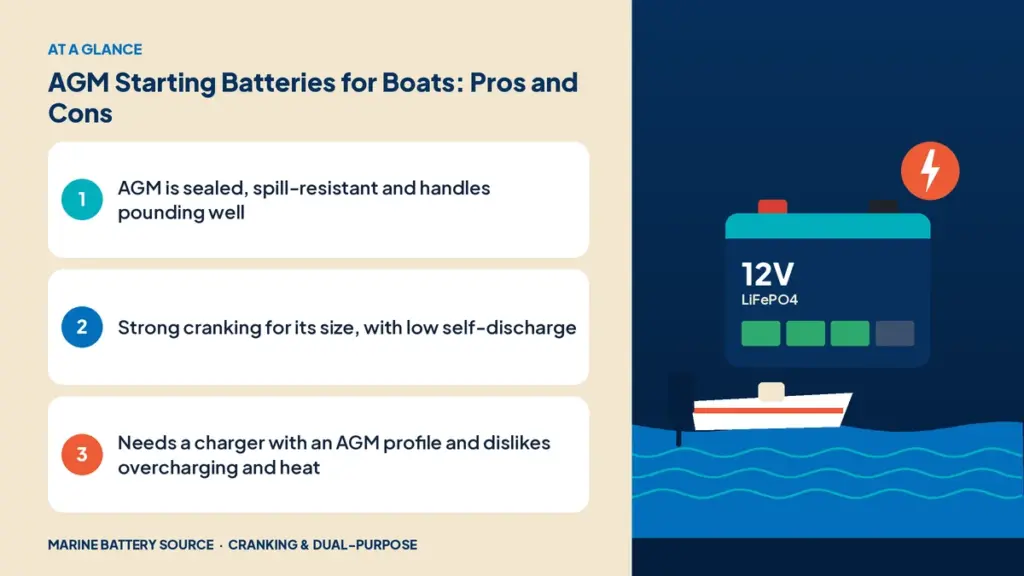
Sealed and spill-resistant
No watering, no acid spills, and less corrosion around the terminals. That’s a big advantage in tight or hard-to-reach compartments.
Vibration resistance
The tightly packed plates and mats resist vibration and shock. On boats that run in rough water, that can mean longer life than a flooded battery.
Strong cranking
AGM batteries have low internal resistance, which helps them deliver high cranking current. Many AGM marine batteries list strong CCA and MCA ratings for their group size.
Low self-discharge
AGM batteries typically lose charge more slowly in storage than flooded batteries, which helps boats that sit between trips.
Mounting flexibility
Many AGMs can be mounted on their side. Check the maker’s guidance.
Disadvantages
- Cost. AGM batteries typically cost more than flooded batteries of similar size.
- Charging sensitivity. AGM batteries need the correct charge voltage. Overcharging can dry them out, and they can’t be refilled.
- Heat sensitivity. High temperatures shorten life, as with all lead-acid batteries.
- Weight. Still heavy compared with lithium.
Real AGM examples from the store
| Battery | Group | CCA | MCA | RC (min) |
|---|---|---|---|---|
| Interstate 24M-AGM-A | 24M | 750 | 940 | 140 |
| Interstate 27M-AGM-A | 27M | 750 | 900 | 175 |
| Interstate 27M-AGM | 27M | 850 | 975 | 182 |
| Interstate 31M-AGM | 31M | 925 | 1190 | 200 |
| Interstate 34M-AGM | 34M | 800 | 1000 | 125 |
These Interstate AGM models are dual-purpose batteries, so they can handle moderate cycling in addition to starting. The store also lists free-replacement periods of 24 to 36 months for these models.
AGM vs flooded for starting
| AGM | Flooded | |
|---|---|---|
| Maintenance | None | Periodic watering |
| Vibration resistance | High | Moderate |
| Self-discharge | Lower | Higher |
| Cost | Higher | Lower |
| Charging | Needs AGM profile | Flooded profile, tolerates equalizing |
| Spill risk | Very low | Possible if tipped or damaged |
For a deeper comparison of the chemistries, see our guide to battery types.
Charging AGM batteries correctly
- Use a charger with an AGM setting.
- Check the battery maker’s recommended charge voltages and compare them with the charger’s AGM profile.
- Avoid equalization unless the battery maker specifically allows it.
- Use temperature compensation if your charger supports it.
The engine’s charging system usually handles AGM starting batteries fine. If you also have a lithium house bank, make sure your charging setup can handle both chemistries. Our guide on charging on the water covers mixed systems, and separating starting and house batteries explains the common layout.
Where AGM shines
- Boats that pound, such as offshore center consoles and bay boats.
- Hard-to-reach battery compartments, where watering is impractical.
- Single-battery boats where a sealed dual-purpose battery handles both jobs; see running a boat on one battery.
- Generator starting batteries, often in tight engine rooms; see generator starting batteries.
Where AGM may not be worth it
- If you’re on a tight budget and the battery is easy to reach for watering, a quality flooded battery is good value.
- If weight is critical and your engine maker allows it, a cranking-rated lithium battery may be worth the higher cost.
Installing an AGM starting battery
Installation is the same as any marine starting battery, with a few AGM-specific points:
- Confirm fit. AGM batteries in the same group size can differ slightly in height and terminal placement. Check the tray, hold-down and cable reach.
- Check the terminals. Many marine AGMs offer threaded studs and automotive posts. Use the type that matches your ring terminals.
- Change the charger setting. If your onboard charger was set for flooded batteries, switch that bank to its AGM profile. This step is easy to forget and has a large effect on battery life.
- Secure it. AGM batteries resist vibration, but a loose battery still damages terminals and cables.
- Cover the positive terminal and coat both terminals with a protectant.
AGM and deep discharges
AGM dual-purpose batteries handle moderate cycling better than pure starting batteries, but they’re still lead-acid. Repeatedly draining one far below half charge shortens its life. If you regularly run electronics for hours with the engine off, either size the battery generously or add a separate house battery, so the AGM you rely on for starting isn’t the one taking the deep cycles.
AGM in hot climates
AGM batteries avoid the water loss that plagues flooded batteries in hot climates, which is one reason they’re popular in Florida and along the Gulf Coast. Heat still speeds up internal aging, though, so ventilation and placement away from engine heat matter. Test AGM batteries each season and expect a shorter service life in very hot conditions than in mild ones.
Getting the longest life
- Charge with the correct AGM profile.
- Recharge after every trip.
- Avoid deep discharges on a starting battery.
- Keep it cool and ventilated.
- Store fully charged and maintained over the off-season.
- Keep terminals clean and tight.
Signs an AGM battery is failing
- Slow cranking.
- A bulging case, which can indicate overcharging or heat damage.
- Failing a load or conductance test.
- Not holding charge.
When those signs appear, see when to replace a marine starting battery.
For the complete buying process, read choosing a boat starting battery, and browse the store’s AGM and lead-acid batteries.
Frequently asked questions
Is AGM better than flooded for a boat starting battery?
AGM is sealed, maintenance-free and more vibration-resistant, with strong cranking. Flooded batteries cost less. AGM is often worth it on boats that pound or have hard-to-reach batteries.
Can I charge an AGM battery with a regular charger?
Use a charger with an AGM profile. A charger designed only for flooded batteries may over- or undercharge an AGM.
Do AGM batteries need maintenance?
They don’t need watering, but they still need clean, tight terminals, proper charging and testing.
Can I mix AGM and flooded batteries on a boat?
You can have different chemistries in separate roles, such as an AGM starting battery and a flooded house bank, if each is charged with the right profile. Don’t mix them in the same parallel or series bank.