


Cold-Weather Cranking: How Temperature Affects Starting Batteries

Every boater who has tried to start an engine on a frosty spring morning knows that cold makes starting harder. It’s not your imagination: temperature affects both the battery and the engine. Understanding how cold cranking amps relate to temperature helps you choose the right battery and avoid no-starts in shoulder seasons. Heat has its own effects too, so this guide covers both ends of the thermometer.
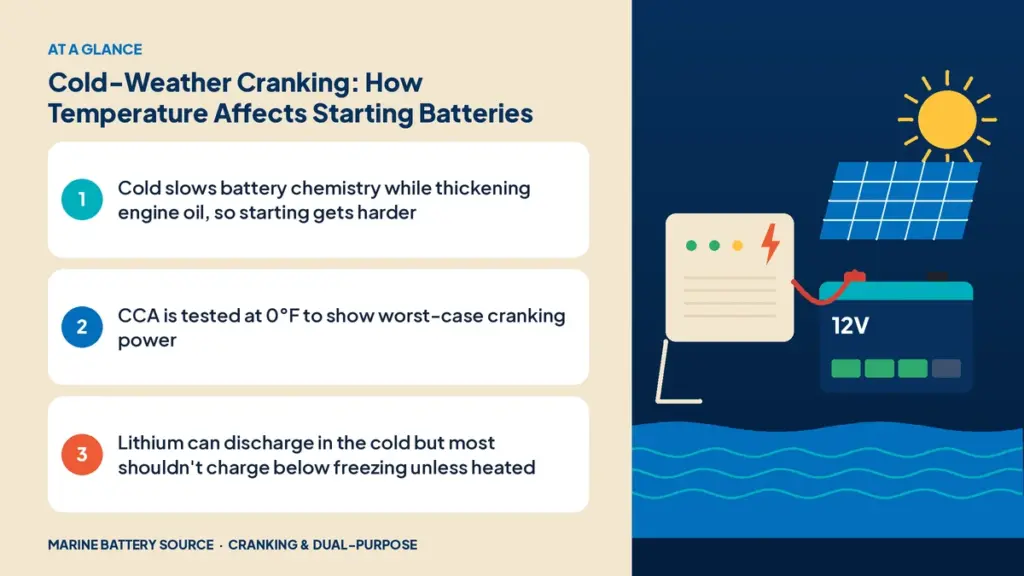
Why cold makes starting harder
Two things happen at once:
- The battery delivers less power. The chemical reactions inside a lead-acid battery slow down as temperature drops, and internal resistance rises. The battery can’t deliver as much current, and its voltage sags more under load.
- The engine needs more power. Engine oil thickens in the cold, increasing the effort needed to turn the engine over.
The combination means a battery that starts the engine easily in summer may struggle in early spring or late fall.
What CCA measures
Cold cranking amps (CCA) is the current a fully charged 12V battery can deliver for 30 seconds at 0°F while keeping voltage at or above 7.2V. It’s a deliberately harsh test designed to represent cold-weather starting. Marine cranking amps (MCA) use the same test at 32°F, so MCA is always higher. For more on the two ratings, read our guide to battery types and ratings.
If you boat in cold weather, CCA is the more relevant number. If you only boat in warm months, MCA better reflects your conditions, but meeting the CCA spec gives extra margin.
State of charge matters more in the cold
A partly discharged lead-acid battery has even less cranking power in cold weather. It’s also more vulnerable to freezing: a fully charged lead-acid battery resists freezing well, while a deeply discharged one can freeze at temperatures not far below 32°F, which can crack the case and ruin the battery. Keep batteries charged in cold weather, especially in storage.
Lithium in the cold
LiFePO4 batteries behave differently:
- Discharge: many lithium batteries can discharge, and therefore crank, at temperatures well below freezing, though output drops. Check each battery’s specification for its discharge temperature range.
- Charging: most lithium batteries should not be charged below about 32°F. Charging cold lithium cells can damage them, so the BMS typically blocks it.
- Heated batteries: some lithium batteries include internal heaters that warm the cells before accepting charge. The Dakota Lithium DL 12V 135Ah heated is a cranking-rated example, listed at 1000 CCA.
If your engine starts on a cold morning and immediately tries to charge a non-heated lithium battery, the BMS may block charging until the battery warms. See lithium cranking batteries and charging systems for more on this interaction.
Heat: the other enemy
Cold makes starting harder in the moment, but heat shortens battery life over time. High temperatures accelerate plate corrosion and water loss in lead-acid batteries. That’s why batteries in hot climates or hot engine compartments often fail sooner than identical batteries in cooler conditions. Heat also increases self-discharge.
Many batteries fail in cold weather because heat weakened them in summer. The damage happens in July; the no-start happens in November.
Practical tips for cold-weather boating
- Choose margin. Buy a battery whose CCA comfortably exceeds the engine’s minimum, especially if you boat in shoulder seasons.
- Keep it charged. Use a maintainer or shore charger between trips.
- Test before the cold arrives. A conductance or load test in early fall shows whether the battery still meets the spec.
- Keep connections clean. Cold amplifies the effect of resistance in corroded terminals.
- Minimize accessory loads before starting. Turn off electronics and lights while cranking.
- Carry a backup. A jump pack is valuable insurance on cold mornings; see emergency starting options.
Practical tips for hot climates
- Ventilate battery compartments.
- Keep batteries out of direct sun where possible.
- Check flooded battery electrolyte levels more often.
- Expect shorter battery life and test more frequently.
- Consider AGM or lithium, which avoid the water loss problems of flooded batteries.
Battery choices by climate
| Conditions | Good choices |
|---|---|
| Cold shoulder seasons | High-CCA starting or AGM battery; heated lithium if using lithium |
| Hot climates | AGM or lithium in a ventilated location; check flooded batteries frequently |
| Year-round mixed | Battery with CCA margin, kept charged and tested seasonally |
Strong cranking examples from the store include the Interstate 24M-XHD (800 CCA) and the Interstate 31M-AGM (925 CCA).
Dual-purpose batteries in the cold
If your starting battery also runs electronics, a cold day hits twice: the electronics drain reduces state of charge, and the cold reduces cranking power. Size accordingly; see sizing a dual-purpose battery for electronics.
Charging in cold weather
Lead-acid batteries charge more slowly when cold, and many smart chargers compensate with temperature sensors. Charging on the water from the outboard may not fully recharge a cold battery during short runs. Read charging on the water for options.
Signs cold is exposing an aging battery
- The engine cranks noticeably slower on cool mornings than it did last year.
- The battery needs a jump after a cold night but works fine in the afternoon.
- A test shows CCA well below the battery’s rating.
When that happens, plan a replacement. Our guide on when to replace a marine starting battery explains how to decide. For the complete process, read choosing a boat starting battery, and browse cranking batteries in the store.
Frequently asked questions
How does cold weather affect boat batteries?
Cold slows the battery’s chemistry and increases internal resistance, so it delivers less cranking current, while engine oil thickens and makes the engine harder to turn over.
Why is CCA tested at 0°F?
To represent difficult cold-weather starting. It shows how much current the battery can deliver in harsh conditions.
Can lithium batteries start an engine in cold weather?
Many can discharge in the cold, though output drops. Most shouldn’t be charged below about 32°F unless they have internal heating.
Can a boat battery freeze?
A discharged lead-acid battery can freeze not far below 32°F, which can crack the case. Keeping it fully charged greatly reduces the risk.