


Bluetooth Lithium Batteries: Is App Monitoring Worth It?
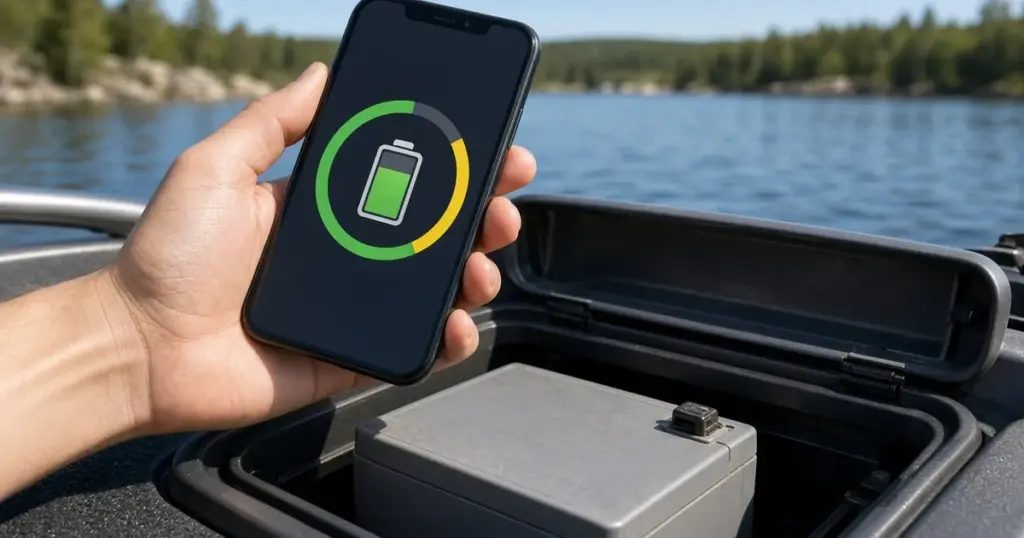
Many lithium marine batteries now come with Bluetooth built in. Pair your phone and you can see state of charge, current flow, temperature and sometimes individual cell voltages. It sounds like a gadget feature, but on a lithium battery it solves a real problem. This guide explains what Bluetooth lithium battery monitoring shows, how much to trust it, its limits on a boat, and when you’d be better off with a dedicated battery monitor.
Why lithium benefits from monitoring
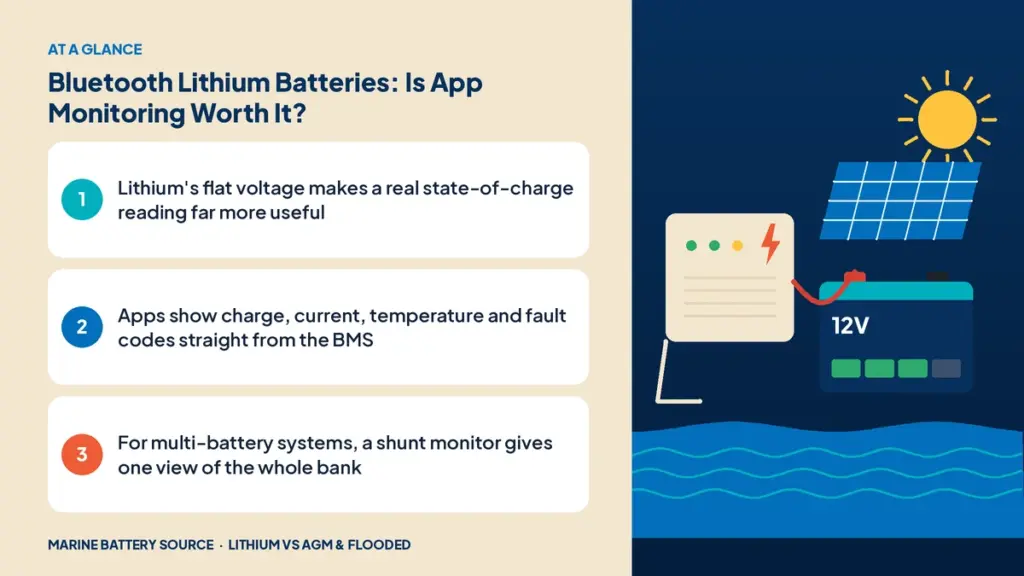
Lead-acid batteries give you a rough fuel gauge in their voltage: it falls steadily as they discharge. LiFePO4 holds an almost flat voltage across most of its capacity, then drops quickly near empty. A voltmeter or the simple LED gauge on a trolling motor might show “full” for hours, then fall off a cliff. Our article on lithium and lead-acid discharge curves explains why. A real state-of-charge reading takes the guesswork out of planning your day.
What a typical battery app shows
Features vary by brand, but common readouts include:
- State of charge (SOC) as a percentage.
- Voltage of the battery and sometimes each cell.
- Current in or out, showing whether you’re charging or discharging and how fast.
- Temperature inside the battery.
- Estimated time remaining at the present load.
- Protection status and fault history, such as low-temperature charge blocking or overcurrent events.
- Cycle count and capacity estimates on some models.
Batteries in the store with Bluetooth
The store’s listings flag Bluetooth on many models, including:
- EPOCH’s Essential series, such as the EPOCH 12V 105Ah Essential and the EPOCH 12V 300Ah Essential.
- EPOCH’s dual-purpose 12V 172Ah.
- The ECO Battery 12V 120Ah heated Bluetooth battery.
- Lithium Rhino’s marine conversion kits.
- The Dakota Lithium 48V 105Ah.
Other models, including many Dakota Lithium and Battle Born base batteries, are listed without Bluetooth. Battle Born’s 100Ah batteries list Bluetooth as varying by variation, so check which version you’re buying.
How accurate is the app?
The app reports what the BMS calculates. Most BMS units estimate state of charge by counting current in and out, a technique called coulomb counting, and periodically reset the estimate when the battery reaches full charge. That has two implications:
- Accuracy improves with regular full charges. If you rarely charge to 100%, the estimate can drift.
- Small currents may be missed. Very low loads can fall below what the BMS measures, so long periods with small parasitic draws can make the estimate optimistic.
For day-to-day use, a BMS-based reading is far better than guessing from voltage.
The limits on a boat
Range and hulls
Bluetooth is short range, and fiberglass, aluminum, batteries and water all weaken the signal. A battery deep in a stern compartment may not connect from the helm. Test it in your boat; you may need to stand closer, or open the hatch.
One app per battery
In a series bank of three 12V batteries, each battery may report separately. That’s useful for spotting imbalance, but you won’t get a single “bank” number unless the app combines them.
Phones and fishing
Checking your phone for battery status is fine at the ramp. While running the boat, it’s a distraction, and some anglers prefer a fixed display.
When a shunt-based battery monitor is better
A shunt monitor measures all current flowing through the negative cable of a bank and shows the result on a display or app. It’s a better choice when:
- You have several batteries or a mixed system and want one reading for the whole bank.
- Your batteries don’t have Bluetooth.
- You want a permanent display at the helm or nav station.
- You want history and alarms for a house bank on a cruising boat.
Some owners use both: a shunt for the bank and the batteries’ own apps for cell-level details.
What to watch in the app
- SOC before you leave the dock so you know what you’re starting with.
- Current draw at your common trolling settings to learn your real-world numbers.
- Temperature on hot days or in winter.
- Cell voltages, if shown. A cell that drifts away from the others is worth raising with the maker.
- Fault logs after any unexpected shutdown. Our BMS guide explains what the protections mean.
Using the data to plan
After a few trips, you’ll know how many amp-hours a typical day takes. That tells you whether your battery has enough margin or whether to add capacity. Over months, the app can also show how capacity holds up, which ties into what cycle life ratings mean.
Monitoring and cold weather
In cold weather, the app tells you when the battery is too cold to accept a charge and, on heated batteries, whether the heaters are running. See heated lithium batteries for more.
Is Bluetooth worth paying for?
It’s worth it if:
- You run a trolling motor hard and want to know exactly how much is left.
- Your battery is the main power source for a kayak, skiff or small boat with no other gauge.
- You want easy troubleshooting and fault history.
It’s less important if you already have a shunt monitor or the battery has a reliable built-in indicator.
If you’re comparing batteries, the lithium marine battery buyer’s guide covers Bluetooth alongside heating, current ratings and fit. If you’re adding lithium to a boat that also has lead-acid batteries, read whether you can mix them first. Browse lithium batteries to compare models with and without Bluetooth.
Frequently asked questions
Do lithium batteries need Bluetooth?
No, but it helps. Because LiFePO4 voltage stays flat, a BMS-reported state of charge is much more useful than a voltage reading.
How far does battery Bluetooth reach on a boat?
It’s short range, and hulls, compartments and other batteries reduce it. Check the connection from where you’ll actually stand on your boat.
Can I see all my batteries in one app?
It depends on the brand. Many apps show each battery separately. A shunt-based monitor gives one reading for a whole bank.
Why does my battery app show the wrong percentage?
The estimate can drift if the battery isn’t regularly charged to full, or if small loads aren’t captured. A full charge usually resets it.