


Marine Battery Chemistry Guide: Lithium vs AGM vs Flooded
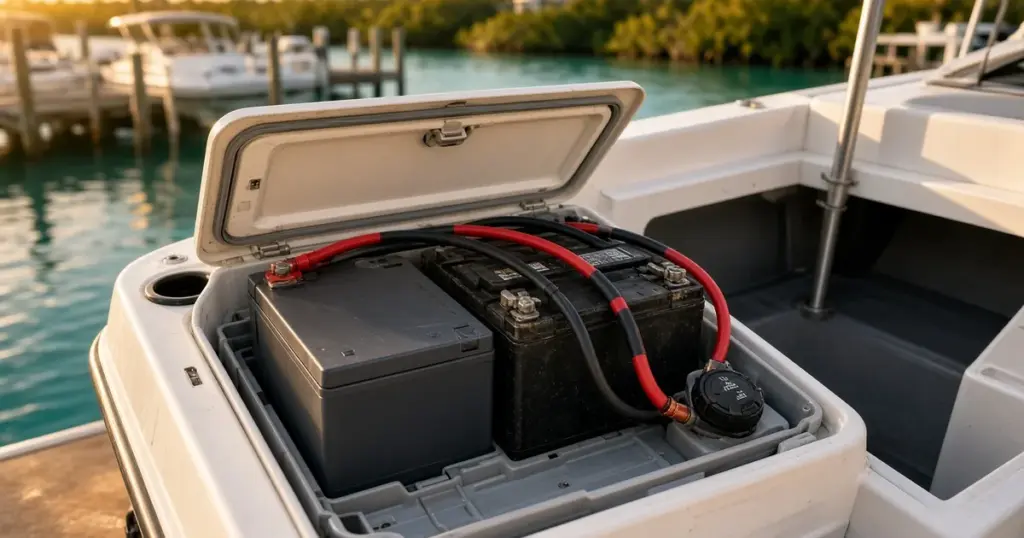
Every marine battery stores energy with chemistry, and the chemistry you pick shapes almost everything else: how much the battery weighs, how much of its rating you can actually use, what charger you need, how often you have to touch it and how long it lasts. Most boaters choose between three families: flooded lead-acid, AGM (absorbed glass mat) lead-acid and lithium iron phosphate (LiFePO4). This guide explains how each one works, where each one shines, and how to match chemistry to the job each battery does on your boat.
The three chemistries in one paragraph each
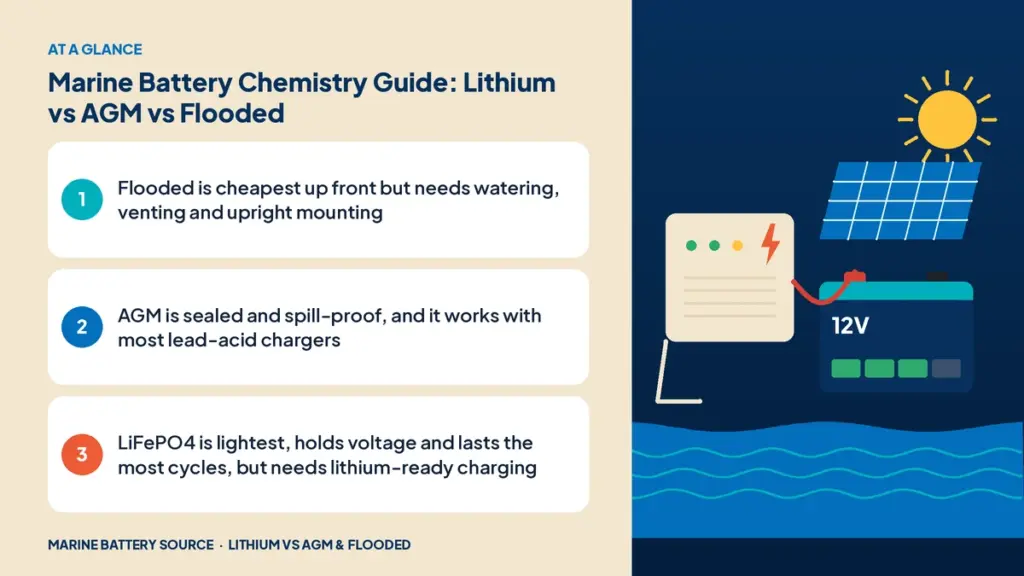
Flooded lead-acid is the original deep-cycle and starting battery. Lead plates sit in liquid sulfuric acid electrolyte, the cells vent gas while charging, and you top them up with distilled water. They’re the least expensive way to buy amp-hours, and well-built flooded deep-cycle batteries such as the Trojan 27TMX have a long track record.
AGM is still lead-acid, but the electrolyte is held in glass-fiber mats between the plates and the case is sealed with pressure-relief valves. You never add water, it won’t spill if the case cracks, and it tolerates vibration better than most flooded designs. It costs more than flooded and weighs about the same or more for the same capacity.
LiFePO4 lithium uses lithium iron phosphate cells managed by a built-in battery management system (BMS). It weighs a fraction of lead-acid, delivers most of its rated capacity, holds a nearly flat voltage until it’s close to empty, and is rated for thousands of cycles. It costs the most up front and needs a charger, and sometimes alternator protection, set up for lithium.
Side-by-side comparison
| Factor | Flooded | AGM | LiFePO4 lithium |
|---|---|---|---|
| Upfront cost | Lowest | Moderate | Highest |
| Weight for the same usable energy | Heaviest | Heavy | Lightest |
| Typical regular depth of discharge | About 50% | About 50% | 80% to 100% (check the maker) |
| Voltage under load | Sags steadily | Sags steadily | Nearly flat until near empty |
| Maintenance | Watering, cleaning, equalizing | Keep charged and clean | Keep charged and clean |
| Mounting | Upright, ventilated | Any orientation the maker allows | Any orientation the maker allows |
| Charger | Flooded profile | AGM profile | Lithium/LiFePO4 profile |
| Cold charging | Yes | Yes | Not below freezing unless heated |
Those depth-of-discharge figures are common planning rules, not hard limits. Lead-acid batteries can go deeper, but their life drops sharply when they’re cycled hard every trip. We explain the numbers in our guide to lithium and lead-acid discharge curves.
Weight: the difference you feel first
Weight is where lithium wins most clearly. Compare two real batteries the store carries. The Trojan 31-AES AGM is listed at 69 lb. The EPOCH 12V 105Ah Essential lithium is listed at 22.1 lb. On a bass boat with a three-battery 36V trolling bank, swapping lead-acid for lithium can take well over 100 lb out of the boat. That affects hole shot, top speed, fuel burn, draft and how the boat sits on the trailer. See how much weight a lithium marine battery saves for worked examples.
Usable capacity: why amp-hours aren’t equal
A 100Ah rating means different things across chemistries. If you plan to use only about half of a lead-acid battery’s capacity day to day, a 100Ah AGM gives you roughly 50Ah of everyday energy. A 100Ah LiFePO4 battery used to 80% or 90% gives you 80 to 90Ah. Lead-acid capacity also shrinks at high discharge rates, so a big trolling motor running hard pulls even less from it. Lithium is much less affected by load.
The practical result is that a smaller lithium battery often matches a larger lead-acid one in real runtime. That’s also why comparing price per rated amp-hour can mislead you. Compare price per usable watt-hour instead.
Voltage behavior and performance
Lead-acid voltage falls steadily as it discharges. A trolling motor slows down through the day, and electronics can brown out during engine cranking. LiFePO4 stays close to its nominal voltage for most of its discharge curve. Your motor holds speed, and your sonar sees steady voltage. The flip side is that lithium voltage tells you little about state of charge in the middle of the curve, so a battery monitor or Bluetooth app is more useful with lithium.
Charging: the part people get wrong
Each chemistry wants a different charge profile:
- Flooded batteries like higher absorption voltages and periodic equalization.
- AGM batteries need tighter voltage control and should not be equalized unless the maker says so.
- LiFePO4 batteries want a constant-current, constant-voltage charge to the maker’s voltage, with no equalization and usually no long float.
Use a charger with a matching profile. Many modern onboard chargers have selectable modes, and lithium-specific chargers like the EPOCH 12V 15A lithium charger are built for the job. Engine alternators can usually charge lead-acid directly. With lithium, follow the battery and engine makers’ guidance, and consider a DC-DC charger to protect the alternator. The step-by-step process is in our guide to converting your boat to lithium.
Maintenance and installation
Flooded batteries need the most care: checking electrolyte levels, adding distilled water, cleaning acid residue and venting hydrogen safely. AGM and lithium are effectively maintenance-free apart from clean, tight connections and proper charging. All three must be secured against movement, and every installation needs proper fusing near the battery.
Lifespan and cost of ownership
Lead-acid deep-cycle batteries are often rated for hundreds of cycles at moderate depth of discharge, depending on the model and how they’re treated. LiFePO4 makers commonly rate their batteries for thousands of cycles. Dakota Lithium, for example, lists up to 80% capacity after 5,000 cycles in recommended conditions for many of its batteries. If you cycle your batteries hard and often, lithium usually costs less per cycle over its life even though it costs more at the register. If you use your boat a few weekends a year, the math is closer. Run your own numbers with our lithium vs AGM cost-per-cycle guide, or read whether lithium is worth it for your boat.
Matching chemistry to the job
Starting batteries
Flooded and AGM starting batteries remain the default for most outboards and inboards. They’re inexpensive, tolerant of alternator charging and good at high-current bursts. Some lithium batteries are built for cranking, but check your engine maker’s position first.
Trolling motor batteries
This is where lithium makes the biggest difference: deep daily cycling, a steady motor speed and big weight savings. AGM remains a sensible budget option. Browse lithium marine batteries or the AGM and lead-acid range.
House banks
For cruisers and liveaboards, lithium’s usable capacity and fast charging can shrink generator time. Large flooded banks of 6V batteries are still a cost-effective classic if you can maintain them and carry the weight.
Other chemistries you’ll hear about
Gel batteries are a sealed lead-acid variant with electrolyte thickened into a gel. They’re less common in marine retail today; see gel vs AGM marine batteries. EFB (enhanced flooded) batteries are a tougher flooded design used in some marine starting and dual-purpose models, covered in our EFB explainer. And not all lithium is LiFePO4. Our LiFePO4 vs lithium-ion guide explains why boat batteries almost always use iron phosphate. If you’re still choosing between the two lead-acid types, start with flooded vs AGM.
Quick decision guide
- Tightest budget, easy access, willing to maintain: flooded deep cycle.
- Sealed, no maintenance, existing lead-acid charger: AGM.
- Lightest weight, longest life, heavy daily use: LiFePO4 lithium with a lithium-ready charger.
- Not sure: start with the job each battery does, then use our lithium marine battery buyer’s guide to see if lithium fits.
Frequently asked questions
Is lithium always better than AGM for a boat?
No. Lithium is lighter, lasts more cycles and delivers more usable capacity, but it costs more and needs compatible charging. For an occasionally used starting battery, an AGM or flooded battery is often the better value.
Can I put a lithium battery in place of my AGM without changing anything else?
Sometimes, but check your charger, your alternator charging and your fusing first. Many lead-acid chargers lack a lithium profile, and alternators may need a DC-DC charger to charge lithium safely.
How much of a lead-acid battery’s capacity can I use?
A common planning rule is about 50% for regular cycling. Going deeper occasionally won’t ruin a deep-cycle battery, but doing it every trip shortens its life.
Do AGM batteries need a special charger?
They need a charger with an AGM setting or a profile that matches the maker’s voltages. Most modern marine chargers include one.