


Scallop Season Boat Prep: Batteries for Gulf Coast Trips
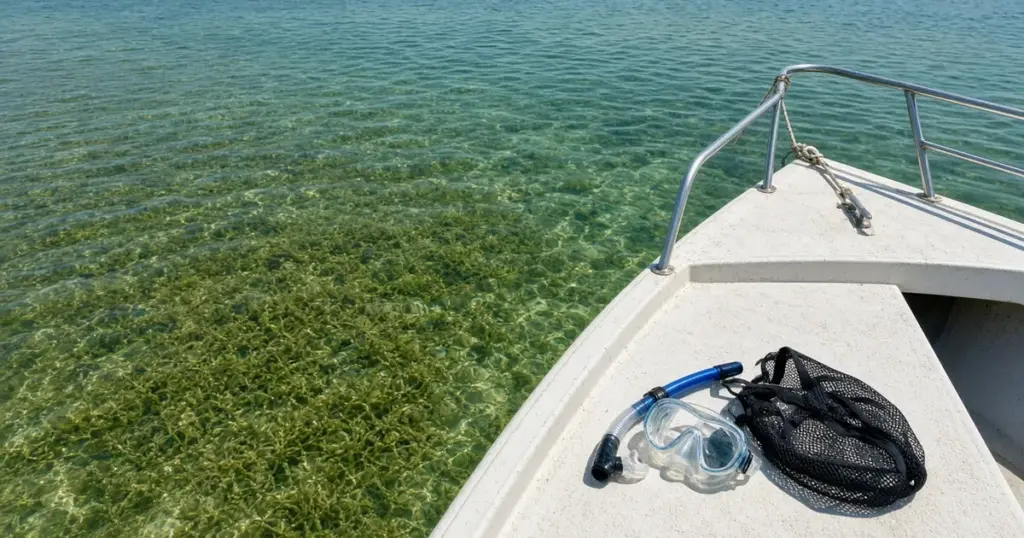
Florida’s bay scallop season is one of the most popular family boating weekends of the year. Boats leave crowded ramps early, run to shallow grass flats, anchor or drift, and then move again and again as the group snorkels for scallops. All that stop-and-start boating is hard on a battery. The engine is shut off and restarted many times, the stereo and livewell or aerator run at anchor, and the boat may sit in hot sun all day. This guide covers how to get your boat’s electrical system ready so the day ends at the ramp, not with a tow.
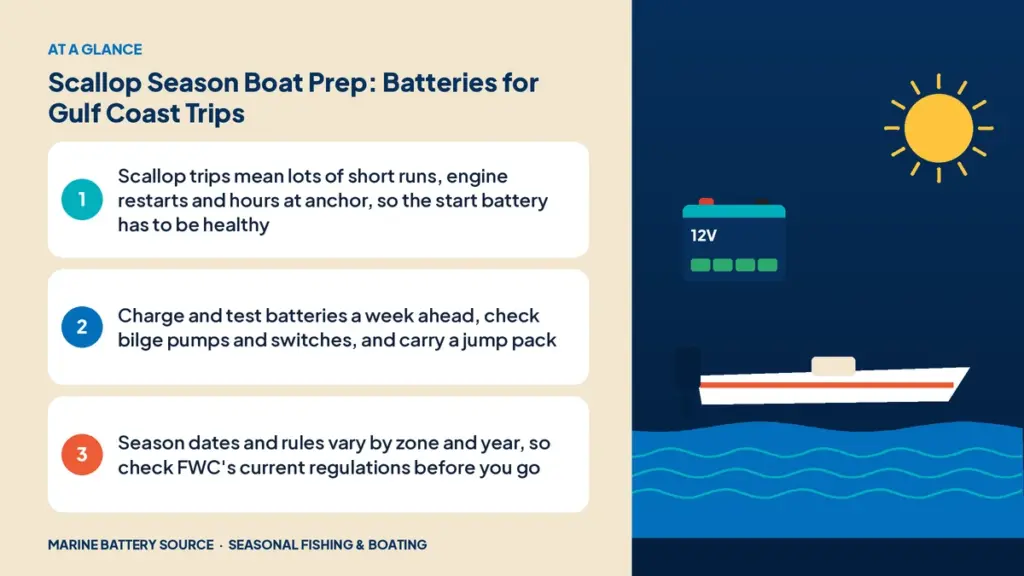
Season dates, bag limits and open areas are set by the Florida Fish and Wildlife Conservation Commission (FWC) and vary by zone and year. Always check FWC’s current scallop rules before you plan a trip; this guide covers the boat, not the regulations.
Why scallop trips are hard on batteries
Most boat trips involve a long run out, a few hours of fishing and a long run back. The engine’s charging system has plenty of time to refill the start battery. Scallop trips are different:
- Many restarts. Every move to a new patch of grass means another crank. Each start takes energy from the battery, and short hops between spots don’t give the alternator much time to put it back.
- Long periods at anchor. While everyone is in the water, the engine is off but the stereo, lights, livewell, bilge pump and electronics may still be running.
- Heat. July and August sun heats battery compartments, which speeds up self-discharge and aging in lead-acid batteries.
- Crowds. Busy flats and ramps are the worst places to discover a dead battery.
If your boat has a single battery that both starts the engine and runs accessories, the risk is higher. A dual-battery setup with a battery switch or automatic charging relay keeps one battery reserved for starting. See the seasonal battery calendar for when to schedule this kind of upgrade.
One week before: charge and test
Give yourself time to fix problems. A week before the trip:
- Fully charge every battery with a smart charger set to the right chemistry.
- Let it rest for several hours, then check resting voltage. A flooded 12V battery should read about 12.6–12.7V when full; AGM is usually about 12.8V. LiFePO4 rests around 13.3–13.4V when full, but voltage alone isn’t a reliable gauge for lithium, so use the battery’s app or monitor.
- Load test lead-acid start batteries. A healthy battery should stay above about 9.6V at half its CCA rating for 15 seconds. Many parts stores will test it for you.
- Check terminals. Clean any corrosion, tighten connections and make sure the cables aren’t cracked or chafed.
- Check water in flooded batteries and top up with distilled water if needed.
If a lead-acid battery is more than three or four seasons old and fails the load test, replace it now rather than hoping it lasts the weekend.
Bilge pumps and switches
Scallop boats take on water: people climb in and out over the gunwale, wet gear piles up and spray comes over the bow on the run. Make sure:
- The bilge pump runs when you flip the manual switch.
- The float switch turns the pump on when you lift it.
- The pump’s fuse is the right size and the wiring isn’t corroded.
- The bilge is clear of debris that could clog the pump intake.
An automatic bilge pump is usually wired to the battery so it works even with the main switch off. That’s good for safety, but a stuck float switch can drain a battery overnight at the dock. If you find the battery low the morning of the trip, check the pump first.
At anchor: managing the load
Plan your power use for the hours you’ll spend anchored or drifting.
| Load | Typical draw | Notes |
|---|---|---|
| Stereo (moderate volume) | 3–10A | Amplified systems can draw much more |
| Livewell or aerator pump | 2–5A | Often not needed for scallops, but used for bait |
| Chartplotter/fishfinder | 1–3A | Turn off at anchor if you don’t need it |
| Bilge pump | 2–8A | Short cycles; matters most if a float switch sticks |
| Anchor light | Under 1A (LED) | Only needed after dark |
| Phone chargers and fans | 1–3A each | Add up quickly with a full boat |
A stereo at moderate volume plus a few phone chargers might use 8–12A. Over four hours at anchor, that’s 32–48Ah, which is a big share of a single group 24 or 27 lead-acid battery’s usable capacity. That’s why a separate house battery, or at least turning loads off between stops, makes a difference. For more on estimating this, see fishing trip power planning.
Starting the engine many times
Each engine start draws a large current for a few seconds. One start uses only a small amount of energy, but a dozen starts with short runs between them can add up, especially if the stereo is draining the same battery at anchor. Tips:
- Use the battery switch to isolate the start battery while you’re anchored, if your boat has two batteries.
- Run the engine a little longer between stops when you can, to give the charging system time to work.
- Avoid cranking for more than a few seconds at a time. If the engine doesn’t start, wait and try again rather than holding the key.
- Carry a portable jump pack. It’s the easiest way to get going if the battery runs low.
Safety gear that depends on power
Florida requires a divers-down warning device when snorkelers or divers are in the water, and boaters must keep their distance from it. Check FWC for the current size and display rules. Other safety items that rely on the battery:
- VHF radio. Make sure it powers on and transmits.
- Navigation lights. Late returns are common on long scallop days; test them before you leave.
- Horn. A quick check takes seconds.
- Bilge pump. Covered above, but worth repeating.
Coolers, ice and weight
Scallop trips mean big coolers and a full boat. Keep heavy coolers and gear off battery boxes so vents stay clear and you can reach the battery switch. Make sure batteries are firmly strapped down; a boat that runs through chop with a full load puts extra stress on battery mounts and cables.
Lithium for scallop boats
Many scallop boats are small center consoles or bay boats with limited space. A lithium house battery can save weight and handle repeated discharges better than lead-acid. Lithium also recharges quickly, so short runs between spots put back more energy. If you add one, use a charger with a LiFePO4 profile and confirm your engine’s charging system can support it, often with a DC-to-DC charger. For gift ideas and small accessories that help on days like this, see gifts for boaters.
Back at the ramp
At the end of the day:
- Turn the battery switch off once the boat is on the trailer, unless your bilge pump needs it.
- Rinse salt and sand off terminals and switches if they got wet.
- Charge batteries fully as soon as you get home. A lead-acid battery left partly discharged in summer heat loses capacity quickly.
- Note any problems, such as slow cranking or a pump that didn’t run, so you can fix them before the next trip.
Planning other summer trips
Scallop season overlaps with other big summer weekends. Many of the same steps apply to Fourth of July boating and Memorial Day weekend. Fall brings redfish and snook trips with longer trolling motor days; see redfish and snook season power. When the season ends, follow winter storage steps if the boat will sit.
Products that help
- EPOCH 12V 15A lithium charger
- Interstate group 27M AGM dual-purpose battery
- Dakota Lithium 12V 60Ah dual-purpose battery
- Browse dual-purpose batteries.
Frequently asked questions
How do I keep my boat battery from dying on a scallop trip?
Charge and test it a week ahead, use a separate battery for starting if you can, turn off loads at anchor and carry a jump pack.
Do I need a second battery for scalloping?
It isn’t required, but a second battery keeps starting power in reserve while the stereo and other loads run at anchor.
Why does my battery die after many short runs?
Each start uses energy, and short runs don’t give the charging system enough time to replace it, especially if accessories are draining the same battery.
When is Florida scallop season?
It varies by zone and year. Check FWC’s current scallop regulations before you go.
Should I charge my battery after a scallop trip?
Yes. Charge it fully as soon as possible, because a partly discharged lead-acid battery loses capacity quickly in summer heat.