


Summer Boat Battery Tips

Summer is peak boating season, and it’s also tough on batteries. Heat speeds up the chemistry inside every battery, which helps cranking power on a hot morning but shortens life over time. In Florida, where battery compartments can get very hot for months, summer care matters even more. This guide covers how to keep batteries healthy through the heat.
How heat affects batteries
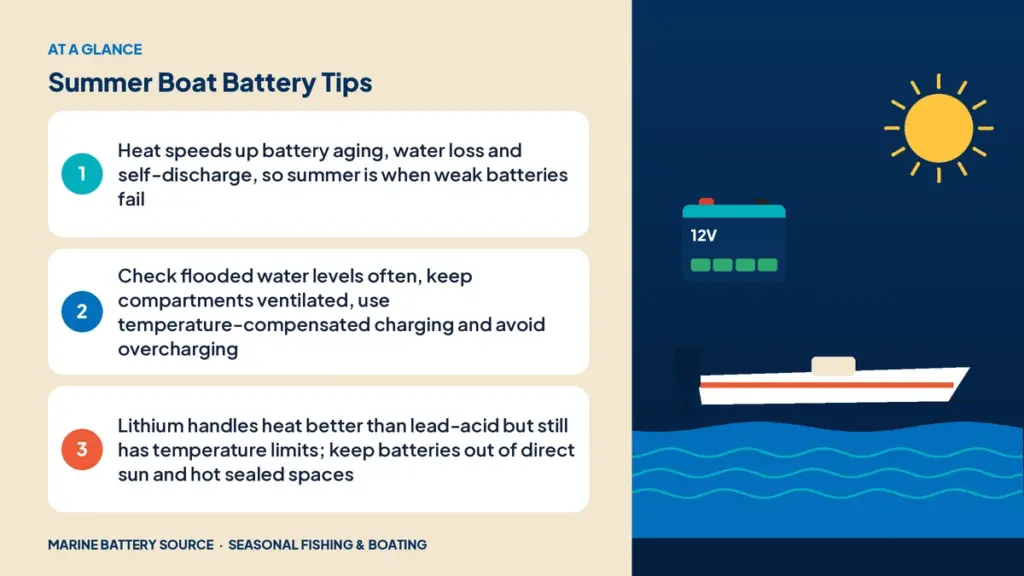
Lead-acid and AGM: heat accelerates plate corrosion and water loss, increases self-discharge and makes overcharging more likely at a given voltage. Many lead-acid batteries that “die in winter” were actually damaged the previous summer; cold just reveals the weakness.
LiFePO4 lithium: lithium handles heat better than lead-acid, but cells still age faster at high temperatures, and the BMS may limit charging or discharging if the battery gets too hot. Listings show charge temperature ranges; EPOCH’s 12V 100Ah Eco lists 32°F to 131°F, for example.
Tip 1: Check water often
Flooded batteries lose water faster in heat. Check levels every couple of weeks in summer, after charging, and top up with distilled water to the maker’s level. Low water exposes plates and ruins batteries quickly.
Tip 2: Ventilate
Hot, sealed compartments make batteries hotter. Keep vents clear, don’t pile gear on battery boxes, and open hatches when the boat is at the dock in the sun if it’s practical and safe. See the seasonal battery calendar for timing.
Tip 3: Set chargers correctly
- Use the right profile for each chemistry.
- Use temperature compensation if your charger has a sensor; it lowers lead-acid charging voltage in heat.
- Make sure the charger drops to float or stops when the battery is full.
- Watch for hot batteries, swelling or a sulfur smell after charging; those are overcharging signs.
Tip 4: Keep batteries charged
Heat increases self-discharge. A boat that sits for two weeks in July can lose more charge than it would in a cooler month. Keep batteries on a smart maintainer at the dock, or check and recharge them weekly. A fully charged 12V flooded battery reads about 12.6–12.7V at rest.
Tip 5: Hunt down parasitic drains
Stereo memory, bilge pump float switches, radios and electronics can slowly drain batteries. With everything off, typical drain should be small, often under about 25 mA. If batteries are flat after a week at the dock, find the drain. Turn the battery switch off when you leave the boat, leaving only automatic bilge pumps connected through their own fuses.
Tip 6: Protect from direct sun
Batteries in open boats or exposed compartments can get very hot. Use covered battery boxes, keep consoles shaded with a cover, and avoid leaving spare batteries in a hot vehicle.
Tip 7: Check connections
Heat and humidity speed corrosion, especially near saltwater. Clean terminals, tighten connections and apply protectant spray. Corroded connections run hot under load.
Tip 8: Plan for heavy summer loads
Summer means stereos, livewells running all day, fans, lights and long afternoons at anchor. If your battery runs low by late afternoon, add capacity or a separate house battery. See Fourth of July boat power for party-day planning.
Tip 9: Watch the livewell
Livewell and aerator pumps run more in summer to keep bait and fish alive in warm water. They can draw a few amps each for hours. Factor that into your daily load. For bait-heavy trips, see fishing trip power planning.
Tip 10: Know the warning signs
- Slow cranking in the morning
- Batteries hot after charging
- Swollen cases
- Rapid water loss
- Lights dimming at anchor
Replace weak batteries before a big trip rather than after a failure. See our checklist in tournament season battery prep.
A summer maintenance routine
| Every trip | Every two weeks | Monthly |
|---|---|---|
| Check state of charge | Check flooded water levels | Clean and tighten terminals |
| Confirm battery switch position | Inspect for swelling or heat | Check charger operation and settings |
| Plug in charger after the trip | Look for corrosion | Test for parasitic drain if batteries run low |
Trailer boats in the heat
Trailer boats parked in a driveway or storage lot can bake in the sun for days. Use a cover to shade the console and battery compartment, keep a maintainer connected if you have power, or disconnect the batteries with the switch so small drains can’t flatten them. Before each trip, check charge levels rather than assuming the batteries are full.
Lithium in summer
Lithium is a good fit for hot climates: no watering, slow self-discharge and less heat-related damage than lead-acid. Still:
- Keep it out of direct sun and very hot sealed spaces.
- Watch for BMS temperature cutoffs on very hot days under heavy load.
- Store partly charged if the boat will sit for weeks.
Hurricane season
Summer is also hurricane season. Keep batteries charged so bilge pumps can run during storms, make sure batteries are secure, and plan how you’ll protect or remove them if the boat is hauled. After a storm, check for water damage.
Getting ready for fall
As summer winds down, check what the heat has done: water levels, capacity and case condition. Fall fishing pushes batteries hard, so start it with healthy ones. See fall fishing battery tips and, for Florida’s cooler months, winter fishing in Florida. Shopping for a boater? See gifts for boaters.
Products that help
- EPOCH 12V 15A lithium charger
- EPOCH 4-bank 12V charger
- EPOCH 12V 105Ah lithium
- Browse chargers and maintainers.
Frequently asked questions
Does heat kill boat batteries?
Heat shortens lead-acid battery life by speeding corrosion and water loss. Many winter failures start in summer.
How often should I check battery water in summer?
Every couple of weeks for flooded batteries, after charging.
Is lithium better in hot weather?
Generally yes, but keep it out of direct sun and very hot sealed spaces.
Why is my battery dead after a week at the dock?
Likely a parasitic drain plus faster self-discharge in heat. Check drains and use a maintainer.
Should I leave my charger on all summer?
Yes, if it’s a smart charger or maintainer with the right profile.