


Recycling Lithium Marine Batteries
Lithium marine batteries last a long time, often many years, but eventually they wear out, get damaged or are replaced in an upgrade. When that happens, they need proper recycling. Lithium batteries aren’t handled like lead-acid batteries, and the options can be less obvious. This guide covers what to do.
Why lithium batteries need special handling
- Fire risk: a lithium battery that’s crushed or shorted can overheat. In a garbage truck or landfill, that can start a fire.
- Valuable materials: recycling recovers lithium, iron, phosphate, copper, aluminum and other materials.
- Regulations: many jurisdictions prohibit lithium batteries in household trash, and shipping is regulated as hazardous materials.
First: is the battery really finished?
Lithium batteries often have life left. Before recycling:
- Check the BMS. A battery that’s been discharged too far may be in a protective shutdown. Some batteries recover when connected to a compatible charger; check the maker’s guidance.
- Check connections. Corroded terminals or a tripped fuse can look like a dead battery.
- Check the app. Bluetooth-enabled batteries may show state of health and fault codes.
- Contact the maker. If the battery is under warranty, a claim may be the right next step rather than recycling. Our warranty page explains how we help with claims.
See battery end-of-life signs for more.
Where to recycle lithium batteries
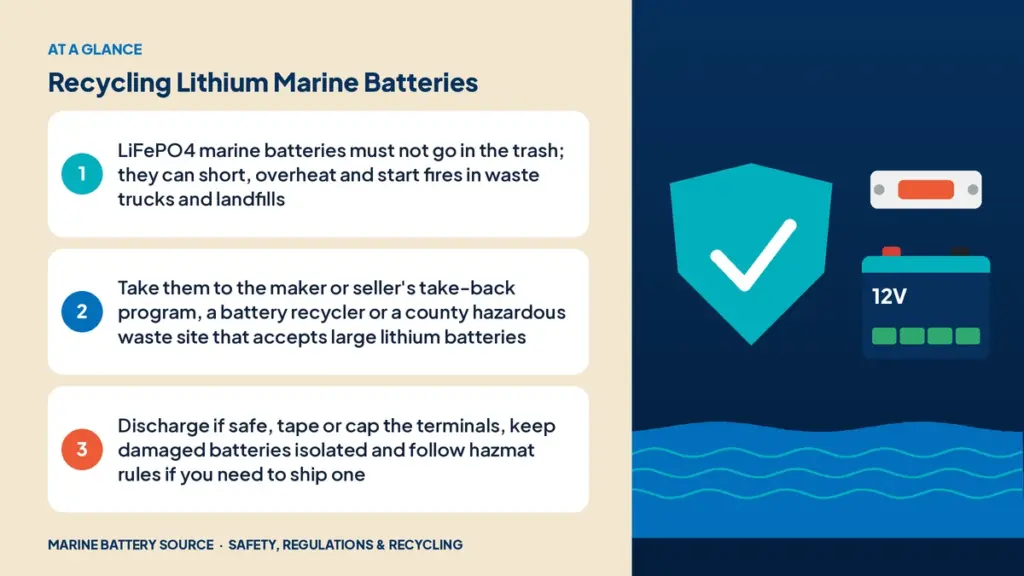
- Maker or seller take-back programs. Contact the battery maker or the store you bought it from.
- Specialized battery recyclers. Some accept large lithium batteries from consumers, sometimes for a fee.
- County household hazardous waste facilities. Many accept lithium batteries; some limit size. Call ahead.
- Retail collection points. Some stores collect rechargeable batteries, but most programs target small batteries, not marine-size ones.
Preparing a lithium battery for recycling
- Discharge it partly, if it’s healthy and safe to do so. A lower state of charge reduces risk during handling and transport.
- Disconnect it from the boat, negative first.
- Protect the terminals with non-conductive caps or electrical tape.
- Bag or box it separately from other batteries so terminals can’t touch.
- Keep it upright and secured for transport.
Damaged or swollen batteries
A swollen, cracked, punctured or overheated lithium battery needs extra care:
- Don’t charge or use it.
- Keep it outside or in a non-combustible container, away from flammables.
- Don’t puncture or crush it.
- Contact the maker, seller or recycler for instructions before transporting.
See lithium battery fire safety on boats.
Shipping a lithium battery for recycling or warranty
Lithium batteries are regulated as hazardous materials for shipping. Large lithium batteries usually ship by ground, with proper packaging, labeling and documentation, and damaged batteries have stricter rules. Don’t just box one up and drop it at a shipping counter. The maker or recycler will usually provide instructions or a prepaid shipping kit. See shipping lithium batteries.
Driving one to a recycler
If you take a battery yourself, follow how to transport a marine battery safely: terminals protected, battery secured, away from heat and fuel cans.
What happens at the recycler
Recyclers typically discharge the battery fully, dismantle the case, BMS and wiring, and then process the cells mechanically, chemically or with heat to recover materials. LiFePO4 batteries don’t contain cobalt or nickel, so the recovered materials differ from phone and EV batteries. Cases, copper cables and aluminum parts are recycled separately.
Lithium vs lead-acid recycling
Lead-acid recycling is mature and widely available; almost any battery retailer will take one. Lithium recycling is growing but still less convenient, which is one reason to buy from makers and sellers who support take-back. On the other hand, a lithium battery typically lasts many more cycles than a lead-acid battery, so you’ll recycle far fewer batteries over time. See the marine battery recycling guide for how both are handled.
Core charges and lithium
Core charges usually apply to lead-acid batteries, not lithium. See battery core charges explained.
Extending battery life
The best way to reduce recycling is to make batteries last:
- Use the correct LiFePO4 charger profile.
- Avoid charging below freezing without internal heating.
- Store partly charged in a cool, dry place.
- Keep terminals clean and tight.
- Fuse and secure the battery properly.
Reusing a healthy battery
If you’re upgrading rather than replacing a failed battery, a healthy lithium battery may have years of life left. Consider reusing it as a power source for a kayak, a shed, a camper or emergency backup, as long as it’s in good condition and used within its specs. Passing it on to another boater is another option. Recycle it only when it’s genuinely at end of life.
Recycling the rest of the system
A lithium conversion often leaves behind other items: old lead-acid batteries, chargers that can’t charge lithium, and cables. Recycle the lead-acid batteries through a retailer or recycler, and take old chargers and wire to an electronics or scrap metal recycler. Copper cable has scrap value.
Quick checklist
- ☐ Confirm it’s really at end of life, or claim warranty
- ☐ Disconnect safely
- ☐ Tape or cap terminals
- ☐ Isolate damaged batteries
- ☐ Contact the maker, seller, recycler or county site
- ☐ Follow shipping instructions if mailing it
- ☐ Never put it in the trash
More reading
For safe handling of every battery type, see the marine battery safety guide, and for lead-acid batteries, see how to dispose of a boat battery.
Replacing your battery
Browse our lithium batteries or compare EPOCH, Battle Born and Dakota Lithium models.
Frequently asked questions
Can I throw a lithium boat battery in the trash?
No. Lithium batteries can start fires in trash trucks and landfills, and many places prohibit it.
Where do I recycle a LiFePO4 battery?
Through the maker or seller’s take-back program, a battery recycler or a county hazardous waste site that accepts large lithium batteries.
Can I mail a lithium battery to a recycler?
Only following hazardous materials shipping rules. Ask the recycler or maker for instructions.
What should I do with a swollen lithium battery?
Stop using it, keep it away from flammables and contact the maker or a recycler for guidance.
Is there a core charge on lithium batteries?
Usually not. Core charges typically apply to lead-acid batteries.