


Trolling Motor Won’t Turn On: Battery and Wiring Checks
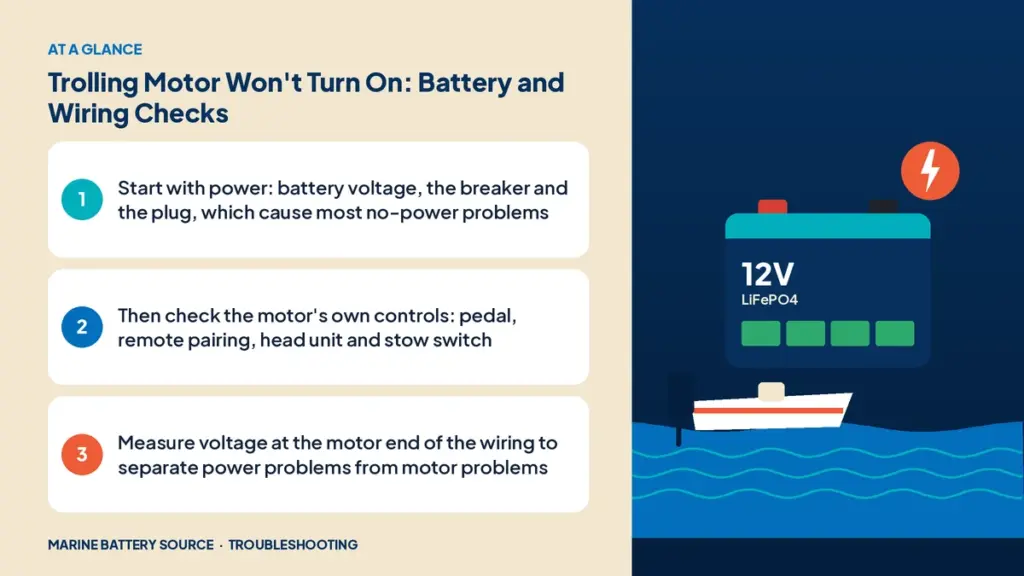
You hit the pedal or the remote, and nothing happens. No hum, no prop, no lights on the head. A trolling motor that won’t turn on is frustrating, but the fix is usually simple once you work through the possibilities in order. Most no-power problems come down to the battery, the breaker, the plug or the wiring. Here’s how to work through them.
Step 1: Battery voltage
Measure voltage at the battery terminals.
- 12V system: about 12.6V or higher for lead-acid; about 13.2V or higher for lithium.
- 24V system: about double.
- 36V system: about triple.
If the bank reads low, charge it fully and try again. If a lithium battery reads zero or near zero, the BMS may have disconnected it; see lithium battery BMS shutdown.
In series banks, check each battery individually and check the jumper cables between them.
Step 2: Circuit breaker or fuse
Trolling motors should have a breaker or fuse near the battery. Check whether it’s tripped. Reset it, and if it trips again immediately, there may be a short. If it won’t reset, it may have failed.
Step 3: Plug and receptacle
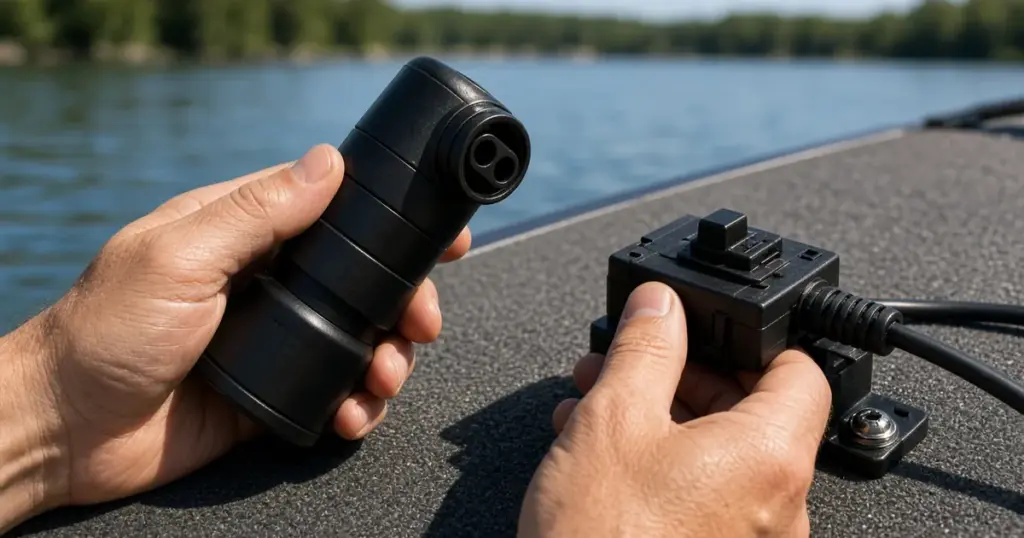
- Make sure the plug is fully seated.
- Look for corroded, bent or burned pins.
- Check for voltage at the receptacle with the plug removed (carefully, using the correct pins).
Corroded plugs are one of the most common causes of a dead trolling motor on saltwater boats.
Step 4: Wiring
- Follow the wires from the battery to the receptacle.
- Look for chafed insulation, loose lugs and corrosion.
- Check the connections in the battery compartment.
Measure voltage at the motor end of the wiring. If it’s present at the battery but not at the motor, there’s a break or bad connection between. A voltage-drop test with the motor trying to run will reveal high resistance. See voltage drop under load.
Step 5: Motor controls
If the motor has power but won’t run:
- Foot pedal: check the cable and connector, and try the momentary and constant switches.
- Remote: replace the battery in the remote and re-pair it per the manual.
- Head unit: some motors have a power button or a stow/deploy interlock.
- Stow switch: many motors won’t run when stowed.
- Speed setting: make sure it’s not set to zero.
Step 6: Electronics and network
Motors integrated with fish finders or networks may have settings that prevent running, or a firmware issue. Restart the network and check for updates. If you see interference on the display when the motor runs, that’s a separate problem; see fish finder interference from the trolling motor.
Step 7: The motor itself
- Prop jammed with weeds or line
- Water intrusion in the lower unit
- Controller board failure
- Worn brushes on older motors
If power is reaching the motor and the controls are good, it’s time for a service center.
Charger interaction
Some onboard chargers can interfere if they’re faulted or still connected. Unplug shore power and try again. If the charger shows fault lights, see battery charger fault lights.
Common situations and what they usually mean
Dead after sitting all winter or for several weeks. The batteries have likely self-discharged, or a small drain has run them down. Charge fully and test. Lead-acid batteries left discharged for a long time may have sulfated and won’t recover fully.
Dead right after charging. The charger may not be reaching the trolling bank. Check the charger’s bank lights, the charger output fuses and the connections at the batteries. A charger that shows “full” on a battery that’s actually low may be connected to the wrong bank.
Dead after hitting a stump or a wave. A connection may have shaken loose, or the plug may have pulled partly out. Check the plug, the battery terminals and the series jumpers first.
Dead after washing the boat. Water may have gotten into the receptacle or a connection. Dry everything and look for corrosion.
Works on the pedal but not the remote (or the reverse). The motor has power; the problem is in that control. Replace the remote’s battery, re-pair it and check the pedal’s cable and connector.
Lights on the head but no prop movement. The motor has power but isn’t being commanded to run, or the prop is jammed. Check the speed setting, the stow interlock and the prop.
Quick checklist
- ☐ Battery charged (each battery in the bank)
- ☐ Breaker reset
- ☐ Plug seated and clean
- ☐ Wiring intact, connections tight
- ☐ Voltage present at the motor
- ☐ Remote battery and pairing
- ☐ Pedal cable and connector
- ☐ Motor deployed, not stowed
- ☐ Prop clear
Preventing the problem
- Cap the receptacle when the motor is unplugged.
- Protect plug pins with a thin film of dielectric grease.
- Check the breaker and connections twice a season.
- Charge the bank after every trip.
- Use marine-rated, correctly sized wiring.
When the battery is the problem
If the bank is worn out, upgrading to lithium simplifies the system and removes series connections. A single 24V or 36V lithium battery, like the EPOCH 24V 60Ah Pro Series or the EPOCH 36V 50Ah Essential, replaces two or three lead-acid batteries. Use a matching charger like the EPOCH 36V 15A lithium charger. Shop trolling motor batteries.
Related guides
If the motor turns on but loses power, see trolling motor losing power. If the boat also won’t start, see boat won’t start, just clicks. For the bigger picture, read the trolling motor power system guide, boat electrical problems troubleshooting and the marine battery troubleshooting guide.
Frequently asked questions
Why won’t my trolling motor turn on?
Usually a discharged battery, a tripped breaker, a corroded plug or a wiring fault. Check power at the motor first.
How do I reset my trolling motor?
Unplug it or turn off the breaker for a minute, then reconnect. Check the manual for model-specific resets and remote pairing.
Can a bad plug stop my trolling motor from working?
Yes. Corroded or loose pins are a common cause, especially on saltwater boats.
Why does my trolling motor work sometimes and not others?
Intermittent problems point to loose connections, a failing plug or breaker, or a pedal cable issue.
Could my lithium battery be the problem?
If it reads zero volts, the BMS may have disconnected it. Connect a lithium charger to reset it.