


Marine Battery Voltage Chart: Lithium, AGM and Flooded
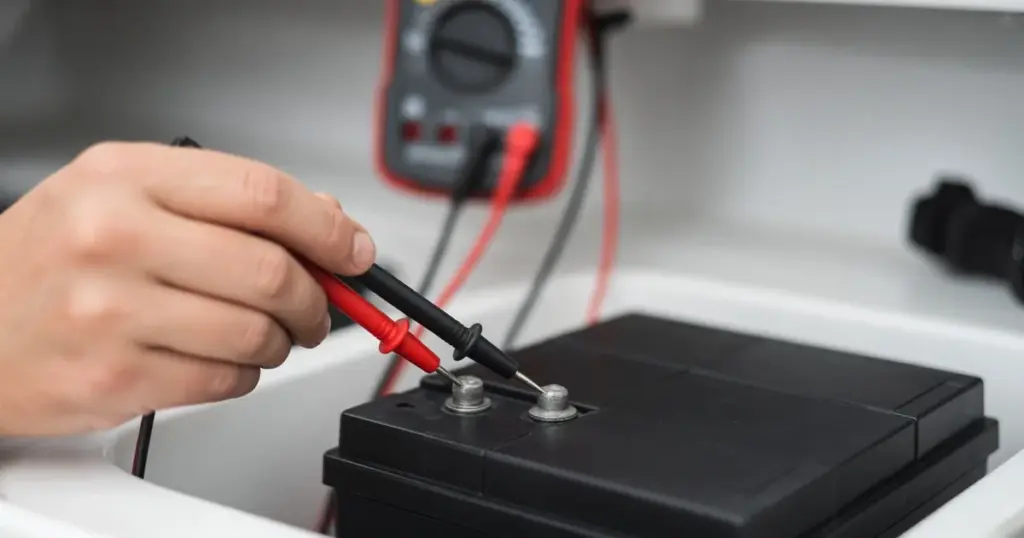
A voltage chart is one of the most useful tools a boater can have. It tells you roughly how charged a battery is from a single multimeter reading. But the numbers differ between flooded, AGM and lithium batteries, and they only mean something if you measure correctly. Here are the charts for 12V, 24V and 36V marine batteries, plus how to read them.
How to measure resting voltage
- Turn off all loads and disconnect or switch off the charger.
- Let the battery rest. For lead-acid, several hours or overnight is best to let surface charge settle. For lithium, 30 minutes to an hour.
- Set a digital multimeter to DC volts.
- Measure directly across the battery terminals.
- Compare with the chart.
Measuring while charging or under load gives readings that don’t match the chart. If you’re new to meters, see multimeter battery testing for boaters.
12V resting voltage chart
| State of charge | Flooded | AGM | LiFePO4 (approx.) |
|---|---|---|---|
| 100% | 12.6–12.7V | 12.8V | 13.3–13.4V |
| 90% | 12.5V | 12.6–12.7V | 13.3V |
| 75% | 12.4V | 12.5V | 13.2V |
| 50% | 12.2V | 12.3V | 13.1–13.2V |
| 25% | 12.0V | 12.0V | 13.0V |
| 20% | 11.9V | 11.9V | 12.9–13.0V |
| 0% | 11.8V or below | 11.8V or below | 12.0V or below, near BMS cutoff |
Values are typical at room temperature and vary by manufacturer. Check your battery’s datasheet for exact figures.
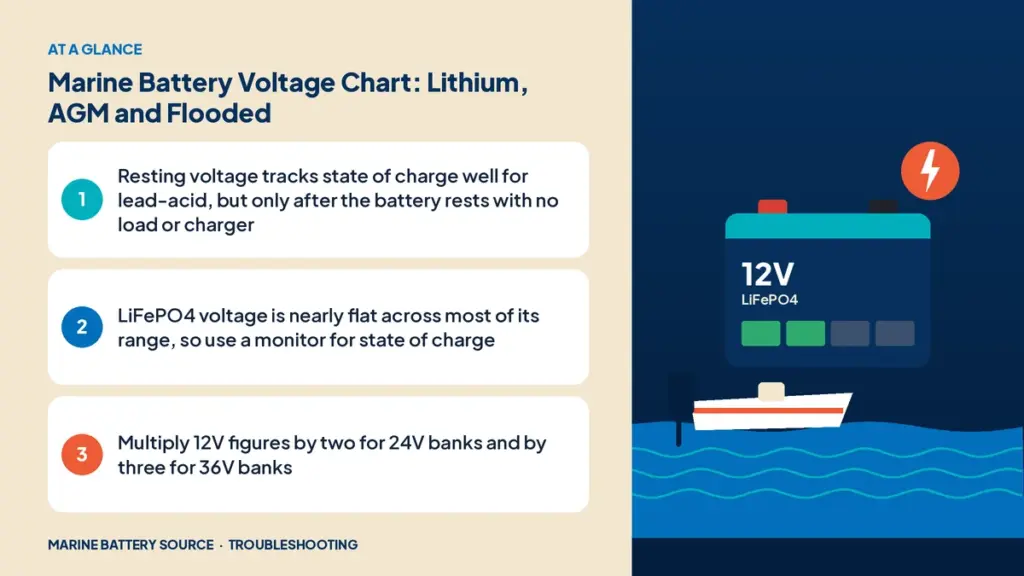
24V bank chart (two 12V batteries in series)
| State of charge | Flooded | AGM | LiFePO4 (approx.) |
|---|---|---|---|
| 100% | 25.2–25.4V | 25.6V | 26.6–26.8V |
| 75% | 24.8V | 25.0V | 26.4V |
| 50% | 24.4V | 24.6V | 26.2–26.4V |
| 25% | 24.0V | 24.0V | 26.0V |
36V bank chart (three 12V batteries in series)
| State of charge | Flooded | AGM | LiFePO4 (approx.) |
|---|---|---|---|
| 100% | 37.8–38.1V | 38.4V | 39.9–40.2V |
| 75% | 37.2V | 37.5V | 39.6V |
| 50% | 36.6V | 36.9V | 39.3–39.6V |
| 25% | 36.0V | 36.0V | 39.0V |
A single 36V lithium battery reads like the LiFePO4 column. In a series bank of 12V batteries, also measure each battery individually; one weak battery throws off the bank.
Charging voltages
While charging, voltage reads higher than resting. Typical ranges for a 12V battery (check your charger and battery specs):
| Stage | Flooded | AGM | LiFePO4 |
|---|---|---|---|
| Bulk/absorption | 14.4–14.8V | 14.4–14.7V | 14.2–14.6V |
| Float | 13.2–13.5V | 13.5–13.8V | Often none, or about 13.4–13.6V |
With the engine running, a 12V lead-acid start battery typically reads roughly 13.8–14.6V.
Why lithium voltage is hard to read
LiFePO4 holds a nearly flat voltage from about 90% down to 20%. A 0.1V difference can represent a big change in charge. That’s great for performance, since trolling motors and electronics see steady voltage, but bad for estimating charge with a meter. Use the battery’s Bluetooth app or a shunt-based battery monitor. When a lithium battery suddenly cuts out, it’s usually the BMS protecting it at the bottom of the curve. See lithium battery BMS shutdown.
Reading the chart in real life
- Full charge, low resting voltage: a lead-acid battery that charges fully but rests well below 12.6V may have a sulfated or shorted cell.
- Good voltage, poor performance: voltage shows charge, not health. Load test it. See battery load test vs voltage test.
- Voltage drops quickly after charging: possible drain or failing battery.
- Voltage under 10.5V on lead-acid: deeply discharged; recharge immediately to limit sulfation.
Temperature
Cold lowers resting voltage slightly; heat raises it. Chargers with temperature sensors adjust charging voltage for lead-acid. For lithium, the BMS limits charging at temperature extremes.
Voltage under load
Under load, voltage drops. A trolling motor at full speed can pull a lead-acid battery’s voltage down noticeably, and it recovers when the load stops. That’s normal. Large drops on lithium, or drops on lead-acid that don’t recover, point to a weak battery or bad connections.
Voltage during cranking
When the engine cranks, voltage dips. A healthy 12V start battery usually stays above about 9.6–10V while cranking. Lower than that, or electronics resetting at every start, suggests a weak battery or voltage drop in the cables. Separating start and house loads helps.
Using the chart for maintenance
Record resting voltage after a full charge each month. A downward trend in “full” voltage over time shows aging. Combined with periodic load or capacity tests, the chart helps you plan replacements. See the marine battery maintenance guide.
Voltage and battery monitors
A shunt-based battery monitor measures the current going in and out of the battery and keeps a running count of amp-hours. It’s more accurate than voltage alone for every chemistry, and almost essential for lithium. Many boaters use both: the monitor for day-to-day state of charge, and occasional resting voltage readings as a cross-check. If the two disagree by a lot, the monitor may need to be resynchronized, which usually happens automatically after a full charge.
A quick field routine
On the water, you won’t always have time for a proper rest. A practical approach:
- In the morning, before turning anything on, check resting voltage on each battery and note it.
- During the day, watch voltage under typical loads. Learn what’s normal for your boat, so a sudden change stands out.
- At the end of the day, note voltage after loads have been off for a while.
- At the dock, charge fully and compare the next morning’s reading with the chart.
Over a few trips, you’ll learn how your batteries behave and spot problems early.
When the numbers look wrong
If readings don’t make sense, check:
- Is the meter set to DC volts?
- Are the probes on the battery posts, not on cable clamps?
- Is the battery resting, not charging or loaded?
- Is the meter battery low?
For a battery that’s hot, swollen or smells, stop and read hot, swollen or smelly batteries.
Common batteries and their charts
- Interstate 31M AGM: use the AGM column.
- EPOCH 12V 105Ah LiFePO4: use the LiFePO4 column and the battery’s app.
- EPOCH 36V 50Ah: use the 36V LiFePO4 column.
Shop lithium marine batteries. For a step-by-step diagnosis, see the marine battery troubleshooting guide and boat electrical problems troubleshooting.
Frequently asked questions
What voltage is a fully charged 12V marine battery?
About 12.6–12.7V for flooded, about 12.8V for AGM and about 13.3–13.4V for LiFePO4 at rest.
What voltage is too low for a 12V marine battery?
For lead-acid, resting voltage around 12.0V or below means it’s heavily discharged. Recharge promptly.
Why does my lithium battery voltage barely change?
LiFePO4 has a flat discharge curve. Use a battery monitor or app for state of charge.
What should a 36V trolling motor battery read when full?
About 37.8–38.1V for three flooded batteries, about 38.4V for AGM and about 40V for LiFePO4 at rest.
Can I check voltage while charging?
You can, but it won’t match the resting chart. Let the battery rest before comparing.