


How to Find a Parasitic Drain on a Boat
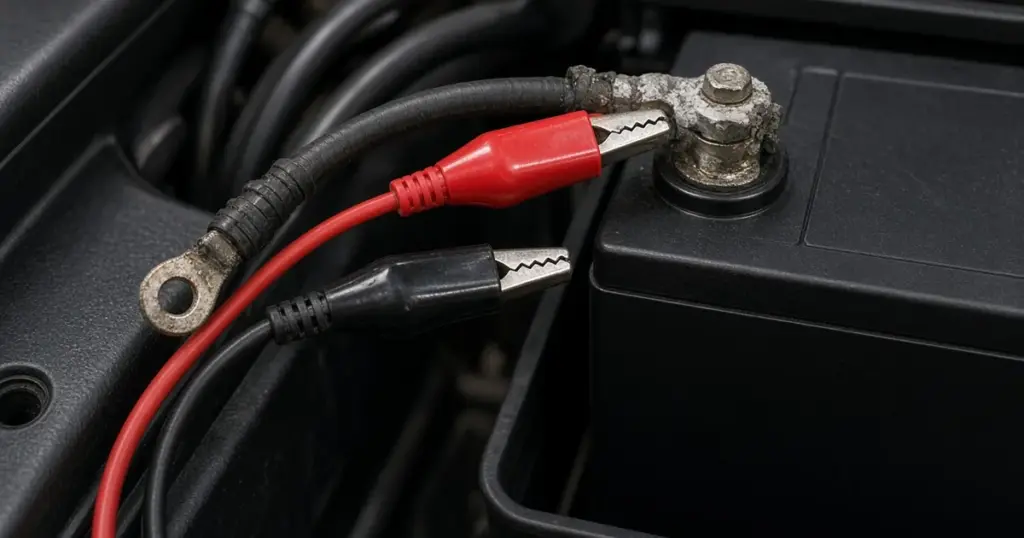
A parasitic drain is any current that flows from the battery when everything is supposedly off. On boats, small drains are common: stereo memory, GPS standby, battery monitors, bilge float switches. Some are normal and small. Others are faults or wiring mistakes that flatten a battery in days. A parasitic drain test tells you how big the draw is and where it’s coming from. Here’s how to do one.
Why small drains matter
Drains are measured in milliamps (mA). They seem tiny, but they add up:
| Drain | Per day | Per month (30 days) |
|---|---|---|
| 10 mA | 0.24Ah | about 7Ah |
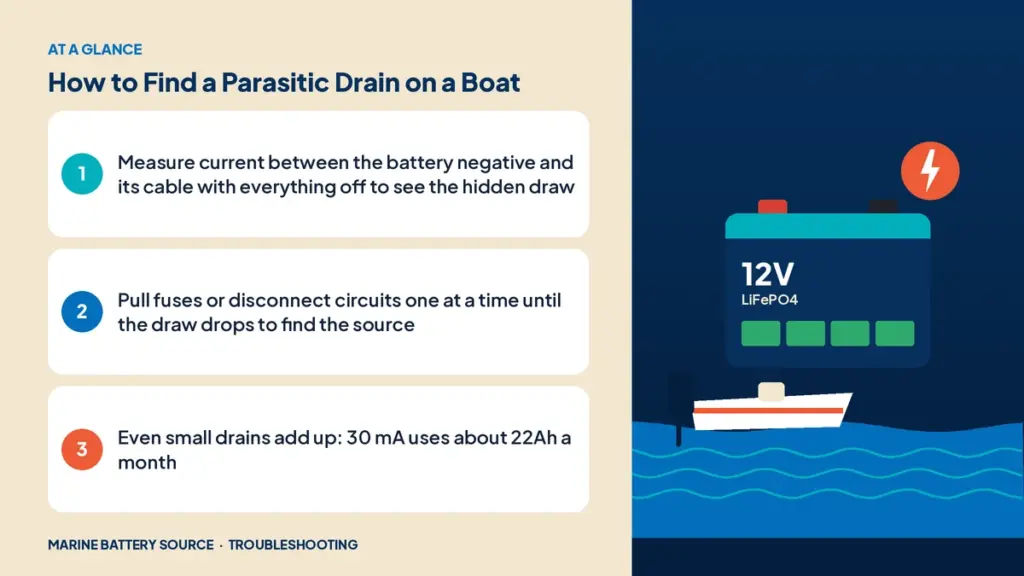
| 30 mA | 0.72Ah | about 22Ah |
| 100 mA | 2.4Ah | about 72Ah |
| 300 mA | 7.2Ah | about 216Ah |
A 100 mA drain can flatten a typical group 27 battery in a few weeks. Add self-discharge in summer heat, and the battery dies even faster.
Tools
- Digital multimeter with a 10A DC current range (and a mA range)
- Or a DC clamp meter that reads low currents
- Basic hand tools
Before you start
- Charge the battery fully.
- Turn off every switch, including the battery switch if you want to test what bypasses it, and unplug shore power.
- Close hatches and doors that trigger lights.
- Wait a few minutes; some electronics take time to go to sleep.
Note: if you want to test what draws with the battery switch on but everything else off, leave the switch on. Running the test both ways tells you what’s wired before the switch.
Method 1: Multimeter in series
- Set the multimeter to DC amps, using the 10A range first. Move the red lead to the 10A jack.
- Disconnect the negative cable from the battery.
- Connect one multimeter lead to the battery negative post and the other to the disconnected cable. The meter now carries all current.
- Read the current. If it’s low, switch to the mA range for a more precise reading (move the lead to the mA jack first, and only if the reading is well under that range’s limit).
- Don’t turn on any large loads while the meter is in series. Cranking the engine through a multimeter will blow its fuse or damage it.
Method 2: Clamp meter
Clamp a DC clamp meter around the negative cable (or positive, but not both). Zero it first. Clamp meters are easier and safer, but many aren’t accurate at very low currents.
What’s normal?
- Under about 25 mA: typical for boats with a few memory devices.
- 25–50 mA: acceptable on boats with more electronics, but worth knowing.
- Above 50–100 mA: worth tracking down unless you know what it is.
These are rules of thumb. A boat with only a bilge float switch and no electronics might draw close to zero. A large boat with monitors and alarms might draw more.
Finding the source
- With the meter connected, pull fuses or turn off breakers one at a time.
- Watch the reading. When it drops, you’ve found the circuit.
- Reinstall that fuse and check every device on it.
- If nothing on the fuse panel changes the reading, look at loads wired directly to the battery: stereos, amplifiers, bilge pumps, chargers, battery monitors and accessories added later.
- Disconnect each direct-wired load until the draw drops.
Common sources
- Stereo and amplifier memory or standby
- Chartplotters left in standby
- Bluetooth battery monitors
- Bilge pump float switch cycling due to water
- Chargers that draw from the battery without shore power
- Corroded wiring leaking current through moisture
- Faulty switches or relays
- Lithium battery BMS (small, usually not a concern)
Fixes
- Rewire accessories through the battery switch so they’re off with the boat off.
- Add a dedicated disconnect for items that need to stay connected only sometimes.
- Repair corroded wiring in the bilge. See the marine battery troubleshooting guide.
- Fix the leak that triggers the bilge pump.
- Use a smart maintenance charger when the boat sits on shore power. The EPOCH 12V 15A lithium charger works for lithium setups.
Drains and lithium batteries
Lithium batteries have very low self-discharge, but a parasitic drain will still empty them. If a lithium battery is drained to its low-voltage cutoff, the BMS will disconnect it. Some batteries need a special charge to reset after that. See lithium battery BMS shutdown.
When the drain test is clean
If there’s no meaningful drain and the battery still dies, check whether it’s being charged (boat battery not charging) and whether the battery itself is failing (how to test a marine battery). For the full list of causes, read boat battery keeps dying.
Keep a record
Write down the drain reading after you’ve fixed any problems. That’s your baseline. If the battery starts dying again later, retest and compare. A reading that has crept up usually means a new accessory, a failing component or moisture in the wiring.
Prevention
- Turn off the battery switch at the end of every trip.
- Wire new accessories through the switch.
- Keep the bilge dry.
- Check for drains once a year, or after adding electronics.
- Include a drain test in your marine battery maintenance routine.
If the drain points to a wiring fault you can’t trace, see boat electrical problems troubleshooting.
Battery choice for boats with unavoidable drains
Some boats need constant loads, like alarms or monitors. Lithium batteries with large capacity, like the EPOCH 12V 300Ah LiFePO4, handle small constant draws better than a single lead-acid battery, and they don’t sulfate when partly discharged. Browse house bank batteries.
Frequently asked questions
What is a normal parasitic drain on a boat?
Under about 25 mA is typical for boats with some memory devices. Higher draws are worth tracking down.
How do I test for a parasitic drain?
Connect a multimeter in series between the battery negative post and the negative cable, with everything off, and read the current.
Can a parasitic drain kill a lithium battery?
It can drain it to the BMS cutoff, which disconnects the battery. Some batteries need a special procedure to recover.
Why does my bilge pump drain my battery?
If water keeps entering, the float switch keeps running the pump. Find and fix the leak.
Can I crank the engine during a drain test?
No. Never crank or run large loads with a multimeter in series; it will blow the meter’s fuse or damage it.