


Year-Round Boating: Battery Care with No Off-Season

Northern boaters have a natural rhythm: launch in spring, use the boat all summer and winterize in the fall. In Florida, along the Gulf Coast and in much of the South, many boats run all year. That’s great for fishing, but it means batteries never get a rest season and never get the annual attention that comes with winterizing. This guide gives year-round boaters a simple routine to keep batteries healthy without an off-season.
Why year-round use is different
- No winterizing checkpoint. Batteries never come out for a full inspection and storage charge unless you plan it.
- Continuous heat. Even winters are mild, and summers are hot. Heat is the main driver of battery aging. See Florida heat and marine battery life.
- Salt exposure all year. Corrosion never takes a break. See saltwater corrosion prevention.
- Stop-and-go use. Boats may run hard one weekend and sit for three weeks.
- Storm seasons. Summer thunderstorms and hurricane season add another layer.
The monthly routine
Pick a day each month and spend 15 minutes on the batteries:
- Look. Check cases for bulging, cracks or leaks, and look for corrosion on terminals and cable ends.
- Tighten. Check that terminals and hold-downs are snug.
- Clean. Wipe battery tops and remove any crust from terminals.
- Water (flooded only). Top up with distilled water after charging, to the level the manufacturer specifies.
- Measure. Check resting voltage after a full charge and write it down. A falling trend shows aging.
- Air out. Open compartments to dry them after rainy weeks.
Charging habits that matter
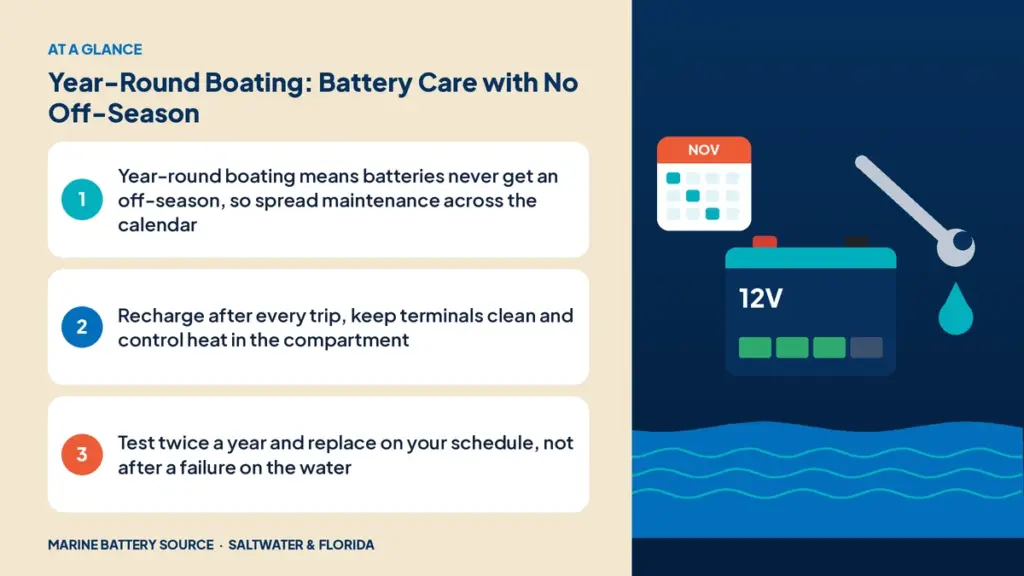
- Recharge after every trip. Lead-acid batteries left partly discharged sulfate, and heat makes it worse.
- Use the right profile. Flooded, AGM and lithium each need their own charger settings.
- Use a smart charger with maintenance mode for boats on shore power. The EPOCH 4-bank marine charger handles several banks at once.
- Don’t leave an old non-smart charger running continuously, which can overcharge and dry out lead-acid batteries.
- Lithium: many lithium batteries don’t need to be held at 100% all the time. Follow the manufacturer’s guidance on float or storage settings.
Controlling heat
- Shade the boat with a cover, a T-top or a covered slip or lift.
- Ventilate battery compartments, especially consoles with electronics nearby.
- Keep batteries away from engines and exhaust where possible.
- Consider relocating batteries from a sealed, sun-baked console to a better-ventilated locker if your boat allows. See battery compartment heat.
Testing twice a year
Because there’s no winterizing checkpoint, set two test dates:
- Spring (March or April): before the busy season and before summer heat.
- Fall (October or November): after summer, when heat damage shows up.
Use a load test or a capacity test, not just a voltage reading. A battery can show good voltage and still fail under load.
Lightning and storms
Summer afternoon storms bring lightning. Add a post-storm check to your routine: inspect electronics, look for burned connections and test batteries if the boat was nearby when lightning struck. Read lightning and boat electrical systems.
A quarterly checklist
- Q1 (Jan–Mar): full electrical inspection, spring battery test, clean all connections.
- Q2 (Apr–Jun): hurricane prep before June 1, test bilge pumps, check charger profiles.
- Q3 (Jul–Sep): heat watch: water levels on flooded batteries, ventilation, terminal corrosion.
- Q4 (Oct–Dec): fall battery test, replace batteries that are failing, inspect after storm season.
For a month-by-month version, see the seasonal boat battery calendar.
Boats that sit between trips
Year-round doesn’t always mean every weekend. Many boats run hard for a stretch, then sit for a few weeks during busy months or bad weather. Those gaps are when batteries quietly run down. Before you leave the boat:
- Turn the main battery switch off.
- Confirm that only the automatic bilge pump circuit stays live if the boat is in the water.
- Plug in shore power so the smart charger can maintain the batteries, or disconnect the negative cables on a trailered or rack-stored boat.
- Close hatches and cover the console to keep rain out.
When you come back, check voltage before you load the boat. A battery that’s lower than expected points to a parasitic drain worth tracking down.
When to replace
- Capacity well below rated, or a failed load test
- Slow cranking that doesn’t improve with charging
- Resting voltage that drops quickly after charging
- Swelling, leaks or heat
- Age near the end of the expected life, especially for lead-acid in hot climates
Replacing on your schedule beats replacing after a no-start at the ramp.
Upgrading for year-round use
Year-round boaters get more value from batteries with long cycle lives:
- Lithium for trolling and house banks; tolerant of partial charge and deep use. The EPOCH 12V 105Ah LiFePO4 is a common 12V choice.
- AGM for starting, with good heat and vibration tolerance. The Interstate 31M AGM is a strong dual-purpose option.
Long trips
Year-round boaters often take longer trips in the cooler months. Plan house power for nights away. See Florida Keys boat trip battery planning.
Local guides
For area-specific tips, see the Sarasota boat battery guide and the Tampa Bay boat battery guide. Shop marine battery chargers and lithium marine batteries.
Keeping a battery log
A simple log on your phone, with the date, resting voltage, any cleaning done and test results, makes trends obvious. When the spring reading is noticeably lower than last fall’s, you’ll know it’s time to plan a replacement.
Example: a year-round bay boat
A bay boat fished every weekend from January to December gets a monthly 15-minute check, a charge after every trip on a 3-bank smart charger, a spring and fall load test, and hurricane prep in May. The flooded start battery is swapped for AGM when it fails its fall test, and the trolling bank moves to lithium a year later. Over time the owner spends less on replacements and has fewer surprises on the water.
Frequently asked questions
Do I need to winterize batteries in Florida?
Not in the traditional sense, but you should schedule a full inspection and test at least twice a year since there’s no natural off-season.
How often should I charge my boat battery if I boat year-round?
After every trip, and keep it on a smart maintenance charger if the boat sits on shore power.
Does heat really shorten battery life?
Yes. Heat speeds up the chemical reactions that wear batteries out, which is why batteries in warm climates often fail sooner.
Is lithium worth it for year-round boating?
For trolling and house banks, often yes. Long cycle life and tolerance for partial charge suit continuous use.
What’s the most important year-round battery habit?
Recharge fully after every trip and keep terminals clean.