


Self-Discharge: How Fast Batteries Lose Charge in Storage

Every battery loses charge while it sits, even with nothing connected. That’s self-discharge, and it varies a lot by chemistry and temperature. Knowing how fast your battery self-discharges tells you how often it needs a charge in storage, whether it can sit on a mooring for a month, and why a battery that was full in October can be flat by March. This guide covers battery self-discharge rates for marine batteries and how to plan around them.
What causes self-discharge
Self-discharge comes from slow chemical reactions inside the battery that happen whether or not it’s connected to anything. In lead-acid batteries, impurities and the natural reaction between the plates and acid slowly consume charge. In lithium batteries, tiny side reactions and the BMS’s own small power draw contribute.
Self-discharge is different from parasitic drain, which is current pulled by devices connected to the battery. On boats, parasitic drain is usually the bigger problem.
Typical self-discharge rates
At around 77°F (25°C):
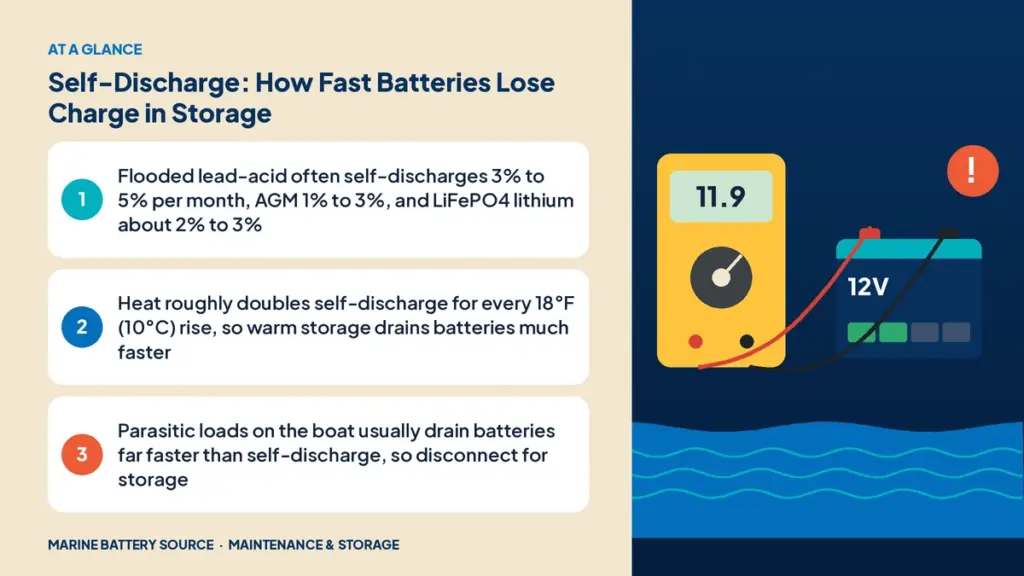
- Flooded lead-acid: about 3% to 5% per month for standard batteries; older or antimony-alloy batteries can be higher
- AGM: about 1% to 3% per month
- Gel: about 1% to 3% per month
- LiFePO4 lithium: about 2% to 3% per month, including the BMS draw on many batteries
These are typical ranges. Actual rates depend on battery design, age and condition. Older batteries generally self-discharge faster.
Temperature effects
Heat speeds up self-discharge dramatically. A common rule is that the rate roughly doubles for every 18°F (10°C) increase:
- At 60°F, a flooded battery might lose about 2% to 3% per month
- At 77°F, about 3% to 5%
- At 95°F, about 6% to 10% or more
Cold slows self-discharge, which is why cool storage helps. But lead-acid batteries that discharge in the cold also risk freezing. See can a marine battery freeze?.
What this means in practice
Flooded battery stored for five months
Starting at 100% at 77°F, losing about 4% per month, it would be near 80% after five months. That sounds fine, but in a warm garage or with any parasitic draw, it could fall much lower, into the range where sulfation sets in.
AGM battery stored for five months
At about 2% per month, it might be around 90% after five months in moderate temperatures.
Lithium battery stored for five months
At about 2% to 3% per month, a lithium battery stored at 60% would be around 45% to 50%, still safe.
Parasitic drain: the bigger problem
Many boats have small loads that run even when “off”:
- Stereo memory
- Chartplotter or radio standby
- Bilge pump float switch circuits
- Battery monitors
- Alarm systems
- Onboard charger standby draw (when not plugged in)
A drain of just 0.05A pulls about 36Ah per month, more than ten times a typical battery’s self-discharge. That’s why disconnecting batteries for storage matters so much. A parasitic drain test can show what’s happening; see the troubleshooting guide.
Planning charging in storage
Lead-acid
- Use a smart maintainer, or
- Recharge every four to six weeks, or when voltage drops below about 12.4V
See storing lead-acid batteries off-season.
Lithium
- Store at 50% to 80%, disconnected
- Check every two to three months
Boats on moorings, lifts and in slips
Boats that sit in the water between uses face both self-discharge and parasitic drain, plus bilge pump use after rain. Solar or a shore-powered charger keeps them topped up. See boat lift and slip battery care.
Storage after removal
If you remove batteries for winter, self-discharge is the only loss. Store them cool and charged. See removing a boat battery for winter.
Checking state of charge in storage
For lead-acid, resting voltage is a good guide:
- 12.7V: 100%
- 12.4V: about 75%
- 12.2V: about 50%
For lithium, use the battery’s app or a battery monitor, since voltage is flat across most of the range.
How self-discharge changes with age
As lead-acid batteries age, self-discharge increases because of plate corrosion and contamination. A battery that once held charge for months may start dropping noticeably in weeks. That’s a sign it’s nearing the end of its life.
Choosing a battery for infrequent use
If your boat sits for long periods between uses, low self-discharge matters. AGM and lithium batteries hold charge much longer than flooded. Lithium like the EPOCH 12V 105Ah LiFePO4 or AGM like the Interstate 31M AGM can sit between trips with less worry. Browse our lithium marine batteries.
Spring readiness
Even batteries stored perfectly should be fully charged before the first trip. See spring boat battery commissioning.
Testing a battery’s self-discharge
Want to know how your own battery performs? Try this:
- Fully charge the battery and let it rest for 24 hours, disconnected.
- Record the resting voltage.
- Leave it disconnected in a moderate-temperature spot for two weeks.
- Measure resting voltage again.
A healthy lead-acid battery should drop only slightly, perhaps 0.05V to 0.1V over two weeks. A drop of 0.3V or more suggests high self-discharge, often from age, contamination or an internal short. For lithium, compare the app’s state of charge before and after.
Self-discharge and battery monitors
A shunt-based battery monitor stays connected to the battery and draws a small current, usually a few milliamps. That’s small, but over months it adds up. Some monitors have a low-power or sleep mode. If yours doesn’t, disconnect its fuse during long storage, then resync it to 100% after the spring charge.
For the full storage guide, see winter storage for marine batteries and our marine battery maintenance guide.
Frequently asked questions
How fast does a marine battery lose charge when not in use?
Flooded batteries often lose 3% to 5% per month, AGM 1% to 3%, and lithium about 2% to 3%, at moderate temperatures.
Does temperature affect self-discharge?
Yes. Self-discharge roughly doubles for every 18°F (10°C) rise in temperature.
Why is my battery dead after sitting a month?
Most likely a parasitic drain from devices on the boat, which can be far larger than self-discharge.
Do lithium batteries self-discharge?
Yes, slowly, often about 2% to 3% per month including BMS draw.
How often should I charge a battery in storage?
Lead-acid every four to six weeks or on a maintainer; lithium every two to three months.