


How Long Do Marine Batteries Last?
A marine battery is a significant investment, and how long it lasts depends on more than the label. Chemistry, how deeply you discharge it, how you charge it, heat and storage all play big roles. Two identical batteries can last two years or eight, depending on care. This guide answers how long marine batteries last and what you can do to get the most from yours.
Typical lifespans
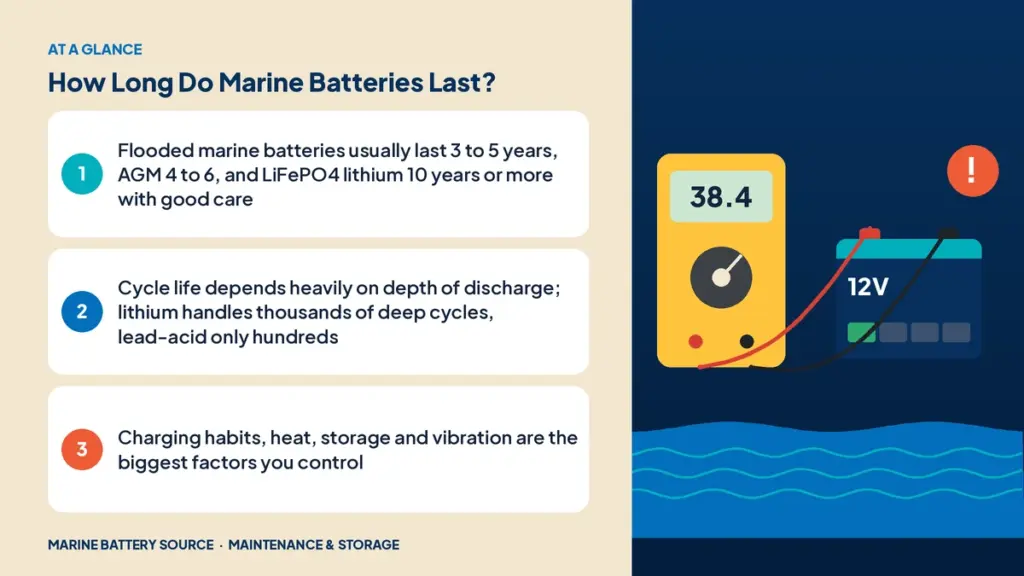
Flooded lead-acid
- Lifespan: about 3 to 5 years
- Cycle life: roughly 200 to 500 cycles at 50% depth of discharge, depending on quality
- Maintenance: watering, equalization, regular charging
AGM
- Lifespan: about 4 to 6 years
- Cycle life: roughly 300 to 700 cycles at 50% depth of discharge
- Maintenance: proper charging, no watering
Lithium (LiFePO4)
- Lifespan: often 10 years or more
- Cycle life: commonly 3,000 to 6,000 cycles or more at 80% to 100% depth of discharge
- Maintenance: lithium-compatible charging, storage at partial charge
These are typical ranges. Actual life depends on use and care. Many lithium batteries, like the EPOCH 12V 105Ah LiFePO4, carry long warranties that reflect their expected life.
Starting batteries vs deep cycle
Starting batteries that only crank the engine see shallow discharges and can last as long as deep cycle batteries, often three to five years for lead-acid. The main enemies are heat, vibration and sitting discharged. Deep cycle batteries used for trolling motors and house loads see deeper discharges, so their life is measured more in cycles.
Depth of discharge matters
For lead-acid, how deeply you discharge each cycle has a huge effect on life:
- 20% discharge: many more cycles
- 50% discharge: the common recommended limit
- 80% to 100% discharge: dramatically fewer cycles
Lithium handles deep discharges much better. A LiFePO4 battery discharged to 80% still delivers thousands of cycles.
What shortens battery life
- Leaving lead-acid partly discharged. Sulfation hardens on the plates. See battery sulfation explained.
- Undercharging. Never reaching full charge causes gradual sulfation.
- Overcharging. Excess voltage dries out flooded batteries and damages AGM.
- Heat. High temperatures accelerate chemical reactions and shorten life.
- Vibration. Pounding in rough water can damage plates if the battery isn’t secured.
- Deep discharges on lead-acid.
- Poor storage. Months without charging kill lead-acid batteries.
- Low water in flooded batteries.
Warning signs of an aging battery
- Slow cranking
- Reduced runtime on trolling motors or house loads
- Battery won’t hold a charge overnight
- Low voltage after a full charge
- Hydrometer readings that vary between cells. See battery hydrometer test.
- Swollen or cracked case
- Frequent BMS shutdowns (lithium)
If you see these, test the battery. See the troubleshooting guide.
How to extend battery life
- Recharge promptly after every use.
- Use a smart charger with the correct profile.
- Avoid deep discharges on lead-acid.
- Keep flooded batteries watered.
- Keep terminals clean and tight.
- Secure batteries against vibration.
- Keep batteries cool and ventilated.
- Store properly in the off-season. See winter storage for marine batteries.
- Follow a monthly routine. See our monthly boat battery checklist.
Lithium longevity tips
- Use a lithium charger.
- Avoid charging below freezing.
- Store at 50% to 80%.
- Keep terminals tight.
See lithium battery maintenance.
Cost per year
Lithium costs more upfront, but its longer life often makes it cheaper per year. For example:
- A $250 AGM battery lasting 5 years costs about $50 per year.
- A $900 lithium battery lasting 10 to 12 years costs about $75 to $90 per year, but delivers more usable capacity, less weight and no maintenance.
For trolling motors that cycle deeply every trip, lithium’s cycle life often makes the cost per cycle much lower. Compare options in our lithium marine batteries and trolling motor batteries.
Calendar age vs cycles
Batteries age in two ways: from use (cycles) and from time (calendar aging). A lead-acid starting battery that sees only shallow cranking still loses capacity each year as its plates corrode. A lithium battery that sits mostly unused still ages slowly, especially if stored hot and fully charged. On boats used only a few weekends a year, calendar aging often matters more than cycle count, which is why storage habits make such a difference.
When to replace
Replace a battery when:
- It fails a load test
- Capacity has dropped noticeably
- It won’t hold a charge
- The case is damaged
- It’s beyond its typical lifespan and showing symptoms
Replace batteries in a bank together to avoid mismatched performance.
Heat and lifespan
Heat is one of the biggest lifespan factors, especially in southern climates. A general rule for lead-acid: every 15°F above 77°F can roughly halve battery life. Batteries in hot compartments or under direct sun age much faster. Lithium tolerates heat better but still benefits from shade and ventilation.
Real-world examples
- Weekend bass angler, flooded trolling batteries, charged after every trip: often 3 to 4 years.
- Same angler, batteries left discharged in the garage over winter: sometimes only 1 to 2 years.
- Pontoon with an AGM starting battery on a maintainer in storage: 5 to 6 years is common.
- Tournament angler with a 36V lithium bank, charged nightly: 8 to 10 years or more of hard use.
- Florida center console with a flooded battery in a hot console: may only reach 2 to 3 years.
These examples show why care and conditions matter as much as the battery itself.
Warranties and real life
A battery’s warranty gives a rough guide to how long the maker expects it to last, but it isn’t a guarantee of service life. Lead-acid warranties are often 12 to 36 months free replacement. Lithium warranties commonly run 5 to 11 years. Keep your receipt and maintenance records in case you need to make a claim.
For complete care routines, see our marine battery maintenance guide.
Frequently asked questions
How long does a marine battery last?
Flooded batteries usually last 3 to 5 years, AGM 4 to 6, and lithium 10 years or more with good care.
How many cycles does a lithium marine battery last?
Commonly 3,000 to 6,000 cycles or more, depending on the battery and depth of discharge.
What kills marine batteries fastest?
Leaving lead-acid batteries discharged, overcharging, heat and poor storage.
Should I replace both batteries at the same time?
Yes, for batteries in a bank. Mixing old and new reduces performance and shortens the life of the new battery.
Is lithium worth the cost?
Often, especially for deep-cycle use. Its longer life and usable capacity can make it cheaper per year and per cycle.