


How to Install a Lithium Trolling Motor Battery
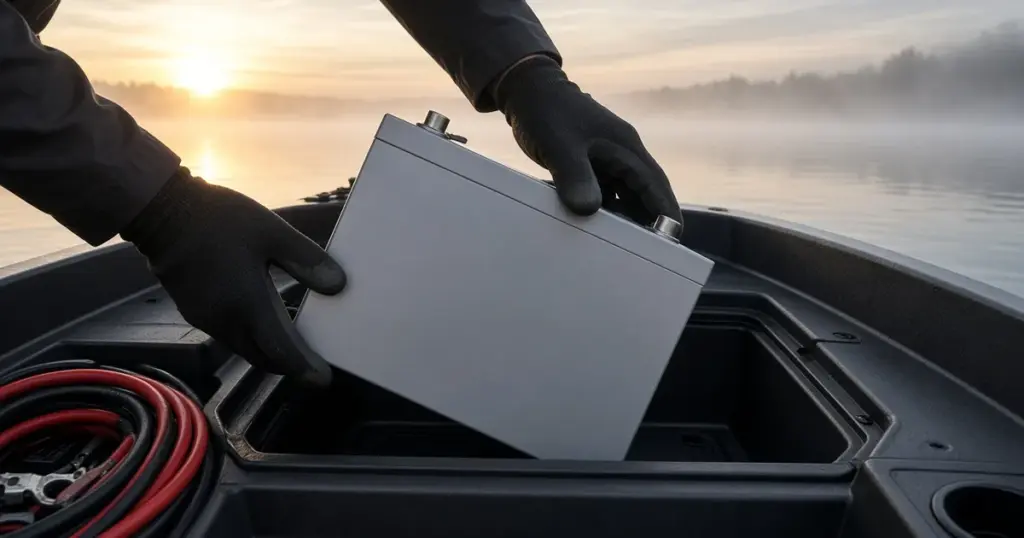
Swapping lead-acid trolling batteries for lithium is one of the biggest upgrades an angler can make. You’ll typically save 50 to 100 pounds or more, get more usable runtime and keep full power until the battery is nearly empty. The installation is straightforward, but there are a few lithium-specific steps you shouldn’t skip. This guide walks through how to install a lithium trolling motor battery from planning to the first charge.
Step 1: Plan the system
Choose the voltage
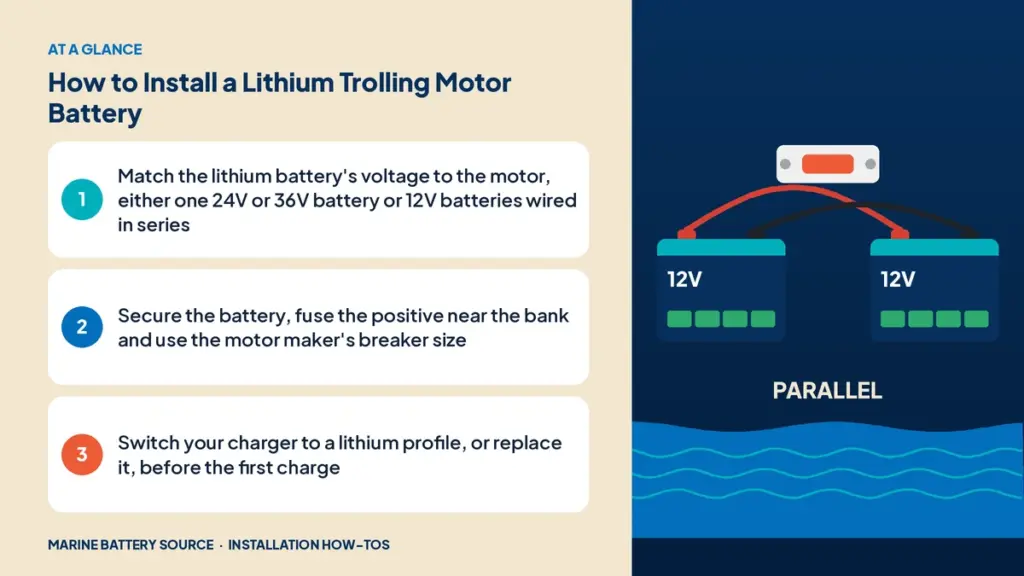
Your trolling motor runs at 12V, 24V or 36V. You can match it two ways:
- One battery at full voltage, such as the EPOCH 36V 50Ah or EPOCH 36V 100Ah. Fewer connections, less weight and a single charger lead.
- Several 12V batteries in series, such as three 12V batteries for 36V. Useful if you need flexibility or want to reuse batteries.
Choose the capacity
Pick enough amp-hours for your typical day. A 36V motor on a big lake in wind may need 100Ah; a 24V motor on small water may be fine with 50Ah to 60Ah. Browse our trolling motor batteries to compare.
Check the BMS rating
The battery’s continuous discharge rating must exceed your motor’s maximum draw. Most modern trolling motors draw 40A to 60A at full power, which most trolling lithium batteries cover.
Step 2: Remove the old batteries
- Unplug the trolling motor and disconnect the charger.
- Disconnect the motor leads and series links, negative first.
- Remove hold-downs and lift out the old batteries.
- Recycle lead-acid batteries at a retailer or recycling center.
Step 3: Prepare the compartment
- Clean the compartment and inspect the old trays or boxes.
- Lithium batteries often have different dimensions from lead-acid. A 36V lithium may fit in a single group 31 space.
- Plan how you’ll secure the new battery, ideally with a tray or bracket designed for it. See our marine battery hold-down guide.
Step 4: Mount and secure
Set the battery in place and secure it so it can’t move in rough water. EPOCH offers trays such as the EPOCH 36V 50Ah battery tray, and many lithium batteries fit standard group-size trays.
Step 5: Wire the battery
Single battery
- Connect the motor’s positive lead to the battery positive, through the breaker or fuse.
- Connect the motor’s negative lead to the battery negative.
Series bank
- Connect battery 1 negative to battery 2 positive.
- Connect battery 2 negative to battery 3 positive (for 36V).
- Connect the motor positive to battery 1 positive, through the breaker or fuse.
- Connect the motor negative to the last battery’s negative.
Use cables of the size the motor maker specifies, and keep series links short.
Step 6: Fuse or breaker
Install the breaker or fuse the motor maker recommends, typically 50A or 60A, close to the battery positive. A resettable breaker is popular for trolling motors. Make sure it’s rated for your system voltage.
Step 7: Trolling motor plug
If your boat has a bow plug, wire it to the battery according to the plug maker’s instructions. See how to install a trolling motor plug.
Step 8: Set up charging
Lead-acid chargers may not charge lithium correctly. Options:
- Switch the existing onboard charger to lithium mode, if it has one.
- Replace it with a lithium charger, like the EPOCH 36V 15A lithium charger, or an onboard charger like the EPOCH 12V and 36V onboard charger.
- Add a DC-DC charger to charge the trolling bank from the engine while you run.
See how to install an onboard battery charger for the charger install.
Step 9: First charge
Charge the battery fully before the first trip. This also lets the BMS balance the cells. Check that the charger reports full charge and the battery’s app (if it has one) shows 100%.
Step 10: Test
- Measure voltage at the battery and at the motor plug.
- Run the motor at low, mid and high speeds and check that terminals stay cool.
- Confirm the breaker doesn’t trip at full speed.
Lithium tips
- Cold weather: don’t charge most lithium batteries below freezing unless they have heating.
- Storage: charge to the maker’s recommended storage level and disconnect.
- Don’t mix lithium and lead-acid in the same series bank.
- Bluetooth monitoring lets you check state of charge from your phone.
Optional: solar
Some anglers add a small solar panel to top up the trolling bank between trips. See how to install a solar panel on a boat.
Estimating runtime after the switch
Lithium gives you more usable capacity than lead-acid of the same rating. Lead-acid batteries are best kept above about 50% charge, while LiFePO4 can be used to 80% to 90% of its rating without harm. That means a 50Ah lithium can often match or beat a 100Ah lead-acid in real runtime.
A simple estimate:
- Note your motor’s typical draw at the speed you fish. Many 36V motors pull 15A to 25A at mid speed.
- Divide usable amp-hours by that draw. A 36V 100Ah battery at 20A gives about 4.5 to 5 hours of continuous use at that speed.
- Real days include stops, so runtime usually stretches well beyond the continuous figure.
Lithium also holds steady voltage through most of the discharge, so the motor keeps its speed until near the end instead of slowing down through the afternoon.
Keeping the starting battery separate
The trolling bank should stay isolated from the boat’s 12V starting system. Don’t connect the series links to the boat’s negative bus, and don’t power accessories from one battery in the trolling bank, which unbalances the series string. If you want to charge the trolling bank from the engine, use a DC-DC charger that’s designed for the job.
Common mistakes
- Using the old lead-acid charger profile.
- No hold-down because the battery is lighter.
- Breaker undersized for the motor.
- Mismatched batteries in a series bank.
DIY or professional?
Most anglers can do this install in an afternoon. For complex systems with DC-DC charging and multiple banks, consider professional help. See DIY vs professional installation. For general installation steps, see how to install a marine battery and our marine battery wiring guide.
Frequently asked questions
Can I use my lead-acid charger with lithium?
Only if it has a lithium mode or a profile that matches the battery. Otherwise, replace it with a lithium-compatible charger.
Is one 36V battery better than three 12V batteries?
One 36V battery is simpler, lighter and needs fewer connections. Three 12V batteries offer more flexibility. Both work well.
How much weight will I save with lithium?
Usually 50 to 100 pounds or more, depending on the setup.
Do lithium trolling batteries need a breaker?
Yes. Use the breaker or fuse size the trolling motor maker recommends, mounted close to the battery.
Can I charge lithium below freezing?
Most LiFePO4 batteries can’t be charged below freezing unless they have built-in heating.