


Tools You Need for Marine Battery Work
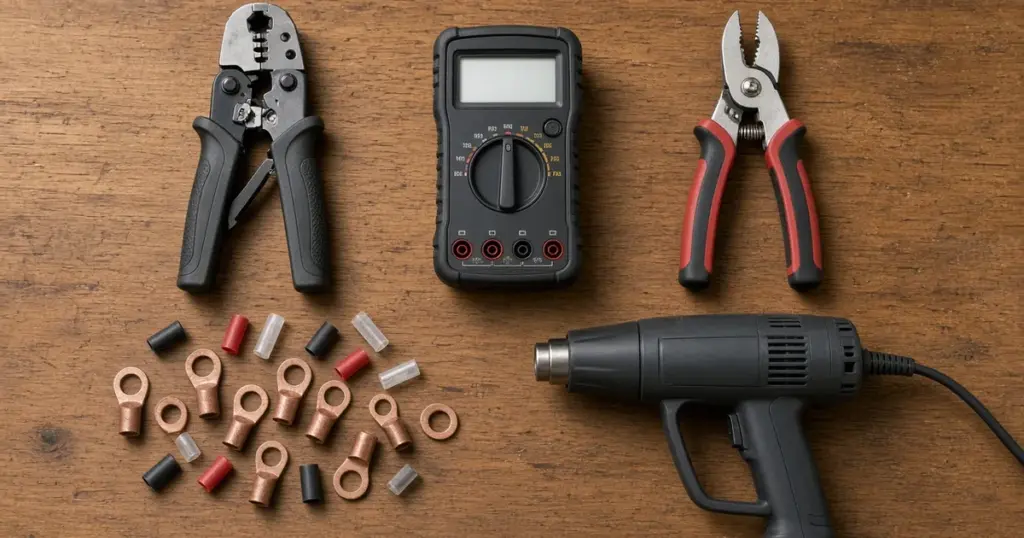
Good tools make marine electrical work faster, safer and more reliable. The wrong ones lead to bad crimps, stripped terminals and connections that fail in the middle of a tournament or a weekend at anchor. You don’t need a professional’s van full of equipment, but a few quality tools will handle almost every battery and wiring job on a typical boat. This guide covers the marine electrical tools every boat owner should have.
Essential tools
Digital multimeter
The single most important tool. Use it to:
- Measure battery voltage and check state of charge on lead-acid
- Test for voltage drop under load
- Check continuity in wires and fuses
- Find parasitic drains with the amp function
Choose an auto-ranging meter with a DC amp range of at least 10A. A clamp meter that measures DC current without breaking the circuit is a great upgrade for checking trolling motor and inverter draw.
Wire strippers
An automatic or adjustable stripper that removes insulation cleanly without nicking strands. Nicked strands reduce current capacity and invite corrosion.
Ratcheting crimper for small terminals
For heat-shrink butt connectors, ring terminals and spade terminals from 22 AWG to 10 AWG. A ratcheting crimper won’t release until the crimp is complete, which ensures consistent results. Avoid the cheap pliers-style crimpers often included in kits.
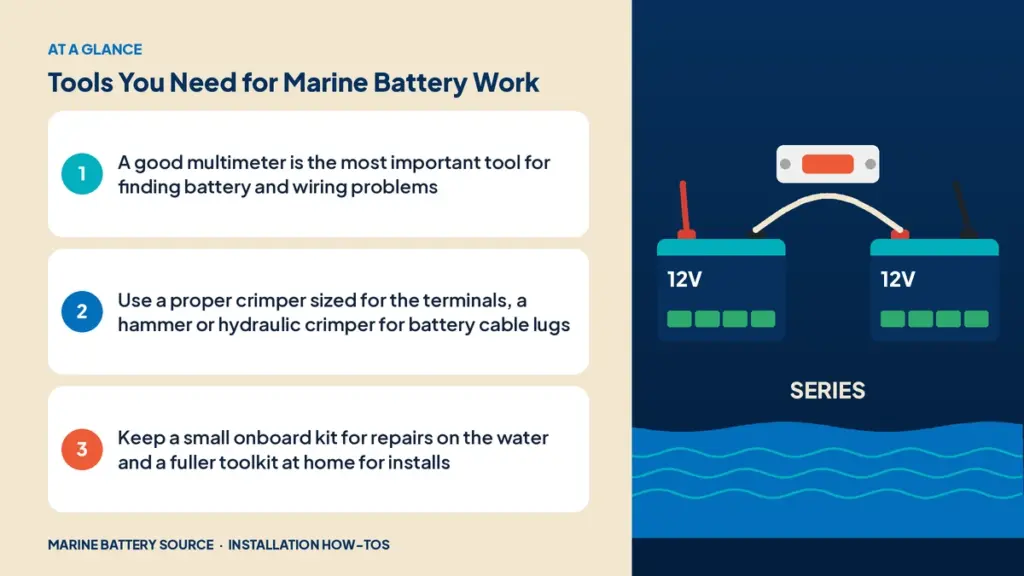
Battery cable lug crimper
For cables from 8 AWG to 4/0. Options:
- Hammer crimpers: inexpensive, work well with practice
- Hydraulic crimpers: consistent, easy, ideal for large cables
- Ratcheting lug crimpers: good for mid-size cables
Cable cutter
A dedicated cable cutter makes clean cuts on heavy battery cable. Hacksaws and side cutters crush or fray the strands.
Heat gun
For shrinking heat-shrink tubing and adhesive-lined connectors. A lighter or torch can burn insulation and isn’t safe near batteries.
Torque wrench
Battery terminals, busbars and fuse holders all have torque specs. An inch-pound torque wrench prevents loose connections and cracked terminals.
Socket and wrench set
Common battery terminal sizes include 7/16″, 1/2″, 9/16″, 10mm and 13mm. A small ratchet set covers most needs.
Useful extras
- Battery terminal cleaner and wire brush for cleaning posts and lugs
- Hydrometer for checking flooded lead-acid batteries
- Battery load tester for lead-acid batteries
- Fish tape or wire pull for routing cables through tight spaces
- Label maker or heat-shrink labels
- Headlamp for working in dark compartments
- Inspection mirror for checking hidden connections
- Cable ties and mounts, stainless or UV-resistant
Supplies to keep on hand
- Tinned copper wire in common sizes and colors
- Heat-shrink connectors and tubing
- Ring terminals in common stud sizes
- Spare fuses in each size used on the boat
- Terminal protectant spray
- Dielectric grease
- Electrical tape (for temporary repairs only)
- Battery terminal covers
Find fuses, fuse blocks and distribution hardware in our marine battery accessories, including the MRBF fuse block and heavy-duty power distribution block.
Onboard repair kit
Keep a small waterproof kit aboard:
- Compact multimeter
- Small crimper and strippers
- Assorted heat-shrink connectors
- Spare fuses
- A short length of wire in common gauges
- Cable ties
- Electrical tape
- Small adjustable wrench and screwdrivers
This kit handles most on-the-water fixes like a blown fuse, a broken wire or a loose terminal.
Using a multimeter for common checks
Battery voltage
Set to DC volts, red lead on positive, black on negative. A 12V lead-acid battery at rest should read about 12.6V or more when full.
Voltage drop
With the load running, measure from the battery positive to the load positive, then from the load negative to the battery negative. Each reading should be small, a few tenths of a volt or less.
Parasitic drain
Disconnect the battery negative, set the meter to amps, and connect it between the negative cable and the battery negative post. Any reading with everything off is a drain to track down.
Making a proper crimp
Tools only help if you use them correctly. For a battery cable lug:
- Cut the cable square with a cable cutter.
- Strip the insulation to the depth of the lug barrel, without nicking strands.
- Slide on heat-shrink before crimping. Adhesive-lined tubing seals best.
- Insert the cable fully into the lug barrel so strands are visible at the inspection hole, if there is one.
- Crimp with the correct die for the cable and lug size. With a hammer crimper, use a solid surface and firm blows.
- Pull test. The lug shouldn’t move when you tug hard on it.
- Shrink the tubing with a heat gun until adhesive flows at the edges.
Our guide to crimping battery lugs goes into more detail.
Testing for a bad connection
A connection that looks good can still be bad. Use the voltage-drop method: with current flowing, measure across the connection itself, from the cable to the terminal. More than about 0.1V across a single connection at moderate current suggests resistance. Re-clean and re-torque it, or redo the crimp.
Storing tools on a boat
Salt air is hard on tools. Keep your onboard kit in a sealed, waterproof case with a desiccant pack, and wipe tools with a light oil after use. Multimeters should have their batteries removed if they’ll sit unused for months.
Tool quality matters
Cheap crimpers and strippers are the most common cause of failed connections on DIY projects. A crimp that looks fine but isn’t fully compressed will heat up and fail under load. Spend the money on a good crimper and stripper; they’ll last for years.
Tools for lithium installs
Lithium batteries often use M8 bolts with specific torque values. A torque wrench is essential. A clamp meter helps confirm charge and discharge currents stay within BMS limits. A Bluetooth-capable phone lets you monitor many lithium batteries, like the EPOCH 12V 105Ah LiFePO4, during installation.
Related guides
Once you have the tools, use them with our marine battery installation checklist and wiring labeling and documentation guide. For specific projects, see relocating a boat battery and pontoon lithium installation.
For bigger projects, compare doing it yourself with hiring a pro in DIY vs professional installation. Our marine battery installation guide and trolling motor power system guide cover common projects.
Frequently asked questions
What’s the most important marine electrical tool?
A good digital multimeter. It lets you check voltage, find voltage drop and track down drains.
Do I need a special crimper for battery cables?
Yes. Use a hammer, hydraulic or ratcheting lug crimper sized for battery cable lugs. Pliers won’t make a reliable crimp.
Should I solder marine connections?
Crimped connections with adhesive-lined heat-shrink are preferred. Solder alone can crack under vibration; if used, it should supplement a good crimp.
What should I keep in an onboard electrical kit?
A compact multimeter, crimper, strippers, connectors, spare fuses, wire, cable ties and basic hand tools.
Do I need a torque wrench for battery terminals?
It’s strongly recommended. Proper torque prevents loose connections and damaged terminals.