


Marine Battery Cable Sizing: Amps, Length and Voltage Drop
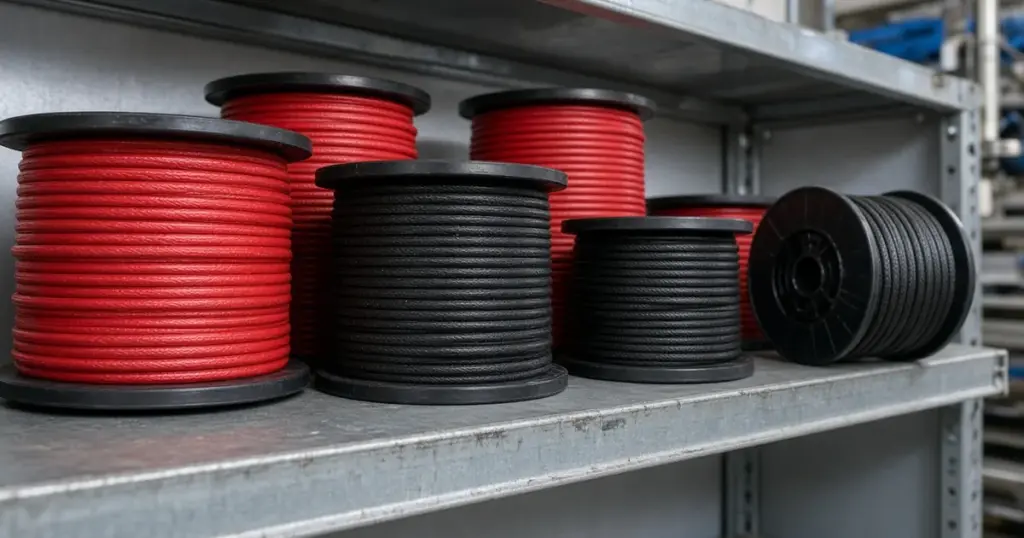
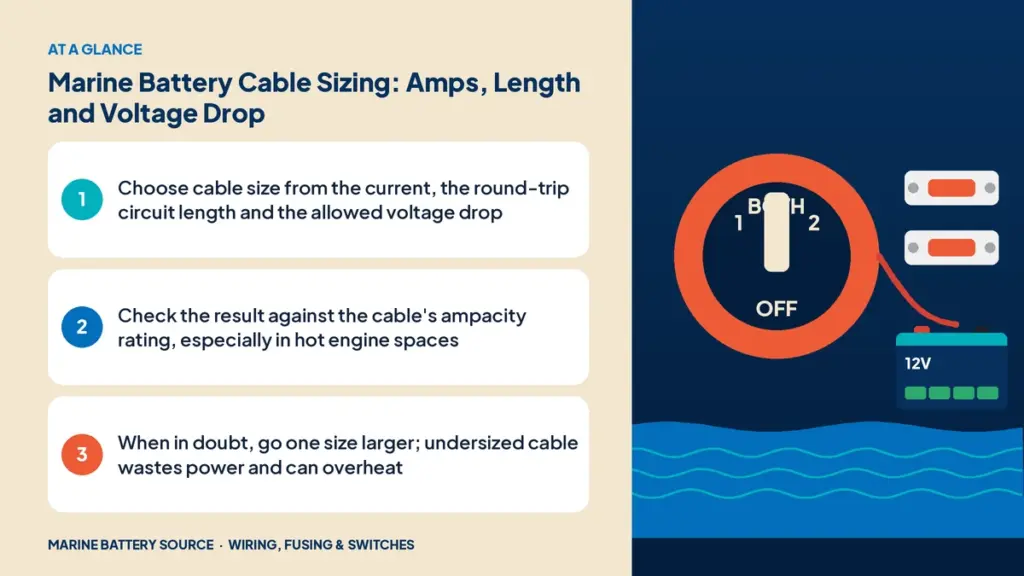
Choosing the right cable size is one of the most important decisions in any boat battery installation. Too small and you lose power to heat, starve trolling motors and electronics of voltage, and risk overheating. Too large costs more and is harder to route, but it rarely causes problems. This guide explains how to choose marine battery cable size with simple formulas and worked examples.
The three factors
- Current: the maximum amps the circuit will carry.
- Length: the total round-trip length of the circuit, from the battery to the load and back on the negative.
- Allowed voltage drop: typically 3% for critical circuits like navigation equipment, electronics and charging, and up to 10% for less critical loads like lighting. Many installers use 3% for trolling motors and starting circuits too, for best performance.
Why round-trip length matters
Current flows out on the positive cable and back on the negative. Both contribute resistance. A trolling motor 15 feet from its batteries has a 30-foot round-trip circuit. Use that full length in calculations.
The voltage drop formula
For copper wire:
Circular mils needed = (10.75 × current in amps × round-trip length in feet) ÷ allowed voltage drop in volts
Then choose the AWG size with at least that many circular mils:
| AWG | Circular mils |
|---|---|
| 14 | 4,110 |
| 12 | 6,530 |
| 10 | 10,380 |
| 8 | 16,510 |
| 6 | 26,240 |
| 4 | 41,740 |
| 2 | 66,360 |
| 1/0 | 105,600 |
| 2/0 | 133,100 |
| 4/0 | 211,600 |
Worked examples
12V fish finder, 3A, 20 ft round trip, 3% drop (0.36V): 10.75 × 3 × 20 ÷ 0.36 ≈ 1,790 circular mils. 16 AWG would meet voltage drop, but many installers use 14 AWG or the maker’s specified size for strength and margin.
12V trolling motor, 50A, 20 ft round trip, 3% drop (0.36V): 10.75 × 50 × 20 ÷ 0.36 ≈ 29,860 circular mils → 4 AWG.
36V trolling motor, 50A, 30 ft round trip, 3% drop (1.08V): 10.75 × 50 × 30 ÷ 1.08 ≈ 14,930 circular mils → 8 AWG. Higher voltage systems need smaller cable for the same current and length because the allowed drop in volts is larger.
12V inverter, 150A, 10 ft round trip, 3% drop (0.36V): 10.75 × 150 × 10 ÷ 0.36 ≈ 44,790 circular mils → 2 AWG minimum; many installers choose 1/0 for margin and lower heat.
Check ampacity too
Voltage drop isn’t the only test. A cable must also safely carry the current without overheating. Ampacity depends on the insulation’s temperature rating, whether the cable is bundled with others, and whether it runs through an engine space, where ratings are reduced. Marine cable makers and recognized standards publish ampacity tables. Use the larger size from the voltage drop and ampacity checks.
Trolling motor maker recommendations
Trolling motor manufacturers publish recommended cable sizes for their motors at various lengths. Follow those as a minimum. Connection kits like the Dakota Lithium 24V trolling motor connection kit include pre-sized cables for common setups.
Fuses must match the cable
A fuse protects the cable, so its rating must not exceed the cable’s ampacity. Choose the cable first, then a fuse rated at or below that cable’s ampacity and at or above the circuit’s normal current. Terminal-mounted fuses like the Battle Born 58V 300A marine fuse suit heavy cables near the battery.
Use tinned marine cable
Choose finely stranded, tinned copper cable designed for marine use. It’s flexible, resists corrosion and is labeled with its gauge and temperature rating. See tinned copper marine wire.
Series and parallel interconnects
Jumpers between batteries in a series bank carry full system current and should match the main cable size. Parallel interconnects should be at least as large as the main cables and of equal length. See series vs parallel wiring and wiring batteries in parallel.
Switches and busbars
Battery switches, busbars and distribution blocks must be rated for the circuit’s current. A heavy cable connected through an undersized switch creates a bottleneck. See battery switch basics and the EPOCH heavy-duty distribution block for high-current distribution.
Signs your cables are too small
- Trolling motor slows under load or loses top speed.
- Cables or terminals feel warm after use.
- Electronics reset when the trolling motor or engine starts.
- Measurable voltage drop between the battery and the load under load.
See voltage drop in boat wiring for how to measure it.
Starting circuits
Engine starting circuits draw very high current for a few seconds, often several hundred amps on larger engines. Most engine makers specify the minimum battery cable size for a given cable length, and those requirements should be followed exactly. Because the starting motor is often close to the battery, cables may be short, but they’re heavy: 2 AWG, 1/0 or 2/0 is common on outboards and inboards. Undersized starting cables are a frequent cause of slow cranking, especially when an owner moves the battery to a new location farther from the engine and reuses the old cables.
Planning for future loads
If you expect to add loads later, such as a bigger trolling motor, an inverter or more electronics, size main feeder cables for the future now. Replacing a main cable later is more work than installing a slightly larger one the first time.
Practical tips
- Measure the actual cable route, not a straight line.
- Add a little extra for bends and service loops.
- Round up to the next size when calculations land close.
- Keep high-current runs as short as possible by placing batteries near major loads.
When upgrading to lithium
Lithium batteries deliver high current with little voltage sag, so a cable that was marginal with lead-acid may now be the limiting factor. When you upgrade batteries, check that cables and fuses are sized for the new battery’s continuous and peak current, and for any added loads.
For a complete overview, see the marine battery wiring guide, and browse battery accessories in the store.
Frequently asked questions
What size cable do I need for my trolling motor?
Use the motor maker’s recommendation as a minimum, or calculate from current, round-trip length and a 3% voltage drop.
Should I measure one-way or round-trip length?
Round-trip: the positive and negative cable lengths combined.
Can I use a smaller cable on a 36V system?
Often yes, because a 3% drop is more volts at 36V. Always confirm with the formula and ampacity tables.
Is bigger cable always better?
Bigger reduces voltage drop and heat, but costs more and is harder to route. Go one size up when close.