


Battery Boxes and Mounting on Small Boats
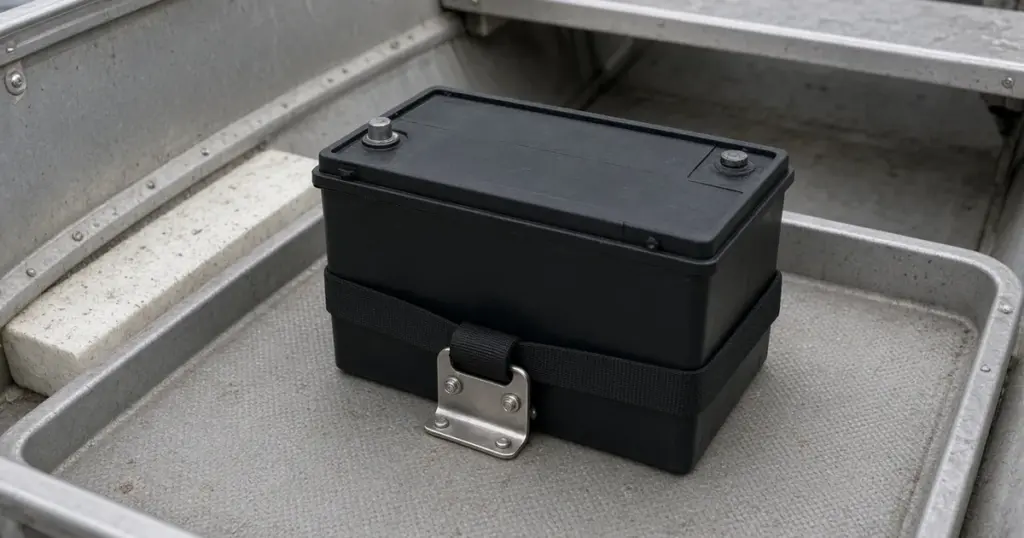
A battery that slides across the floor of a jon boat or tips in a kayak isn’t just an annoyance. It can short its terminals, start a fire, damage the hull or shift the boat’s balance at the worst moment. Proper mounting is one of the simplest, most important things you can do for a small boat electrical system. This small boat battery box guide explains how to choose, place and secure a battery box, protect the terminals and route cables safely.
Why secure mounting matters
- Short circuits: a loose battery can contact metal hulls, tools or other batteries.
- Acid spills: flooded batteries can leak acid if tipped.
- Hull damage: a heavy battery bouncing in rough water can crack fiberglass or dent aluminum.
- Balance: a sliding battery changes a small boat’s trim and stability.
- Standards: recognized marine guidelines call for batteries to be secured against movement and for terminals to be protected.
Choosing a battery box
- Match the box to the battery group size. Group 24, 27 and 31 boxes are common. Small lithium batteries may need compact boxes or custom trays.
- Choose marine-rated plastic that resists acid, fuel and UV.
- Look for a vented lid if you use flooded batteries, which release gas while charging.
- Use a strap that secures both the lid and the box to the hull.
Measure the battery. A Group 24 lithium battery like the EPOCH 12V 100Ah Eco measures 10.25 × 6.75 × 9 inches, while a Battle Born 30Ah is about 7.7 × 5.1 × 6.1 inches and fits much smaller spaces.
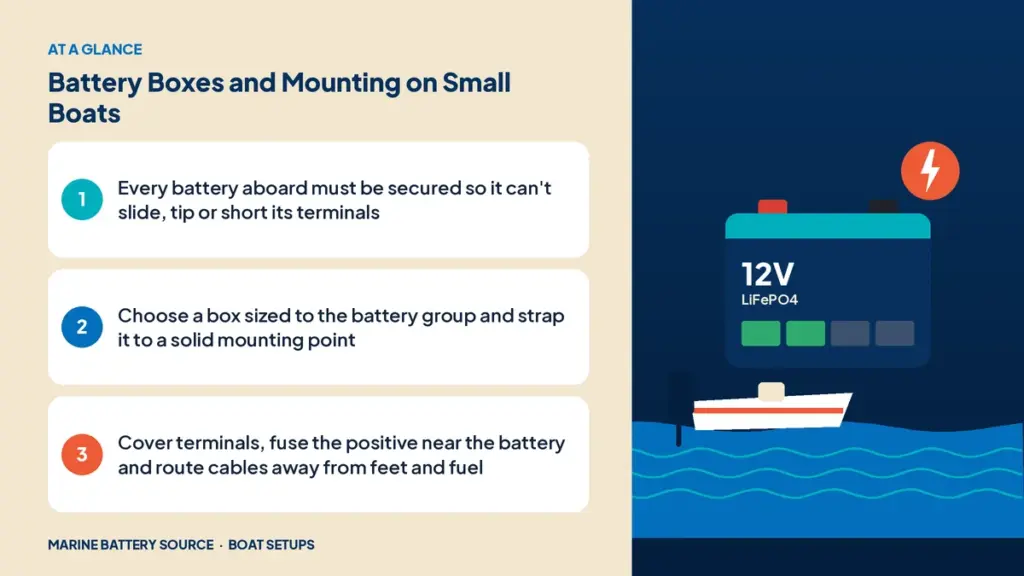
Choosing a location
- Low and near the centerline for stability.
- Away from fuel tanks and fuel lines.
- Out of standing bilge water.
- Accessible for inspection and charging.
- Close to the main load to keep high-current cables short; for a bow-mount trolling motor, that may mean a forward battery position.
In canoes and kayaks, use the battery as trim ballast. In jon boats, placing the battery forward can balance a heavy tiller outboard. See canoe trolling motor batteries and the tender battery guide for boat-specific tips.
Securing the box
- Exact-fit trays: some battery makers sell trays for specific models, such as the EPOCH battery tray for its 12V 100Ah and 105Ah Group 24 batteries.
- Screw-down mounts: bolt or screw a battery tray or box base to a solid surface like a floor, stringer or bulkhead. Use stainless hardware and seal holes in fiberglass.
- Strap anchors: install strap anchors on each side and run the strap through the box handles.
- No-drill options: in kayaks and inflatables, use track mounts, padeyes or purpose-built cradles.
- Test by pushing and pulling the box firmly. It shouldn’t move.
Protecting the terminals
- Use terminal covers or a box lid that fully encloses the terminals.
- Keep metal tools and gear away from the battery.
- Apply dielectric grease to reduce corrosion.
- Tighten terminal nuts properly; loose connections cause heat and voltage drop.
Fusing and cables
- Fuse the positive cable as close to the battery as practical, typically within about 7 inches, with a fuse rated for the cable and load. Marine fuse blocks like the Battle Born MRBF fuse block mount directly on the terminal.
- Use marine-grade tinned copper cable sized for current and length.
- Route cables along the hull, secure them every 18 inches or so, and protect them where they pass through bulkheads.
- Keep cables away from where feet, dogs or gear land.
Venting and charging
Flooded lead-acid batteries release hydrogen while charging, so they need ventilation. Sealed AGM and lithium batteries don’t vent under normal use, but battery compartments should still not be sealed airtight. Don’t charge any battery in a closed, unventilated space.
Mounting for specific uses
- Fish finder batteries: small lithium batteries in compact boxes; see the fish finder guide.
- Ice fishing: keep batteries insulated and secured in shelters; see the ice fishing guide.
- Hunting boats: rugged boxes with heavy straps for rough use; see the duck boat guide.
Lithium mounting tips
Lithium batteries can usually be mounted in any orientation, but check the maker’s instructions. They’re light, which makes securing them easier, but they still need hold-downs. Keep them out of direct sun in hot climates.
Common mistakes
- Setting a battery loose on the floor.
- Using a box that’s too large, letting the battery slide inside it.
- Leaving terminals uncovered.
- Running the positive cable without a fuse.
- Mounting near fuel tanks.
Inspection checklist
- Box secure and strap tight.
- Terminals clean, tight and covered.
- Fuse present and correctly rated.
- Cables secured and undamaged.
- Box free of water and debris.
Mounting two batteries
When a small boat needs two batteries, such as a starting battery and a trolling battery, mount each in its own secured box. Space them so you can reach each terminal, label each battery, and use separate fuses. Keep the two batteries close together if they’ll be wired in series for a 24V trolling motor, which keeps the jumper cable short. For trolling motor wiring and system sizing, the trolling motor power system guide explains the options.
When to upgrade a mount
Many older small boats have makeshift battery mounts: a battery sitting in a milk crate, a strap screwed into thin plywood, or a box wedged between seats. If your mount relies on friction, rope or gear stacked around the battery, replace it. A proper tray and strap costs little and protects the battery, the boat and you.
For the bigger picture, read the small boat battery guide and setups by boat type. Browse battery accessories in the store.
Frequently asked questions
Do I need a battery box in a small boat?
You need the battery secured and its terminals covered. A battery box with a strap is the easiest way to achieve both.
Where should I mount a battery in a jon boat?
Low, near the centerline, away from fuel, and positioned to balance the boat. Forward placement often balances a tiller outboard.
Can I mount a battery box without drilling?
In kayaks and inflatables, use track mounts, padeyes or cradles. In hard boats, screw-down mounts are more secure.
How close to the battery should the fuse be?
Install the fuse as close to the battery positive as practical, often within about 7 inches, following marine wiring guidelines.