


Battery Setups for Twin and Triple Outboards
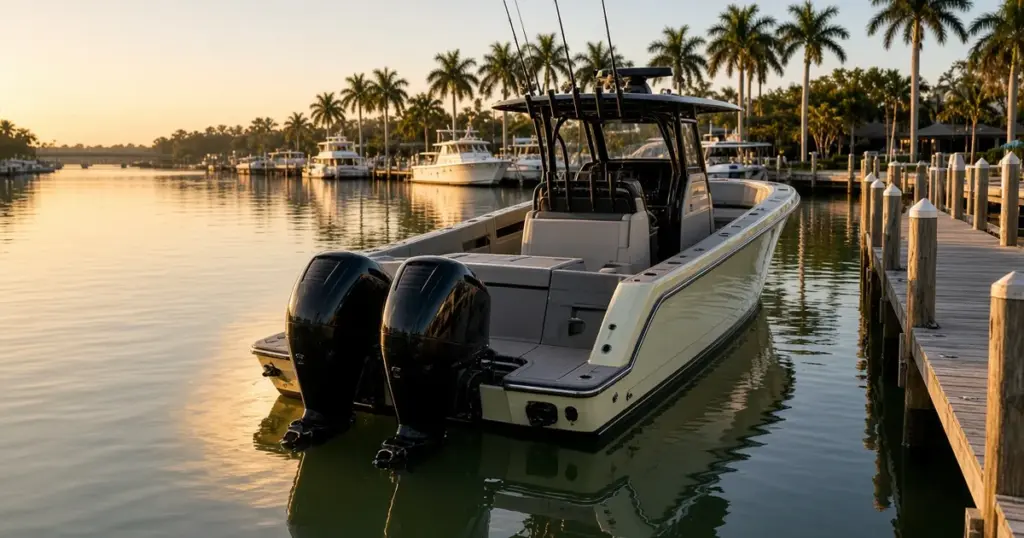
Twin and triple outboards are standard on offshore center consoles, and they bring more electrical complexity than a single engine. Each engine has its own starting and charging system, the boat usually carries a lot of electronics, and redundancy is part of the reason for multiple engines in the first place. This guide explains common twin outboard battery setups, how to switch and charge them, and how to choose batteries.
The goals of a multi-engine battery system
A good system should:
- Start each engine reliably.
- Keep electronics and accessories from draining starting batteries.
- Charge every battery while underway.
- Allow an engine to be started from another battery if one fails.
- Be simple enough to operate correctly in a stressful moment.
Common layouts
Layout 1: one battery per engine, no house bank
Each engine has its own starting battery. Electronics run from one of them, or are split between them. Simple and common on older or smaller twin-engine boats. The downside: electronics can draw down a starting battery.
Layout 2: one battery per engine plus a house bank
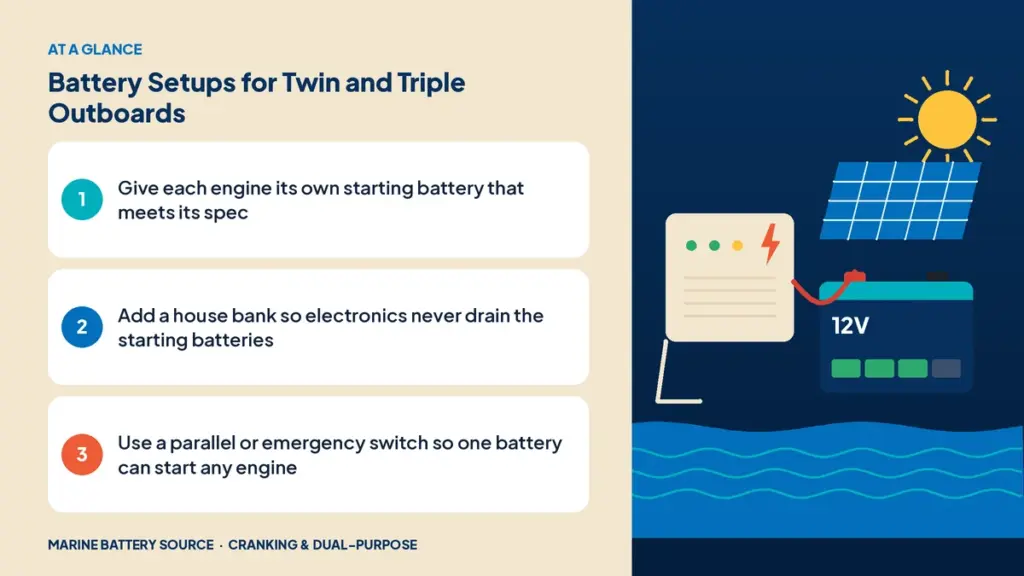
Each engine starts from its own battery, and a separate house battery or bank runs electronics, pumps and lights. The engines charge the starting batteries directly and the house bank through automatic charging relays or DC-DC chargers. This is the most common modern setup on offshore boats.
Layout 3: triple or quad engines
Each engine still has its own starting battery. One or more house banks serve the electronics. Switch panels become more complex, so labeling and a clear wiring diagram are essential.
Switching options
- Individual on/off switches for each starting battery and the house bank.
- A parallel or emergency switch that connects starting batteries (and sometimes the house bank) together so a healthy battery can start an engine whose battery has failed.
- Dual circuit plus switches that separate starting and house circuits and offer a combine position.
Many engine makers and boat builders specify particular switching arrangements for their engines. Follow them, especially with modern outboards whose electronics are sensitive to voltage spikes.
Charging multiple batteries
Each outboard charges its own starting battery while running. To charge the house bank:
- Automatic charging relays (ACRs) connect the house bank to a starting battery once the starting battery reaches a charging voltage, and disconnect it when voltage falls.
- DC-DC chargers take power from the engine side and charge the house bank with a controlled profile. They’re the better choice for lithium house banks.
- Shore power chargers with several banks top up everything at the dock. The EPOCH 4-bank 12V charger provides 10A per bank, enough for two starting batteries and a two-battery house bank.
Choosing starting batteries
Each starting battery must meet that engine’s cranking and reserve requirements. Twin engines usually use matched batteries for simplicity. Interstate’s marine line lists both CCA and MCA, for example:
- Interstate 27M-XHD: 800 CCA, 1000 MCA, 182 minutes RC.
- Interstate 31M-AGM: 925 CCA, 1190 MCA, 200 minutes RC.
See outboard cranking requirements for how to read the specs.
Lithium on twin-engine boats
Lithium is popular for house banks on center consoles because it saves weight and handles deep cycling. Cranking-rated lithium batteries like the EPOCH 12V 172Ah dual purpose (1000 CCA listed) can also serve as starting batteries where the engine maker allows it. Dakota Lithium sells a Connect-Ease dual outboard connection kit designed for this kind of layout. Before using lithium for starting, review lithium starting batteries for outboards.
Dual-purpose batteries as a simpler option
Some owners use identical dual-purpose batteries for every position. Any battery can start any engine or run the electronics, which simplifies spares. Read more in our dual-purpose battery guide.
Wiring essentials
- Fuse every positive conductor near the battery, except where ABYC allows unfused starter cables.
- Size cables for current and length. Starter cables on center consoles with batteries in the console can be long.
- Keep negative returns tied together at a common point as the builder designed.
- Label every switch position and cable.
Good connections matter more as systems grow. Corroded lugs and loose terminals cause slow cranking and charging problems that are hard to trace.
Group size and space
Many center consoles store batteries in the console or under the leaning post, where space is tight. Group 24, 27 and 31 batteries are most common. Our BCI group size guide helps you compare dimensions. Lithium’s smaller weight can help with weight distribution, too.
Inboard twins
Twin inboards and sterndrives use similar principles: one starting battery per engine, a house bank, and a parallel switch for emergencies. See inboard and sterndrive starting batteries.
Operating the system
- Turn on each engine’s starting battery and the house bank before starting.
- Start engines one at a time.
- Use the parallel switch only if a starting battery can’t start its engine.
- Turn the parallel switch off once engines are running, unless the builder’s instructions say otherwise.
- Turn off battery switches when leaving the boat.
Troubleshooting tips
- One engine cranks slowly: test that engine’s battery and check its cables and switch.
- House bank always low: check the ACR or DC-DC charger and its fuse.
- Starting battery drained overnight: look for electronics or a bilge pump wired to the wrong battery, or a parasitic load.
Keep the original wiring diagram aboard. Without it, diagnosis on a complex system takes far longer. If you’re comparing this system with a jet ski or car battery, our guides to PWC batteries and marine vs car batteries explain the differences.
For the fundamentals, read choosing a boat starting battery and cranking vs dual-purpose vs deep-cycle batteries. Browse cranking batteries in the store.
Frequently asked questions
How many batteries do I need for twin outboards?
At least one starting battery per engine. Most offshore boats also add a house battery or bank for electronics.
Can twin outboards share one battery?
They can be paralleled for emergency starting, but each engine normally has its own starting battery so one failure doesn’t strand you.
What is a parallel switch?
A switch that connects batteries together, so a healthy battery can help start an engine whose own battery is weak or dead.
Should I use lithium for my house bank on a twin-engine boat?
Lithium is a popular house-bank choice because of its weight savings and deep-cycle ability. Charge it with a DC-DC charger or equipment designed for lithium.