


AGM Trolling Motor Batteries: When They Still Make Sense
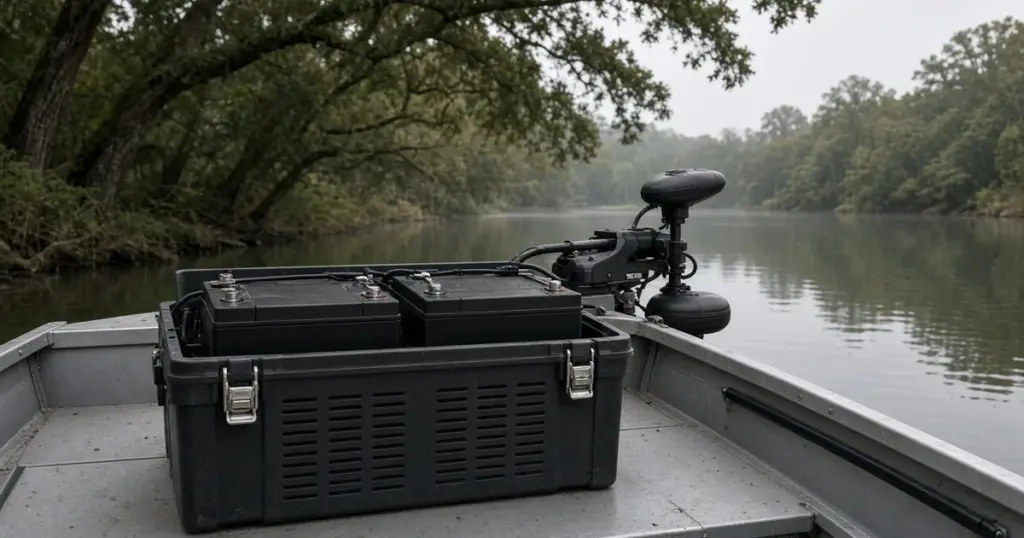
Lithium gets most of the attention in trolling motor conversations, and for good reason. But an AGM trolling motor battery is still the right answer for plenty of anglers. If you fish a handful of weekends a year, already own a good lead-acid charger, or need to keep the up-front cost of a two- or three-battery bank down, AGM deserves a fair look. This guide explains where AGM fits, where it falls short, and how to size and care for it so it lasts.
What makes AGM different
AGM stands for absorbent glass mat. The electrolyte is held in fiberglass mats pressed between the lead plates, so there is no free liquid to slosh or spill. That brings several practical advantages over flooded batteries:
- No watering. The battery is sealed and recombines most of the gas it produces during normal charging.
- Mounting flexibility. Most AGMs can be installed on their side (check the maker’s instructions), which helps in cramped compartments.
- Vibration resistance. The compressed plate pack holds up well to pounding in a chop.
- Low self-discharge. AGMs typically lose charge more slowly in storage than flooded batteries.
It is still lead-acid chemistry, though, so it carries the same basic limits: heavy weight, voltage that falls steadily as you discharge, and shorter life if you regularly drain it deep. For a full comparison of the chemistries, see our lithium trolling motor battery guide.
When AGM still makes sense
You fish occasionally
If the boat goes out ten or fifteen times a season, you may never use enough cycles to justify lithium’s higher price. An AGM bank that is recharged promptly after every trip can give years of service at a fraction of the cost.
You already own a lead-acid charger
Many onboard chargers installed on bass and walleye boats were set up for flooded or AGM batteries. Staying with AGM means no charger change and no re-wiring. Switching to lithium usually requires a charger with a lithium profile, or at least one whose voltage settings match the battery maker’s recommendations.
Cold-weather charging
Lead-acid batteries can accept charge below freezing, while most lithium batteries should not be charged below about 32°F unless they have built-in heating. For early-spring walleye anglers who charge in an unheated garage, that difference matters, though heated lithium batteries now close that gap.
Budget for a 24V or 36V bank
A 36V system needs three 12V batteries. Multiplying a lithium price by three is a big number, and AGM keeps the entry cost manageable for many owners.
Where AGM falls short
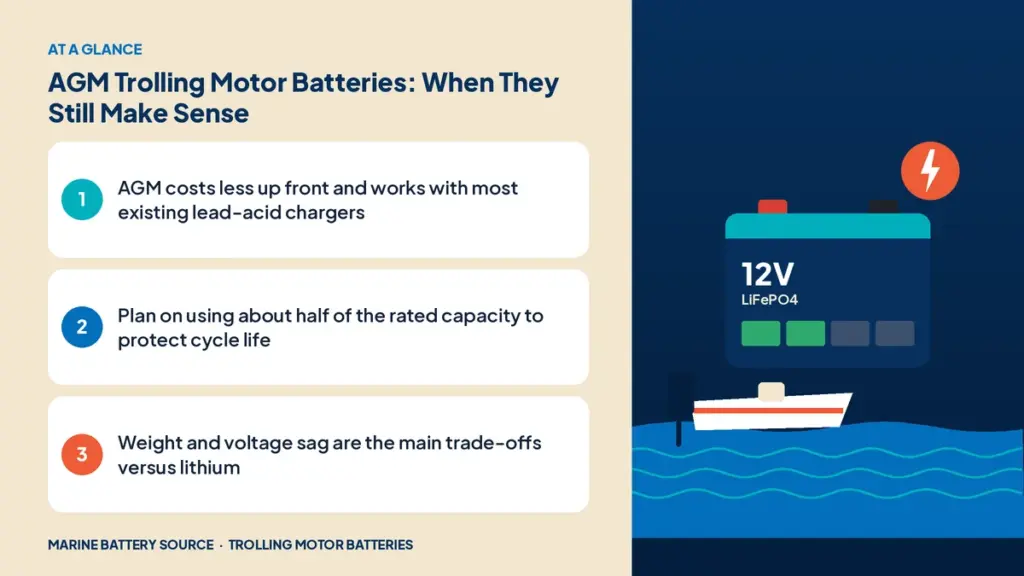
- Weight. A deep-cycle AGM in Group 27 or 31 commonly weighs 60 to 70 lb. The Trojan 27-AES is listed at 66 lb and the Trojan 31-AES at 69 lb. A three-battery 36V bank can easily add 200 lb to the boat.
- Usable capacity. To get good cycle life, most anglers plan to use only about half of an AGM’s rated capacity.
- Voltage sag. As an AGM discharges, its voltage drops, and many trolling motors lose some thrust and speed with it.
- Charging time. AGM batteries need a long absorption stage to get fully charged, so a quick top-up between sessions rarely gets them to 100%.
How to size an AGM trolling bank
Start with your motor’s average current draw, which our amp draw guide helps you estimate. Then work out the hours you fish.
Rated Ah needed ≈ (average amps × hours) ÷ 0.5
Example: a 24V motor averaging 20A for 5 hours uses about 100Ah from the bank. Planning for 50% depth of discharge, you want around 200Ah of rated capacity at 24V. Two Group 31 AGMs in series give 24V but only the capacity of one battery, so you would either accept a shorter day or move to a larger battery or a second string.
Use the battery’s 20-hour amp-hour rating or its listed kWh for comparisons, and remember that capacity at high current is lower than the 20-hour figure. The store lists the Trojan 27-AES at 1.19 kWh and the 31-AES at 1.38 kWh at the 20-hour rate, with reserve capacity of 158 and 180 minutes respectively.
| Rated capacity planning | Lead-acid (AGM) | Lithium (LiFePO4) |
|---|---|---|
| Typical planned depth of discharge | About 50% | About 80% or more |
| Usable from a 100Ah battery | About 50Ah | About 80Ah |
| Voltage through the day | Falls steadily | Stays nearly flat |
| Charger | Lead-acid AGM profile | Lithium profile per maker |
Wiring an AGM bank
AGM batteries wire exactly like any other 12V battery. Two in series give 24V; three give 36V. Always connect the positive of one battery to the negative of the next, then take the motor leads from the free terminals at each end. Fuse or breaker protection belongs on the positive lead near the battery, sized per the motor maker’s instructions. The step-by-step layout is covered in our guide to wiring 24V and 36V banks, and the bigger system picture is in our trolling motor power system guide.
Matching the batteries
Lead-acid batteries in a series string should be the same model, capacity and age. Mixing an old battery with a new one means the weaker battery hits its limits first and drags the whole string down. Replace AGM batteries in a bank as a set.
Charging AGM trolling batteries correctly
- Use a multi-bank onboard charger with a dedicated output per 12V battery, set to its AGM profile.
- Recharge after every trip, even short ones. Lead-acid batteries left partly discharged develop sulfation that permanently reduces capacity.
- Give the charger enough time to finish the absorption stage. Unplugging as soon as the “charged” light flickers often leaves the battery short.
- Check the charger’s AGM voltage settings against the battery maker’s recommendations.
Our guide on how to charge trolling motor batteries covers multi-bank chargers in detail.
Getting the longest life from AGM
- Avoid deep discharges. Stopping around half capacity rather than running the battery flat makes a large difference in cycle life.
- Recharge promptly. Don’t let the bank sit discharged overnight, let alone for a week.
- Keep connections clean and tight. Loose lugs create heat and voltage drop.
- Store fully charged. Over the off-season, keep the batteries topped up with a maintainer or recharge them periodically.
- Watch the heat. High temperatures accelerate aging, so give the compartment ventilation where possible.
AGM or lithium: a quick decision guide
Choose AGM if you fish occasionally, your boat is not weight-sensitive, you want to keep your current charger, or the up-front budget is the deciding factor. Choose lithium if you fish often, want the full day of steady thrust, need to save weight on a smaller boat, or want a battery that may outlast several AGM sets. If you are weighing the single-battery lithium option for a 24V motor, read one 24V lithium battery vs two 12V batteries. Owners stepping up in power should also read about 48V trolling motor options.
For the full decision process, our pillar guide on how to choose a trolling motor battery walks through thrust, voltage and runtime. You can compare deep-cycle lead-acid options in the AGM and lead-acid battery category or browse Trojan batteries. Your boat type changes the answer too, which is covered in battery setups by boat type.
Frequently asked questions
Is AGM good for a trolling motor?
Yes, a deep-cycle AGM is a solid trolling motor battery. It is sealed, vibration-resistant and maintenance-free. It weighs much more than lithium and delivers less usable capacity, so size it with about 50% depth of discharge in mind.
How long does an AGM trolling motor battery last?
Lifespan depends on how deeply and how often you discharge it, how promptly you recharge, and heat. Shallow discharges and prompt, complete recharging give the longest life. Check the battery maker’s cycle-life data for your model.
Can I mix AGM and flooded batteries in a trolling bank?
No. Batteries in a series string should match in chemistry, capacity, model and age, so each one charges and discharges evenly.
Do I need a special charger for AGM batteries?
Use a charger with an AGM setting whose voltages match the battery maker’s recommendations. Most modern multi-bank marine chargers have one.