


24V Trolling Motor Batteries: Series Sets vs Single 24V Lithium
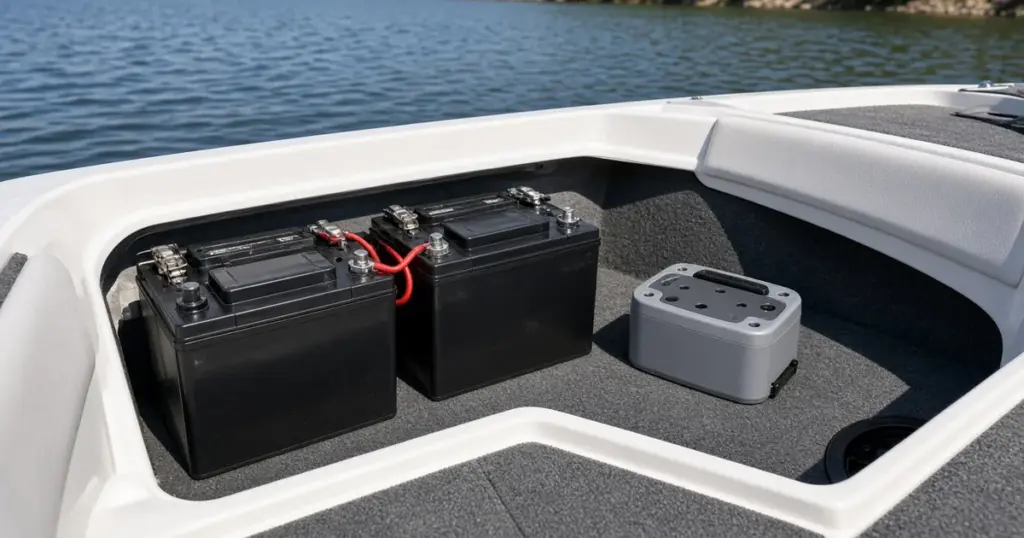
Twenty-four-volt trolling motors are the middle ground of freshwater and inshore fishing. They deliver more thrust than 12V motors without the third battery a 36V system needs, and they’re common on bass boats, bay boats, deck boats and larger aluminum boats. This 24V trolling motor battery guide explains your two ways to build a 24V bank, how to size it, and how to wire and charge it properly.
Two ways to get 24V
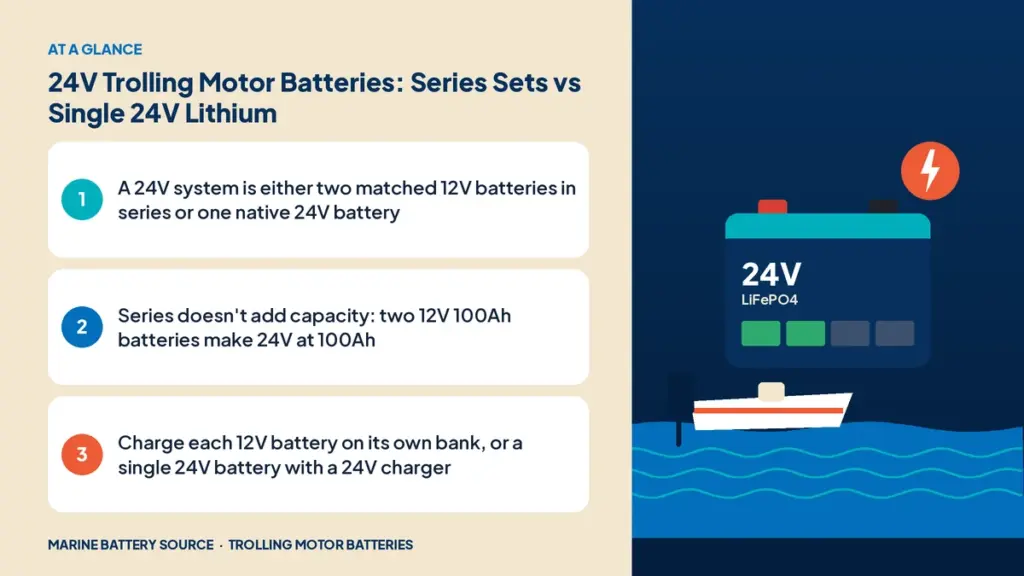
Two 12V batteries in series
The traditional approach. Connect the positive of battery one to the negative of battery two with a jumper cable. The remaining negative and positive terminals become the 24V output. You can use lead-acid or lithium, as long as both batteries are identical in chemistry, capacity, age and brand.
One native 24V battery
A single lithium battery built as 24V. One case, two terminals, one charger connection. Examples in the store include the Dakota Lithium 24V 60Ah, listed at 24.9 lb in a Group 24 footprint, the EPOCH 24V 100Ah with Bluetooth and heating, Battle Born’s 24V 50Ah in a Group 27/31 case, and the Interstate Li31M 24V 60Ah.
Matched 12V sets are also sold together, like Dakota Lithium’s 24V 100Ah trolling motor battery set of two 12V 100Ah heated batteries. The trade-offs between the approaches are covered in one 24V battery vs two 12V batteries.
Sizing a 24V bank
Series doesn’t add amp-hours
Two 12V 100Ah batteries in series give you 24V at 100Ah, not 200Ah. What doubles is the voltage, and with it the energy: 24V × 100Ah is about 2,400Wh nominal for lead-acid or about 2,560Wh for lithium at 25.6V.
Use average current at 24V
Check the motor’s maximum current draw at 24V in the manual, then estimate your average. Usable Ah ≈ average amps × hours.
Example: a 24V motor averaging 20A for 7 hours needs about 140Ah usable.
- Lithium at about 80% usable: around 175Ah rated. That might mean a large 24V battery or two parallel 24V batteries, depending on what fits.
- Lead-acid at about 50%: around 280Ah rated, which is impractical for most boats.
Many anglers fish less aggressively than that example, and a 100Ah lithium 24V bank covers a long day. Learn your real average from a monitor or battery app before buying more capacity. Our run-time guide has more worked examples.
Comparing single-case 24V lithium options
These figures come from the store’s listings:
| Battery | Listed energy | Listed weight | Size and features |
|---|---|---|---|
| Dakota Lithium 24V 60Ah | 1,536Wh | 24.9 lb | Group 24 footprint; 80A continuous |
| EPOCH 24V 60Ah Pro | 1.54 kWh | 30 lb | Group 27 size; Bluetooth and heating |
| EPOCH 24V 100Ah | 2.56 kWh | 48.5 lb | 13 × 10.25 × 11 in; Bluetooth and heating |
| Interstate Li31M 24V 60Ah | 24V, 60Ah | n/a | Group 31M size; 60-month free replacement |
| Dakota Lithium 24V 110Ah | 2,816Wh | 50.5 lb | 19.1 × 6.6 × 9.9 in; 100A continuous |
Notice how the footprints vary. A Group 24 or 27 size 24V battery can drop into a space that used to hold one 12V battery, freeing the second compartment for storage or a dedicated electronics battery. Larger capacities come in longer or wider cases, so measure before you choose.
Choosing chemistry
Lithium is the most popular upgrade for 24V systems: a single 24V lithium battery can weigh less than one of the 12V lead-acid batteries it replaces. AGM pairs, such as two Trojan 27-AES or 31-AES batteries, are a sealed, lower-cost option. Flooded pairs are cheapest up front but heavy and need maintenance.
Wiring a 24V system
- Use a jumper cable of the same gauge as the main cables between the two 12V batteries.
- Fuse or breaker the positive lead as the motor maker specifies, close to the battery.
- Size cable gauge for the motor’s maximum current and the round-trip length.
- Keep all terminals covered and tight.
Our step-by-step guide to wiring 24V and 36V trolling motor batteries includes diagrams in words, and Dakota Lithium’s 24V trolling motor connection kit with onboard charging bundles the jumper, breaker and charging leads.
Charging a 24V bank
Series bank of 12V batteries
The common approach is a two-bank or multi-bank onboard charger with one 12V bank connected to each battery. Each battery charges independently, which keeps the pair balanced. With lithium, set every bank to a lithium profile.
Native 24V battery
Use a charger built for 24V and the battery’s chemistry, such as the EPOCH 24V 15A lithium charger or Dakota Lithium’s 24V 20A onboard charger.
On-the-water charging
A DC-DC charger can charge a 24V bank from a 12V engine system while you run. That’s covered in our charging section.
Powering 12V electronics on a 24V boat
Don’t run 12V electronics off one battery in a 24V series bank. It drains that battery faster and unbalances the pair, shortening its life. Options:
- Power electronics from the starting battery or a dedicated 12V battery.
- Use a DC-DC converter from the 24V bank, like the Dakota Lithium 24V or 36V to 12V 10A converter, sized for your electronics’ draw.
Common 24V mistakes
- Mixing an old and a new battery in series.
- Charging the series bank with a single 12V charger on one battery.
- Tapping 12V from one battery for electronics.
- Using a jumper cable that’s thinner than the main leads.
- Forgetting the fuse or breaker.
When to consider 36V instead
If your boat is large, fishes big water or you want the extra thrust, 36V may suit you better. Compare with our 36V trolling motor battery guide. For lighter boats, the 12V guide might be all you need, and newer high-output motors are covered in 48V trolling motor batteries.
For the full decision process, start with how to choose a trolling motor battery, or browse the store’s trolling motor batteries.
Frequently asked questions
How many batteries do I need for a 24V trolling motor?
Either two 12V batteries wired in series or one native 24V battery.
Do two 12V batteries in series double the amp-hours?
No. Series connection doubles the voltage while capacity stays the same. Two 12V 100Ah batteries in series give 24V at 100Ah.
Can I charge a 24V trolling bank with a 12V charger?
Not as a series pair through one 12V output. Use a two-bank charger with one bank per battery, or a 24V charger for a native 24V battery.
Can I run my fish finder off one battery of my 24V bank?
It’s not recommended. It unbalances the bank. Use a separate 12V battery or a DC-DC converter.