


12V Trolling Motor Batteries: Sizing and Smart Choices
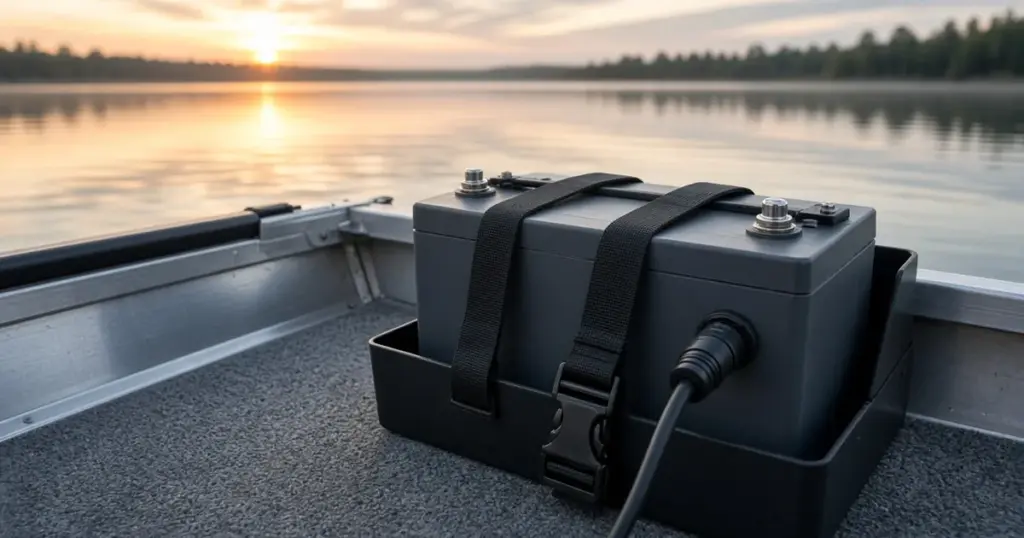
A 12V trolling motor is the simplest trolling setup there is: one battery, two cables, no series wiring. That simplicity is why 12V motors are standard on kayaks, canoes, jon boats and small aluminum fishing boats. It also means your single battery carries the entire load, so choosing it well matters. This 12V trolling motor battery guide covers sizing, chemistry, fit, wiring and charging, with examples from the store’s lineup.
Who uses 12V trolling motors
Twelve-volt motors are typically the lower-thrust end of the range, commonly up to around 55 lb of thrust, though designs vary by brand. They suit:
- Kayaks and canoes with small transom or bow mounts.
- Jon boats and small skiffs.
- Small aluminum fishing boats on lakes and rivers.
- Sailboat tenders and dinghies.
If your boat is larger or you fish in heavy wind and current, a 24V or 36V system may be the better tool. Our guides to 24V trolling motor batteries and 36V trolling motor batteries cover those systems.
Step 1: Estimate your current draw
Your motor’s manual should list its maximum current draw at full speed. Most anglers spend much of the day at lower settings, so average draw is lower than the maximum. To estimate:
- Note the maximum draw from the manual.
- Think about how you fish: constant cruising into wind, or short bursts while casting.
- Pick a conservative average. When in doubt, assume higher.
If your battery has Bluetooth or you add a monitor, you’ll learn your real average within a few trips.
Step 2: Size capacity
Runtime in hours is roughly usable amp-hours divided by average draw in amps. Flip that around and you get the capacity you need:
Usable Ah needed ≈ average amps × hours on the water
Example: a motor averaging 15A over 6 hours needs about 90Ah of usable capacity.
- With lithium used to about 80%, that’s a battery rated around 110Ah or more, or a 100Ah battery if you accept less margin.
- With lead-acid planned at about 50% depth, that’s around 180Ah of rated capacity, which usually means two batteries in parallel.
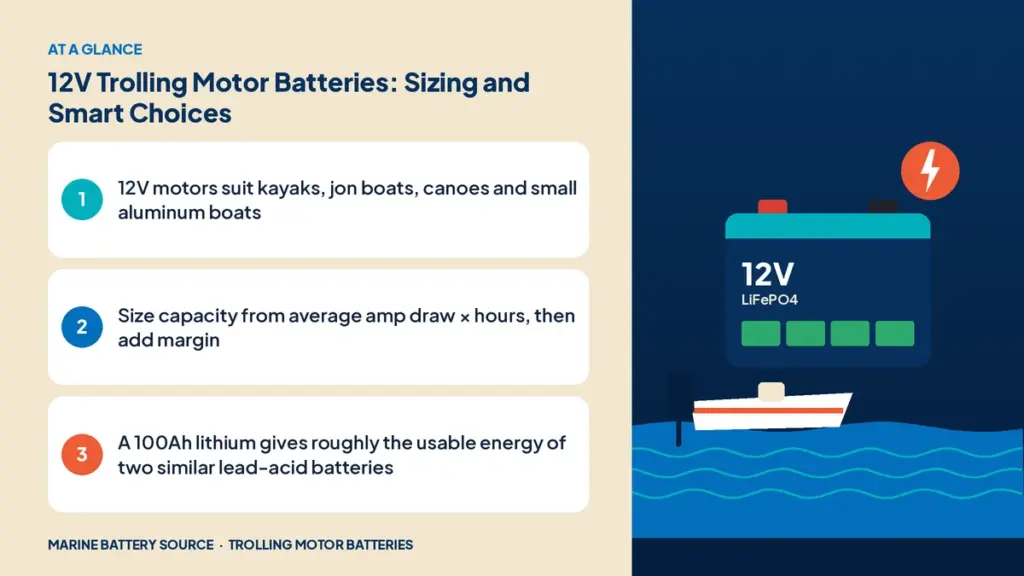
That comparison is why so many 12V anglers switch to lithium. One 100Ah lithium battery often replaces two lead-acid batteries. Our run-time math guide walks through more examples.
Step 3: Choose a chemistry
Lithium (LiFePO4)
Light, steady voltage, long cycle life and deep usable capacity. Examples in the store:
- EPOCH 12V 100Ah Eco: listed at 21 lb in a Group 24 size with a 6-year warranty.
- Dakota Lithium 12V 100Ah heated: 27.5 lb, Group 24 size, 100A continuous, with internal heating for cold charging.
- Interstate Li27M 12V 100Ah: Group 27M size with a 60-month free-replacement period.
- Battle Born’s 100Ah 12V in a Group 27/31 case, listed at 31 lb.
For kayaks and canoes, smaller batteries like the Dakota Lithium 12V 46Ah U1, listed at 10.5 lb, keep weight down.
AGM
Sealed, maintenance-free and compatible with most lead-acid chargers on an AGM setting. Heavier, and voltage sags through the day. The Trojan 27-AES is a deep-cycle AGM in Group 27.
Flooded deep cycle
The budget choice. Needs watering, ventilation and upright mounting. The Trojan 27TMX, listed at 1.40 kWh at the 20-hour rate and 55 lb, is a classic Group 27 trolling battery.
Whatever you choose, use a deep-cycle or dual-purpose battery rated for cycling. A pure starting battery isn’t built for long, steady discharge.
Step 4: Check fit and weight
Measure the battery compartment or box and compare with listed dimensions. Common sizes for 12V trolling are Group 24, 27 and 31. On small boats, weight and its placement affect trim. A 55 lb lead-acid battery in the stern of a jon boat changes how it rides more than a 21 lb lithium battery does.
Step 5: Wiring
A 12V setup is straightforward:
- Positive cable from the battery through a circuit breaker or fuse sized per the motor maker’s instructions, to the motor’s positive lead.
- Negative cable back to the battery’s negative terminal.
- Cable gauge sized for the motor’s maximum current and the round-trip cable length.
A trolling motor plug and receptacle make it easy to remove the motor. Connection kits like the Dakota Lithium 12V trolling motor connection kit with onboard charging bundle the parts. For more detail, see our trolling motor power system guide.
Step 6: Charging
- Lithium: use a charger with a LiFePO4 profile. A 10A to 20A charger suits most 100Ah batteries for overnight charging, and Dakota Lithium lists 12V 10A or 20A chargers as recommended for its 60Ah DL+.
- AGM and flooded: use an AGM or flooded profile as appropriate.
An onboard charger lets you plug in at home or at the dock without moving the battery. On kayaks and small boats, a portable charger is often enough.
Step 7: Running electronics from the same battery
On a 12V system, you can power a fish finder from the trolling battery. Some sonar units show interference from trolling motors, and running both from one battery reduces trolling time. Many anglers use a small separate battery for electronics. A compact battery like the Dakota Lithium 12V 20Ah is a common choice.
When 12V isn’t enough
Consider stepping up if:
- You need more thrust than 12V motors in your style offer.
- You’re running out of battery every trip despite a large battery.
- Your boat is larger or heavier than a 12V motor is rated for.
Moving to 24V means a new motor. If you’re weighing a single 24V lithium battery against two 12V batteries, read one 24V battery vs two 12V. Higher-voltage options including 48V are covered in 48V trolling motors and batteries.
12V trolling battery checklist
- Motor voltage confirmed as 12V.
- Average draw estimated and capacity sized with margin.
- Deep-cycle chemistry chosen.
- Compartment measured; weight and balance considered.
- Breaker or fuse and cable gauge per the motor maker’s spec.
- Charger profile matched to the chemistry.
For the bigger picture, start with how to choose a trolling motor battery, or read about battery setups by boat type. Browse all trolling motor batteries in the store.
Frequently asked questions
What size battery do I need for a 12V trolling motor?
Multiply your motor’s average current draw by your hours on the water to get usable amp-hours, then size up for chemistry: about 80% usable for lithium and about 50% for lead-acid, plus margin.
Can I use a car battery for a 12V trolling motor?
It’s not a good idea. Car starting batteries aren’t built for deep, sustained discharge and will wear out quickly. Use a deep-cycle or dual-purpose marine battery.
Is 100Ah enough for a 12V trolling motor?
For many small-boat anglers, a 100Ah lithium battery covers a full day at moderate speeds. Check your motor’s draw and your fishing style to be sure.
Can I run my fish finder off my 12V trolling battery?
Yes, but it shortens trolling time, and some setups pick up interference. A separate small battery for electronics avoids both problems.