


Bass Tournament Battery Planning for a Full Day

In a bass tournament, the batteries are part of your fishing gear. If the trolling motor fades in the afternoon or the electronics shut down while you’re graphing a ledge, you lose fishing time when it matters most. Tournament anglers push batteries harder than almost anyone: eight or more hours on the trolling motor, several large displays running nonstop, livewells keeping fish healthy for weigh-in, and a high-speed run back to check-in.
This guide covers how to plan battery power for a tournament boat so it lasts from blast-off to weigh-in, day after day.
The three systems on a bass boat
Most modern bass boats have three battery systems:
- Starting battery: cranks the outboard and often powers electronics, livewells and the bilge pump.
- Trolling bank: usually 24V (two 12V batteries in series) or 36V (three in series), powering the bow-mount trolling motor.
- Electronics battery (optional): many tournament anglers add a dedicated battery for their displays and sonar so the start battery isn’t drained and electrical noise is reduced.
How you divide loads among these batteries makes a big difference. For general guidance on matching batteries to the boat, see battery setup by boat type.
Sizing the trolling bank
The trolling motor is the biggest consumer. A tournament day might include long stretches running at low speed along a bank, bursts at high speed to reposition, and lots of spot-lock time on offshore structure in wind.
To estimate your needs:
- Look up your motor’s maximum current draw.
- Estimate average use. Many anglers average 25–40% of maximum over a full day, but windy days on big water can be much higher.
- Multiply by hours on the water.
For example, a 36V motor averaging 18A over eight hours uses about 144Ah at 36V. Three 100Ah lead-acid batteries in series give 100Ah at 36V, and only about half of it is good for regular use, so that bank would fall short on a hard day. A 36V lithium battery of 100Ah gives most of its rated capacity, which covers more of that day. Some anglers choose higher capacities for big-water events.
Size for your worst realistic day, not an average day. Wind is the biggest variable. For the full sizing method, see fishing trip power planning.
Electronics and forward-facing sonar
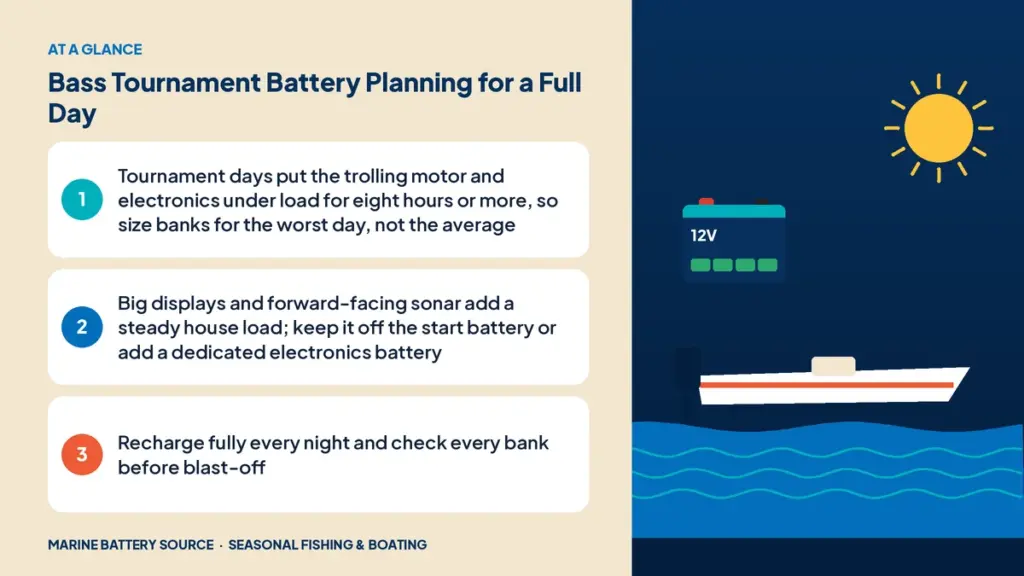
Bass boats now often run two to four large displays plus forward-facing sonar, side imaging and 360 units. Together they can draw 8–15A or more for the entire day. Over eight hours, that can be over 100Ah from a single 12V battery, more than many start batteries can supply without being badly drained.
Options:
- Dedicated electronics battery. A 12V lithium battery dedicated to electronics isolates them from the start battery. Lithium’s flat voltage also keeps displays from dimming or shutting off as the battery drains.
- Larger start battery. A high-capacity dual-purpose battery can handle both cranking and moderate electronics loads.
- Charging relay or DC-to-DC charger. Lets the outboard charge the electronics battery during runs.
Always check your electronics makers’ wiring and fusing guidance, and use correctly sized wire to avoid voltage drop.
Livewells
Tournament rules usually require healthy fish at weigh-in, so livewells run much of the day, often with timers and recirculation. Each pump might draw 2–5A. Most boats run livewells off the start battery. Make sure it’s healthy and that the engine has time to recharge it during runs.
Charging between days
Multi-day events require a full charge every night:
- Onboard charger. A multi-bank onboard charger with enough output per bank to fully recharge overnight. Check that each bank is set to the correct chemistry.
- Shore power at the hotel or campground. Plan ahead. Extension cords should be heavy enough for the charger’s draw. If you’re camping near the lake, see boat camping power.
- Charge time. Lead-acid batteries need many hours to fully recharge, especially the final absorption stage. Lithium recharges faster but still needs a charger with enough output.
Wake up a little earlier and check every bank before you leave the ramp. Bluetooth lithium batteries make this quick; with lead-acid, check resting voltage after the charger finishes.
Before blast-off
A short check before each tournament day prevents most problems:
- All banks fully charged.
- Terminals tight and clean.
- Trolling motor plug and receptacle free of corrosion.
- Breakers and fuses intact.
- Electronics power up without errors.
- Livewell pumps and aerators working.
See the pre-trip battery check for a full list.
Weight and handling
Bass boats are sensitive to weight distribution. Replacing three lead-acid batteries with one 36V lithium battery can save a lot of weight in the bow or rear compartment, which can improve hole shot and top speed. If you change battery types or locations, check how the boat rides and make sure the batteries are secured.
Off-season and pre-season
The off-season is the time to test capacity, replace weak batteries and upgrade wiring. A trolling bank with one weak battery drags down the whole series string. Use the seasonal battery calendar to plan. Tournament anglers who fish at night or for crappie can find more tips in night fishing lights and crappie spider rigging.
Common tournament battery problems
| Problem | Likely cause | Fix |
|---|---|---|
| Trolling motor weak in afternoon | Undersized bank or one weak battery in the series string | Test each battery; upgrade capacity |
| Electronics reboot when trolling or cranking | Voltage drop or low start battery | Dedicated electronics battery; check wiring |
| Engine slow to crank after a long day | Electronics and livewells drained the start battery | Separate loads; larger battery |
| Bank not full in the morning | Charger too small or not finished | Higher-output charger; check settings |
Products that help
- EPOCH 36V 100Ah lithium battery
- EPOCH 12V/36V onboard lithium charger
- EPOCH 12V 172Ah dual-purpose lithium battery
- Browse trolling motor batteries.
Frequently asked questions
What size battery do I need for a bass tournament?
Size the trolling bank for your worst realistic day, based on your motor’s draw, hours of use and wind. Many anglers choose a 36V lithium battery around 100Ah or larger.
Should I add a separate battery for electronics?
It’s common on tournament boats. It keeps the start battery reserved for cranking and keeps displays from dimming.
Why does my trolling motor lose power in the afternoon?
The bank may be too small, or one battery in the series string may be weak. Test each battery individually.
How do I charge batteries during a multi-day tournament?
Use a multi-bank onboard charger with enough output to fully recharge overnight, and check every bank in the morning.
Is lithium worth it for tournament fishing?
For many anglers, yes: more usable capacity, steady voltage, faster charging and less weight.