


Battery Disposal in Florida: What Boaters Should Know
Florida has more registered boats than almost any other state, which means a lot of old boat batteries every year. Florida law has specific rules for lead-acid batteries, and counties provide options for other types. This guide explains the rules and your options, especially for Tampa Bay and Sarasota-area boaters. It’s general information; check current state and county rules for your situation.
Florida’s lead-acid battery rules
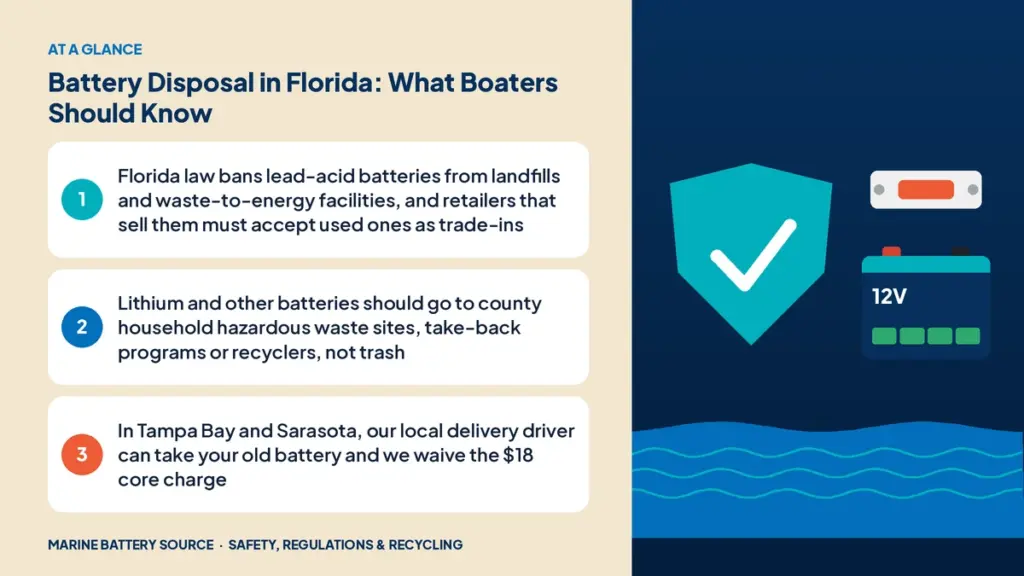
Florida Statute 403.708 says that a person who knows or should know that solid waste is a lead-acid battery may not dispose of it in a landfill, and lead-acid batteries also may not be disposed of in any waste-to-energy facility. To encourage collection and recycling, the same section requires everyone who sells lead-acid batteries at retail to accept used lead-acid batteries as trade-ins for new ones.
Florida defines lead-acid batteries for these rules as those designed for motor vehicles, vessels and aircraft, so boat batteries are clearly included. That covers flooded and AGM marine batteries.
Florida also charges retailers a $1.50 fee on each new or remanufactured lead-acid battery sold, under Statute 403.7185. The money goes to a state water quality fund. It’s a fee on the retailer, separate from any refundable core charge.
What that means for you
- Never put a lead-acid boat battery in household trash or curbside recycling.
- Trade it in when you buy a new lead-acid battery. The retailer must accept it.
- Or take it to a parts store, scrap recycler or county facility.
Lithium batteries in Florida
Lithium batteries, including LiFePO4 marine batteries, shouldn’t go in household trash either. They can short and start fires in collection trucks and facilities. Options include:
- Maker or seller take-back programs.
- Battery recyclers that accept large lithium batteries.
- County household hazardous waste facilities; call ahead to confirm they accept marine-size lithium batteries.
See lithium battery recycling and, if you need to mail one, shipping lithium batteries.
County options around Tampa Bay and Sarasota
Hillsborough, Pinellas, Manatee and Sarasota counties all run household hazardous waste and recycling programs that accept many battery types. Locations, hours and accepted items change, so check the county’s solid waste website or call before you go. Many marinas and boatyards also collect used batteries from customers, and some parts stores in the area accept them even without a purchase.
Installation and old-battery pickup
If you book our installation anywhere from Venice to Gainesville, FL, we take your old battery away when we install the new one, and we waive the $18 core charge. Installation is a flat $99 per battery ($249 for a 24V or 36V lithium bank). See our service area and local installation pages, or our county pages for Hillsborough and Sarasota.
Outside our local area, we ship across Florida; see Florida shipping locations.
Why it matters in Florida
Florida’s waterways, springs and aquifers are especially vulnerable to contamination. Lead and acid from improperly dumped batteries can reach groundwater and surface water. Proper recycling keeps those materials out of the environment and returns lead and plastic to manufacturing.
Florida heat and old batteries
Heat speeds up battery aging. Lead-acid batteries in hot consoles and garages often wear out sooner in Florida than in cooler states. Watch for end-of-life signs, and replace and recycle batteries before they fail on the water. Don’t let old batteries sit in a hot garage waiting for disposal; see storing spare batteries at home.
Hurricane season
After storms, damaged boats and flooded batteries are common. Batteries that have been submerged in saltwater, crushed or cracked should be handled with gloves and eye protection, kept upright in a leak-proof container and taken to a recycler as soon as practical. Damaged lithium batteries should be kept away from flammables and handled according to the maker’s or recycler’s guidance. Follow county debris guidance for storm cleanup; batteries generally shouldn’t go out with storm debris piles.
Preparing a battery for drop-off
- Disconnect safely, negative first.
- Keep it upright and protect the terminals.
- Put it in a leak-proof tub or box.
- Secure it in your vehicle.
- Bring your receipt if you’re claiming a core refund.
See battery core charges explained and how to dispose of a boat battery.
Snowbirds and seasonal boaters
If you leave Florida for the summer or keep a boat here only part of the year, plan battery disposal around your schedule. Replace and recycle failing batteries before you leave, rather than leaving a weak battery to sit and leak through a hot summer. If your boat stays in storage, ask the marina or storage facility whether they’ll handle battery replacement and recycling while you’re away. For batteries you keep, a maintainer or periodic charging prevents the deep discharge that kills lead-acid batteries in storage.
Quick reference
| Battery type | Trash allowed? | Florida options |
|---|---|---|
| Flooded or AGM lead-acid | No (landfill ban) | Retailer trade-in, parts store, scrap recycler, county site |
| LiFePO4 lithium | No | Take-back program, battery recycler, county hazardous waste site |
| Small household batteries | Check county rules | County sites, retail drop-offs |
More reading
The marine battery recycling guide explains how batteries are recycled, and the marine battery safety guide covers safe handling. If you’re storing a battery over a slow season, see winter storage for marine batteries.
Shop replacement batteries
Browse trolling motor batteries, starting batteries and lithium batteries.
Frequently asked questions
Is it illegal to throw away a car or boat battery in Florida?
Florida law bans lead-acid batteries from landfills and waste-to-energy facilities.
Do Florida stores have to take old batteries?
Retailers that sell lead-acid batteries must accept used lead-acid batteries as trade-ins for new ones.
Where can I recycle a lithium boat battery in Florida?
Through take-back programs, battery recyclers and county hazardous waste sites that accept large lithium batteries.
What is Florida’s lead-acid battery fee?
A $1.50 fee on each new or remanufactured lead-acid battery sold at retail, paid by the retailer.
Do you pick up old batteries?
When you book our installation, we take your old battery and waive the core charge.